AI Agent Memory Best Practices
Agent memory is a choice about what to keep. Read the practices, a worked example, and why remembering more can make an agent worse.
Agent memory is often treated as a store that should hold everything, which ignores that retrieval determines what is useful. The Anthropic agent guidance describes how context is managed, and the knowledge-graph entry covers structured relationships. The practices concern what to keep and what to surface.
Direct answer: Store durable facts with provenance, retrieve a small relevant set, and treat working state as separate from long-term memory. The sources describe context and structure; the practices are a synthesis.
Delta: This article adds a claim-status table and a worked example, separating documented guidance from local choices about what to store.
The mechanism
The first practice is separating layers. The agent guidance describes managing context, which includes what the current task needs and what should persist. Mixing the two means a long conversation carries material that no longer matters, which can displace what does.
The second practice is provenance. The knowledge-graph entry describes entities and relationships, which is closer to a reliable memory than a free-text summary. A fact with a source and a date can be checked; a summary without either cannot.
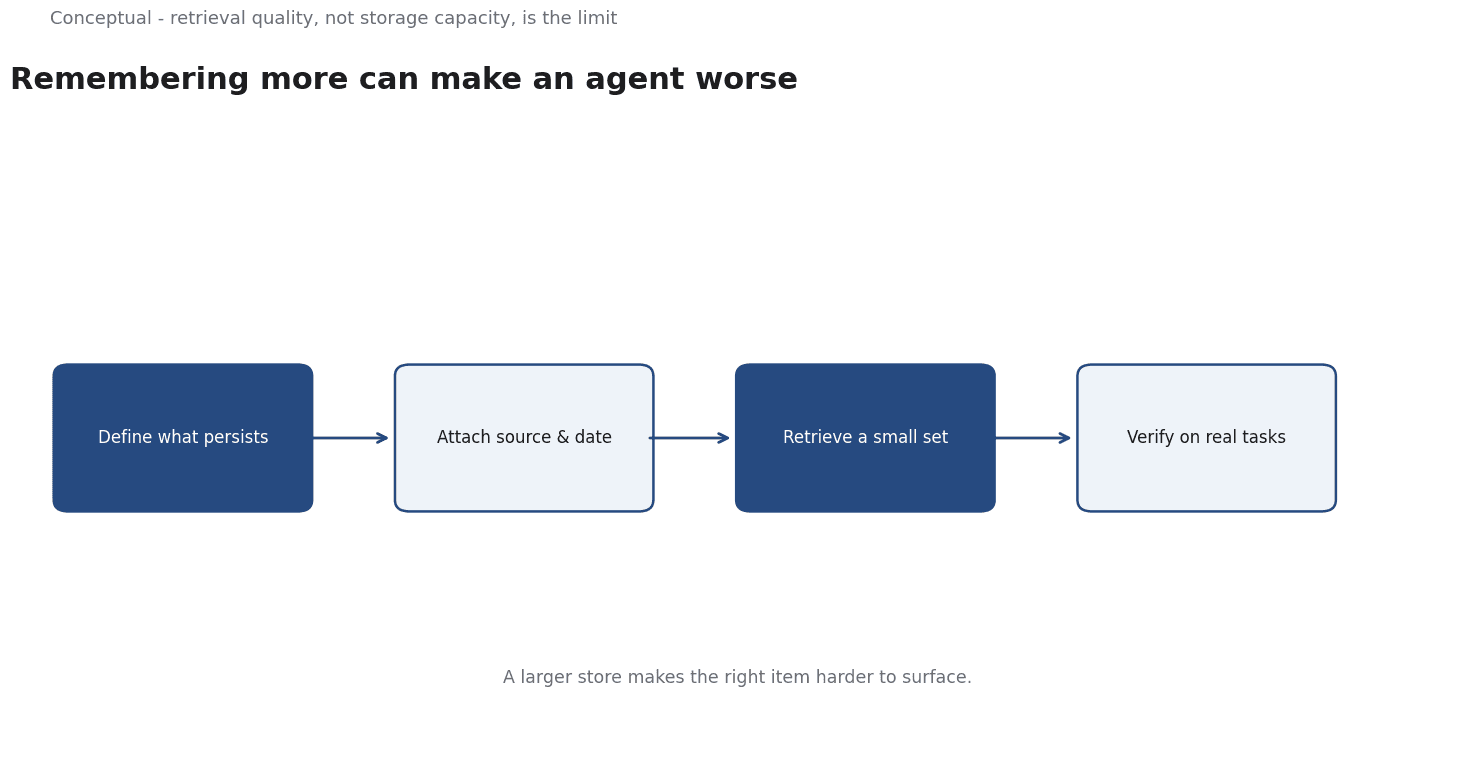
The third practice is retrieval. A memory that cannot surface the right item is no better than no memory, and a larger store makes retrieval harder. Testing what is actually retrieved, on real cases, is the control.
The sequence is: define what persists, attach provenance, retrieve a small set, then verify on real tasks.
The choices are local, so the conclusions are inferred; the guidance is source-reported.
A worked example
Illustrative. A support agent remembers customer preferences across sessions.
Three checks decide. First, which facts are durable enough to store, and where did each come from? Second, how many items are retrieved for a new request, and are they relevant to the current question? Third, what happens when a stored preference is wrong or out of date?
The outcome is a design with an update path. The scenario is hypothetical; the method is the contribution.
Evidence status
| Claim | Status | Source | Verified | Recheck when |
|---|---|---|---|---|
| Context is actively managed in agents | source-reported | Anthropic agent guidance | 2026-11-18 | Guidance changes |
| Knowledge graphs structure entities and relations | source-reported | Wikipedia, Knowledge graph | 2026-11-18 | Definition changes |
| Store little, source it, retrieve selectively | inferred | Derived from both | 2026-11-18 | Tasks change |
Why remembering more can be worse
A larger store increases the chance that retrieval surfaces the wrong item, and wrong context can change a decision more than missing context. The limit is retrieval quality, not capacity, which is why more storage is not automatically an improvement.
A further issue is that stored memory can be wrong without any sign of error.
Giving the user a way to correct stored facts is part of the design, not an optional feature.
The store also has a retention cost. Facts that persist indefinitely accumulate, and the older ones become less likely to be relevant. A rule for when to discard or review an item keeps the memory useful, which is a different discipline from simply adding more.
Finally, memory should be evaluated on the tasks it supports. A store that looks well organised but does not improve task outcomes is a cost, and the only way to know is to compare with the memory disabled.
A stored fact without a date cannot be judged for relevance, which is why provenance is part of the memory.
A larger store makes retrieval harder, which is why relevance matters more than capacity.
A user should be able to correct a stored fact, since an inferred preference can be wrong.
Memory should be evaluated by the tasks it improves, not by the amount it stores.
A record without a source is difficult to trust when the decision depends on it.
The retrieval layer deserves as much attention as the store itself.
What it cannot do
It cannot create facts that were never stored. It does not guarantee that the right item surfaces. And it cannot remove the need to check the memory against reality.
The counterargument that a bigger memory is always better is fair for stable facts and incomplete when retrieval is imperfect.
A decision test
- Define what persists.
- Attach source and date.
- Retrieve a small set.
- Test on real tasks.
- Provide an update path.
- Record the design and recheck condition.
For the boundary, see Agent Memory.
References & Further Reading
- Anthropic, 2026. Building effective AI agents — Guidance on agent design including checkpoints and human oversight.
- Wikipedia contributors, 2026. Knowledge graph - Wikipedia — Structured representation of entities and relationships.