AI Build Versus Buy Explained
The choice is about capability and learning, not just price. Read the decision frame, a worked example, and why buying can cost more than it appears.
Build-versus-buy is often framed as a cost comparison, which ignores what the organisation learns and what it must maintain. Anthropic's use-case guides describe what models can do in production, and re:Work treats capability as a management concern. The decision depends on whether the capability is central to the work.
Direct answer: Decide by asking whether the capability is a differentiator, what you must learn to operate it, and what each option costs over its lifetime. The sources describe capability and management; the decision rule is a synthesis.
Delta: This article adds a claim-status table and a worked decision, separating what the sources state about model use from the local strategic judgement.
The mechanism
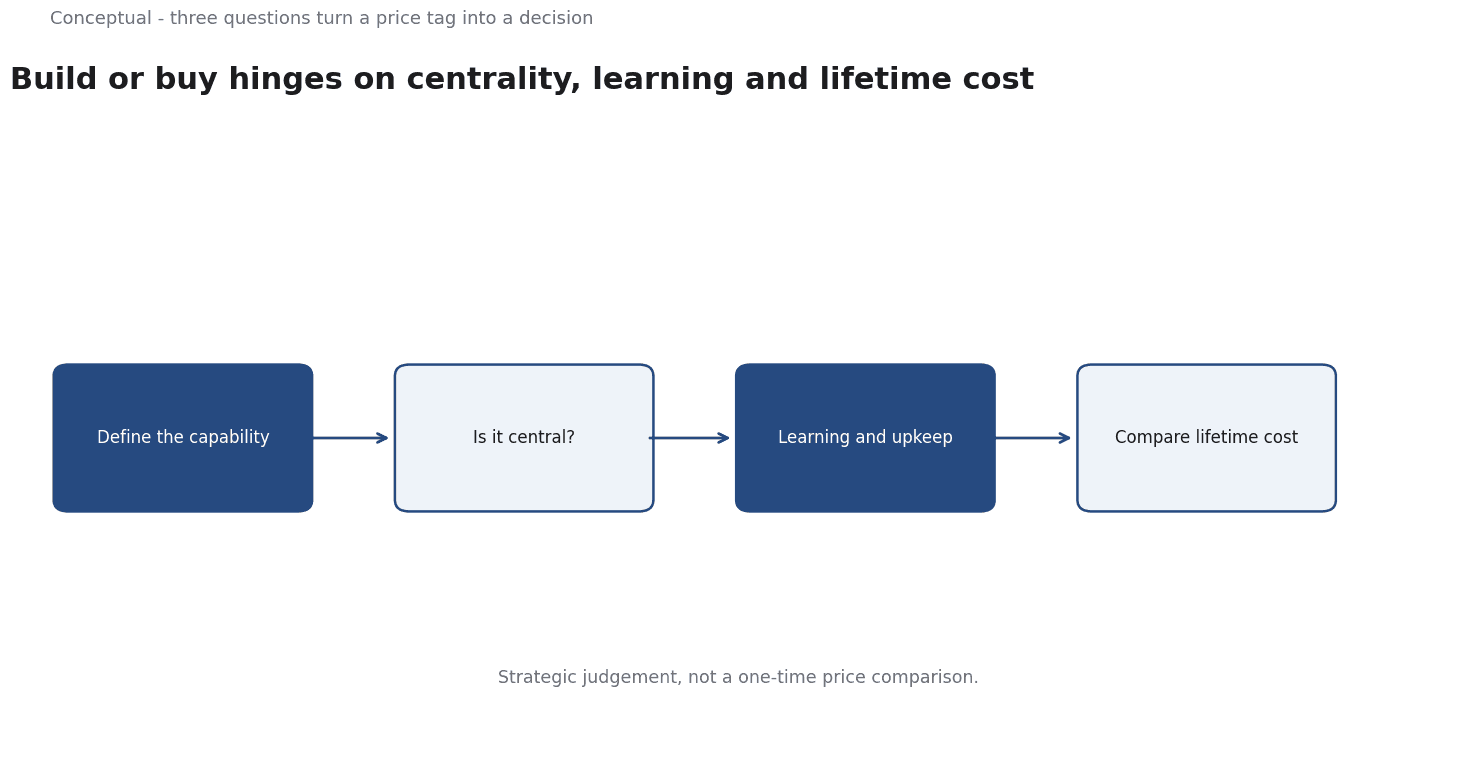
Three questions matter:
- Is the capability central? A capability that defines the product is a different case from one that supports it. The use-case guides describe where models fit, not where they matter strategically.
- What must be learned? A bought tool still needs operators. The management material treats capability as something a team develops.
- What is the lifetime cost? Licensing, integration, maintenance, and switching all count. A short-term comparison misses the last two.
The sequence is: define the capability, decide whether it is central, estimate learning and maintenance, then compare lifetime costs.
The strategic judgement is inferred; the capability descriptions are source-reported.
A worked example
Illustrative. A team considers buying a support assistant or building one with a model API.
Three checks decide. First, is automated support central to the product, or a support function that any competent tool could handle? Second, what must the team learn to operate either option, including evaluation and fallback design? Third, what are the integration and switching costs over two years, not just the first-year price?
The outcome is a decision with a recorded rationale. The numbers are hypothetical; the framing is the contribution.
Why centrality changes the answer
A capability that defines the product is not equivalent to one that supports it. If the way a model reasons is part of what customers buy, building creates knowledge that a vendor cannot provide. If the capability is a commodity function, that knowledge has less value and buying is reasonable. The same tool can therefore be the right choice in one company and the wrong one in another.
Learning is the second consideration. A bought tool still requires operators who understand its limits, its data, and its failure modes. A team that cannot evaluate the tool is not actually buying an outcome; it is buying a dependency. The management literature treats capability as something developed, which applies to both paths.
Why the horizon matters
A first-year comparison is misleading when integration and switching are significant. A built system may cost more initially and less to change later; a bought system may be cheap to start and expensive to replace. Comparing over a realistic horizon makes those differences visible. The horizon is a local choice and belongs in the record.
Evidence status
| Claim | Status | Source | Verified | Recheck when |
|---|---|---|---|---|
| Models support defined production use cases | source-reported | Anthropic use-case guides | 2026-11-18 | Capabilities change |
| Capability is a management concern | source-reported | Google re:Work | 2026-11-18 | Practice changes |
| Decide by centrality, learning and lifetime cost | inferred | Derived from the two sources | 2026-11-18 | Strategy changes |
Why the sticker price misleads
A bought tool has a visible price and hidden integration work. A built tool has visible engineering time and hidden maintenance.
Learning is the most important hidden factor. A team that buys a tool still needs to understand its limits, its data, and its failure modes well enough to evaluate it. A team that builds must learn the same things plus the implementation. The difference is smaller than it appears when the bought tool is complex.
The decision also depends on reversibility. A bought tool can usually be replaced at the end of a contract, but the data and workflows built around it may not transfer easily. A built system can be changed in place, but it carries the cost of maintenance indefinitely. Recording what would make the team reverse the decision is therefore as important as the decision itself, because it turns a one-time choice into a reviewed assumption.
What it cannot do
It cannot guarantee that the chosen option works. It does not remove the need for evaluation, which applies to both paths. And it cannot predict how the capability will change, which is why the recheck condition matters.
The counterargument that building always creates more control is fair for central capabilities and incomplete for commodity functions.
A decision test
- Define the capability.
- Decide if it is central.
- List what must be learned.
- Count integration and maintenance.
- Compare lifetime costs.
- Set a recheck condition.
- Record the rationale.
For the decision method, see Build, Buy, or Integrate.
References & Further Reading
- Anthropic, 2026. Guides to common use cases - Claude Platform Docs — Production use-case guides for ticket routing, customer support agents, content moderation, legal summarization and commerce agents.
- Google, 2026. Google re:Work — A large company's published people practices, including hiring and growth frameworks.