Content Operations in Practice
How ownership, shared standards, and review cadence keep a content team aligned, with a worked example and claim status.
Content operations fail quietly when ownership is implicit: drafts stall, terminology drifts, and no one can say who approves a change. Write the Docs frames documentation as a community practice, and Google re:Work publishes management practices about goals and feedback. Neither source is an operating manual, so the missing piece is a routine that assigns ownership and review.
Direct answer: Treat content operations as a small set of repeatable practices: define roles, keep shared standards for terminology and structure, schedule review, and use feedback to revise. The sources supply the community and management concepts; the routine is inferred from them.
Delta: This article adds a claim-status table and a worked example, mapping community and management concepts to a specific operating decision with claim status explicit.
The mechanism
Write the Docs presents documentation as a community activity supported by shared resources and norms. That framing has a practical consequence: standards stick when they emerge from people who use them, not when they are issued as a rulebook. A terminology list that writers help build is more likely to be consulted than one handed down by a manager, because it reflects the arguments the team actually has.
Google re:Work collects management practices centered on clear goals, regular feedback, and team effectiveness. The practical consequence for a content team is that direction and correction need to be explicit rather than assumed. If nobody states what a page is for or how often it should be revisited, each writer invents a private answer, and the resulting body of work pulls in different directions even when every individual is competent.
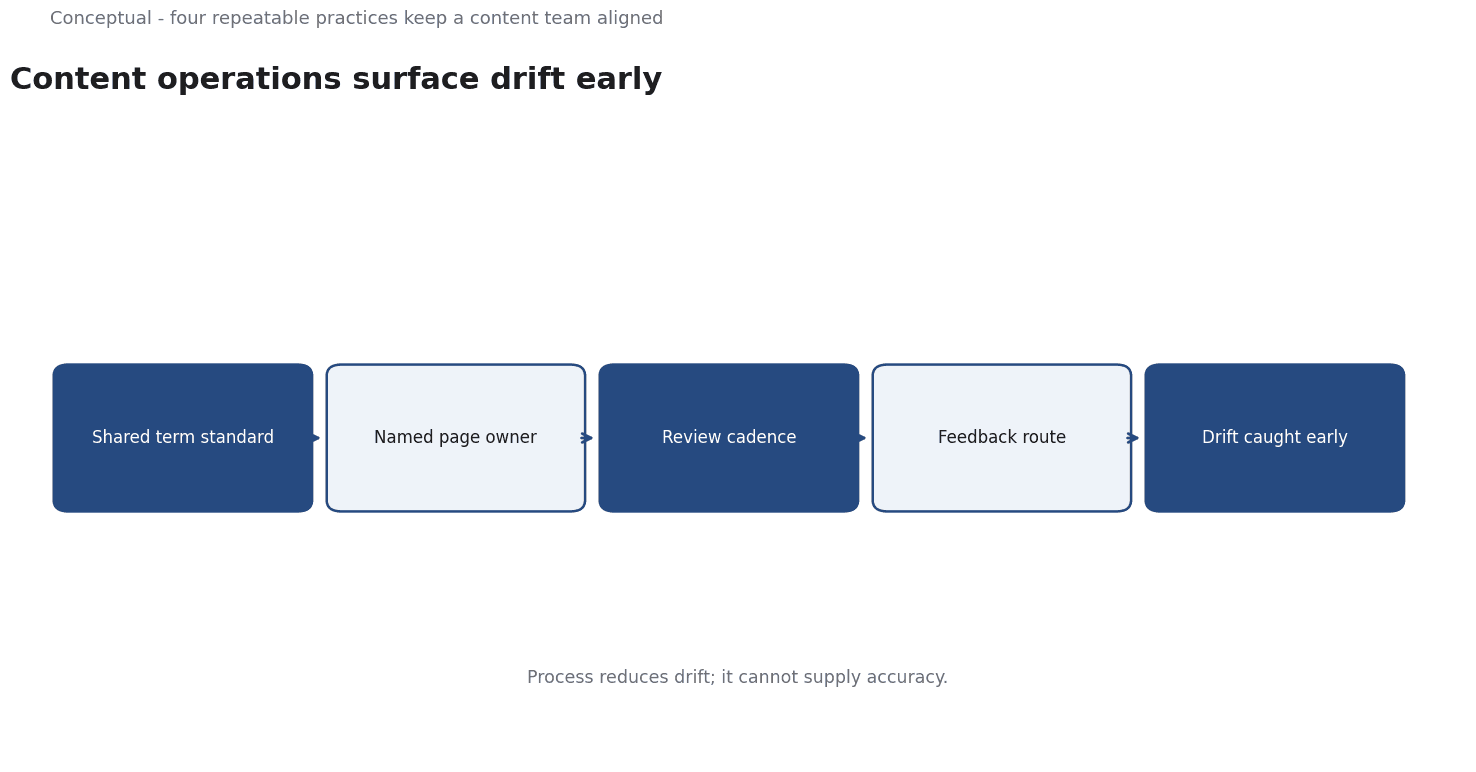
Combining the two gives a workable shape: an owner for each significant page, a shared standard for terms and structure, a review cadence, and a channel for feedback that feeds revision.
The consequence is that drift becomes visible early. A term added by one writer is checked against the shared list, a page due for review appears in a queue, and a correction from support or sales has a route back to the source document instead of disappearing into a message thread.
The community and management concepts are reported by the sources; the specific operating routine and its cadence are inferred from those concepts.
A worked example
The following is hypothetical and illustrative. A small team maintains a public help center and notices that three pages describe the same feature with conflicting names.
Three checks decide. First, ownership: does each page have a named owner who can approve a correction? Second, shared standard: is there a glossary that states which name is correct and where it applies? Third, cadence: is there a scheduled review that would catch the conflict without waiting for a complaint?
The outcome is that the conflict persisted because no page had an owner and no review was scheduled. The fix is to assign ownership, record the canonical name once, and add the three pages to the next review cycle. The scenario is hypothetical; the contribution is the check sequence, not the invented help center.
Evidence status
| Claim | Status | Source | Verified | Recheck when |
|---|---|---|---|---|
| Documentation communities rely on shared norms and resources | source-reported | Write the Docs, Documentation community resources | 2026-11-18 | Community resources change |
| Management practices emphasize clear goals and feedback | source-reported | Google re:Work, Management practices | 2026-11-18 | Published practices change |
| Assigning owners and a review cadence reduces terminology drift | inferred | Derived from the sources | 2026-11-18 | Team size or product scope changes |
The first two rows summarize what the sources describe. The third row is a local synthesis and is not stated as a formula by either source. Recheck it when the team grows, the product changes scope, or the review cadence proves too costly to sustain.
What it cannot do
Operations cannot manufacture subject-matter accuracy. A perfectly owned, reviewed, and standardized page can still state the wrong thing if nobody with the relevant expertise checks the substance. Process controls the path a document takes; it does not supply knowledge the team lacks. The practical risk is that a clean workflow creates an illusion of correctness, and readers trust the structure as a proxy for truth.
It carries a coordination cost that is easy to underestimate. Named owners, glossaries, review queues, and feedback routes all take time, and that time is spent on the process rather than on writing. For a small or stable body of content the overhead can exceed the benefit. The right amount of operation is proportional to the rate of change and the number of people involved, not to an abstract ideal of maturity.
Naming an owner who cannot change a page, correct a term, or escalate a conflict produces a person who absorbs blame without power to fix anything. The role then becomes a bottleneck that everyone routes around. Ownership only works when it comes with the authority to act and a clear path upward when a decision exceeds that authority.
Another failure mode is a review cadence that nobody honors. A schedule that exists only on paper gives false assurance, because stale pages remain indistinguishable from maintained ones. Worse, a rigid cadence can force reviews of stable pages while fast-changing pages go untouched between cycles. Review should be triggered by both time and material change, and the trigger itself should be reviewed when the content landscape shifts.
The boundary is between coordination and judgment. Operations decide who writes, who reviews, and when; they do not decide which trade-off is right for a reader or which claim is defensible. Review the whole routine when team size, product scope, or feedback channels change, since each alters where ownership and standards need to sit.
Counterargument: the claim that heavy process slows teams down is fair for a small, stable content set, and incomplete when many contributors are producing conflicting descriptions of the same thing.
A decision test
- Inventory the pages that matter and identify gaps in ownership.
- Assign an owner with authority to approve changes.
- Record shared terms and structure in one accessible place.
- Set a review cadence tied to time and material change.
- Create a route for feedback to reach the owning writer.
- Apply the smallest process that the current team size warrants.
- Recheck the routine when team, product, or feedback channels change.
The test keeps process proportional to need. It treats operations as a means of reducing drift, not as an end in itself, and it makes the cost of each added step visible.
For further reading, see Technical writing and developer experience.
References & Further Reading
- Write the Docs, 2026. Write the Docs Documentation Guide — The practitioner guide to documentation structure and style.
- Google, 2026. Google re:Work — A large company's published people practices, including hiring and growth frameworks.