Continued Pretraining Trade-Offs
Continued pretraining adds domain knowledge but can erase general ability. Read the trade-offs, a worked plan, and why more data is not always better.
Continued pretraining is often presented as a way to teach a model a new domain, which hides what it can cost. The model documentation literature describes what a model card should record, and the synthetic-data entry covers generated data and its limits. The trade-off is between new knowledge and what is lost.
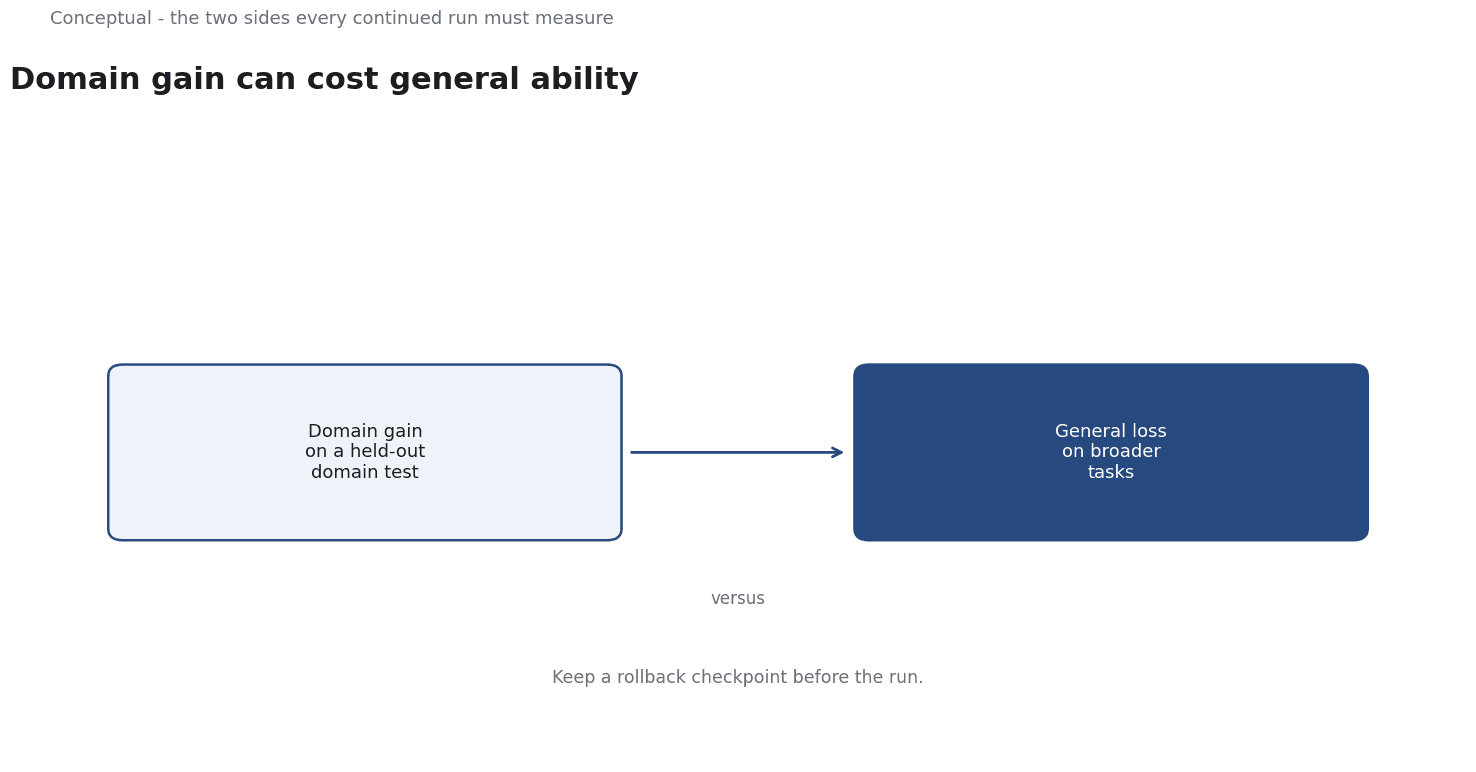
Direct answer: Continue pretraining only when the domain gap is measurable, with a held-out test for both the new domain and general ability. The sources describe documentation and data; the evaluation rule is a synthesis.
Delta: This article adds a claim-status table and a worked plan, separating documented concepts from the local decision to train.
The mechanism
Three points matter:
- Knowledge is not additive. Training on new material changes existing weights. The model card literature exists partly to record what a model can and cannot do, which matters after a change.
- Data quality dominates. The synthetic-data entry describes limits of generated data. Training on more of it can reinforce errors.
- General ability can degrade. Improvement on a domain test can come at the cost of broader performance, which is why both must be measured.
The sequence is: define the gap, prepare a representative corpus, test the new domain and general ability, then decide. The corpus is local work, so it is inferred; the concepts are source-reported.
A worked plan
Illustrative. A team considers continuing pretraining on internal documents.
Three checks decide. First, is there a measurable gap that other methods, such as retrieval, cannot close? Second, is the corpus clean, dated, and representative of the target use? Third, does a held-out test show improvement on the domain without a drop in general ability?
The outcome is a decision to train or use another method. The scenario is hypothetical; the evaluation method is the contribution.
Why a checkpoint matters
Continued training changes a model in ways that are hard to reverse precisely. Saving a checkpoint before the run means a degraded general ability can be rolled back without retraining from the beginning. The cost of the checkpoint is storage; the benefit is a recoverable decision.
Why the corpus is the real input
The quality of the material dominates the choice of method.
A small, clean, representative corpus can produce a useful improvement, while a large noisy one can degrade both the domain and general behaviour. Treating curation as the main work, rather than the training run, is the practical lesson.
Evidence status
| Claim | Status | Source | Verified | Recheck when |
|---|---|---|---|---|
| Model cards document capabilities and limits | source-reported | Model Cards paper | 2026-11-18 | Practice changes |
| Synthetic data has limits | source-reported | Wikipedia, Synthetic data | 2026-11-18 | Methods change |
| Test domain gain against general loss | inferred | Derived from the trade-off | 2026-11-18 | Model changes |
Why retrieval is the baseline
Before training, the team should ask whether retrieval can supply the same knowledge. If it can, training adds cost and risk without a clear benefit. Comparing against retrieval is the cheapest way to justify or reject continued pretraining.
It also cannot guarantee that the new knowledge is correct.
The decision should name the recheck condition. A model that was better than retrieval last quarter may fall behind as retrieval improves, and a periodic comparison keeps the choice honest.
The evaluation should include a held-out set that the training process never saw, because improvement on the training corpus says little about generalisation.
A further consideration is cost. Continued training consumes compute for a benefit that retrieval might provide more cheaply, and the comparison should include both the training run and the ongoing serving cost of the changed model.
The practice also has a maintainability cost. A model adapted to an internal corpus must be retrained when that corpus changes, while a retrieval index can be updated in place. Recording which approach was chosen and why makes the next decision easier.
The checkpoint should be retained until the new model has passed evaluation, not deleted as soon as training finishes.
The decision to train should be revisited whenever retrieval improves, since the comparison can change without any change in the model itself.
The evaluation should include tasks outside the target domain to reveal losses that a narrow test would miss.
The recheck should include the cost of the alternative, since both options continue to change.
What it cannot do
It cannot guarantee that new knowledge is retained correctly. It does not remove the need for evaluation. And it cannot make a poor corpus useful.
The counterargument that more domain data always helps is fair for a clean corpus and incomplete when general ability matters.
A decision test
- Measure the domain gap.
- Compare with retrieval.
- Prepare a clean corpus.
- Test new and general ability.
- Keep a rollback checkpoint.
- Record the decision and recheck condition.
For the data side, see Data Curation.
References & Further Reading
- Anthropic, 2026. Models overview - Claude Platform Docs — The current Claude model lineup (Opus 5, Fable 5.2, Sonnet 5.5, Haiku 5.5), supported inputs and the official model-selection guidance.
- Wikipedia contributors, 2026. Synthetic data - Wikipedia — Artificially generated data and its limits.