Data Modeling Explained
A data model is a set of decisions about what to store and how to retrieve it. Read the mechanism, a worked example, and why a diagram is not a design.
A data model is often presented as a diagram of entities, which hides the decisions it actually records: what must be true, what will be queried, and what can change. The data-modeling entry describes structure and purpose, as the NoSQL entry treats models chosen from access patterns, as Database Indexes and Query Plans: Why the Same Query Gets Slow explains access paths, as the data-governance article requires provenance for relied-upon records, as the decision-memo article requires for a recorded judgement.
Direct answer: Build a data model from the questions it must answer and the constraints it must enforce, then verify it against real access patterns. Wikipedia's data-modeling entry provides the structure, and the NoSQL entry covers model-driven design. The boundary: a model is a decision, not a truth, which the causal-inference article warns, as the risk article requires residual risk, as the publication standard forbids guaranteed outcomes.
The mechanism
Entities and constraints. What things exist and what must be true about them, which the data-modeling entry describes, as the data-quality article advises, as the data-governance article requires provenance, as the rubric article requires concrete criteria, as the decision-memo article requires for a record, as the risk article requires residual risk.
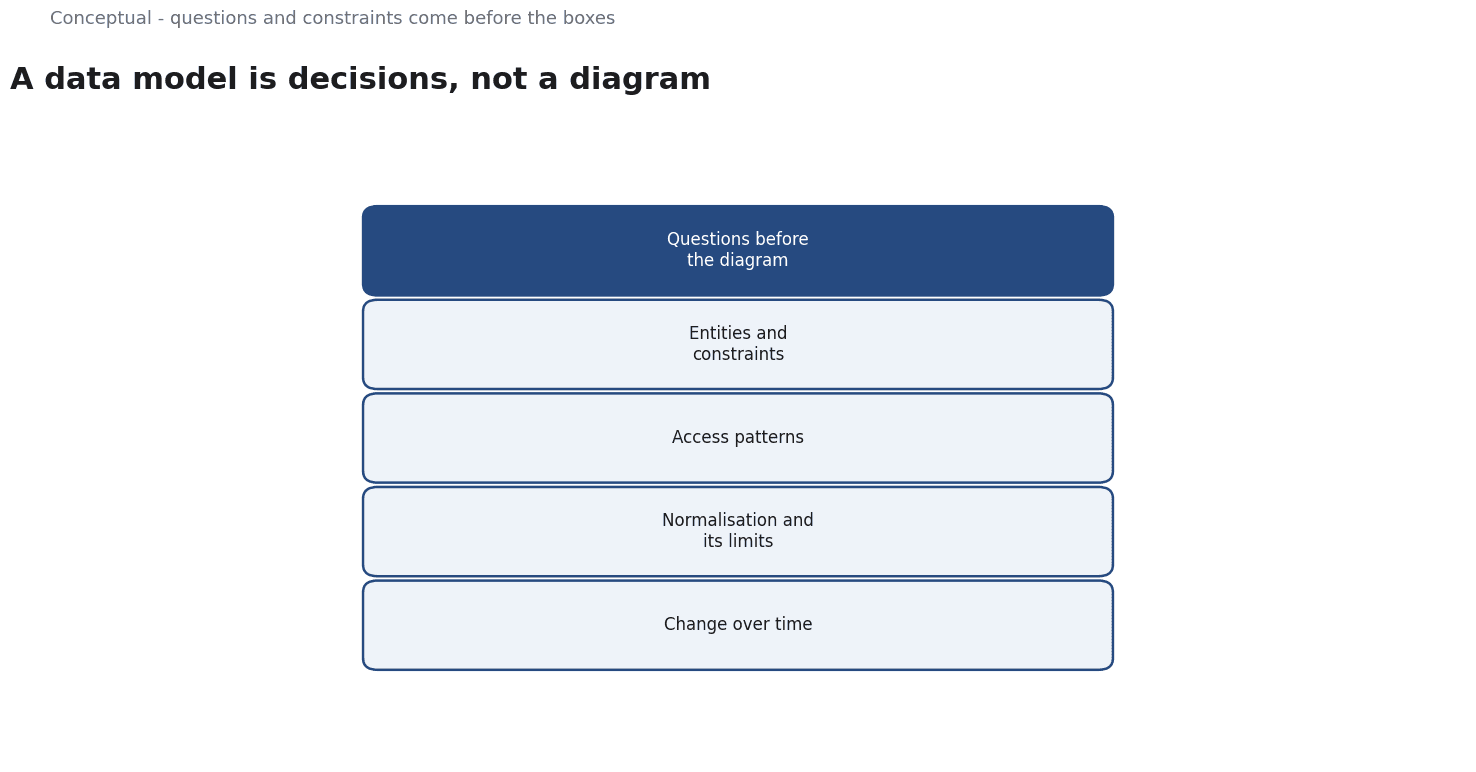
Access patterns. What will be read and written, which the NoSQL entry treats as the basis of a model, as Database Indexes and Query Plans: Why the Same Query Gets Slow advises, as the analytics article recommends for observed behaviour, as the dashboard article argues for metrics tied to decisions, as the rubric article requires criteria, as the decision-memo article requires a question.
Normalisation and its limits. Reducing duplication improves consistency, which the data-modeling entry describes, as the NoSQL entry treats the trade-offs, as the technical-debt article warns about complexity, as the data-quality article advises, as the comparables article requires consistent definitions, as the risk article requires residual risk.
Change over time. A model must evolve as questions change, which the data-modeling entry treats, as the monitoring article advises for review, as the migration article treats change as infrastructure, as the decision-memo article requires a reversal condition, as the data-governance article requires dated definitions, as the risk article requires residual risk.
Three consequences follow. The questions come before the diagram, as the NoSQL entry and database-index article advise, as the rubric article requires, as the analytics article recommends, as the dashboard article argues, as the decision-memo article requires a question, as the data-governance article requires dated definitions, as the monitoring article advises for review, as the migration article treats change, as the risk article requires residual risk, as the technical-debt article warns about complexity, as the data-quality article advises.
A worked example
The following is hypothetical and illustrative. A team designs a model for orders, customers, and products.
Three checks decide. First, what questions must it answer, as the NoSQL entry and database-index article advise, with concrete criteria, as the rubric article requires? Second, what constraints must hold, as the data-modeling entry describes, with provenance, as data governance requires, as the data-quality article advises? Third, how will the model change, as the migration and monitoring articles advise, with a reversal condition, as the decision-memo article requires, as the risk article requires residual risk?
Three conclusions follow.
Constraints matter more than boxes, as the data-modeling and data-quality articles advise.
And the decision should be recorded, as the decision-memo article requires.
What a data model cannot do
It cannot guarantee a good query, which the database-index article treats as an access path, as the publication standard forbids guaranteed outcomes, as the risk article requires residual risk. It does not create data quality, which the data-quality article treats as upstream, as the data-governance article requires provenance, as the rubric article requires criteria, as the monitoring article advises for review. And it cannot remove the need to change, which the migration article treats as infrastructure, as the technical-debt article warns about complexity, as the decision-memo article requires a reversal condition, as the risk article requires residual risk.
The counterargument that a perfect model removes rework is fair for stable problems and incomplete when questions change, which the worked example shows, as the migration and monitoring articles advise, as the risk article requires residual risk.
A decision test
- List the questions the model must answer, as the NoSQL entry advises.
- Define constraints, as the data-modeling entry advises.
- Check access paths, as Database Indexes and Query Plans: Why the Same Query Gets Slow advises.
- Use provenance and dated definitions, as data governance requires.
- Plan for change, as the migration article advises.
- Set a reversal condition, as the decision-memo article requires.
- Record the decision and residual risk, as the decision-memo and risk articles require.
For the trade-offs, see NoSQL Design at Scale; for the access path, see Database Indexes.
References & Further Reading
- Wikipedia contributors, 2026. Data modeling - Wikipedia — The structure and purpose of data models.
- Wikipedia contributors, 2026. NoSQL - Wikipedia — Non-relational database models and their design trade-offs.