DevOps: Bridging Development and Operations
DevOps is a set of feedback loops, not a team name. Read how the loops work and why renaming a group does not create them.
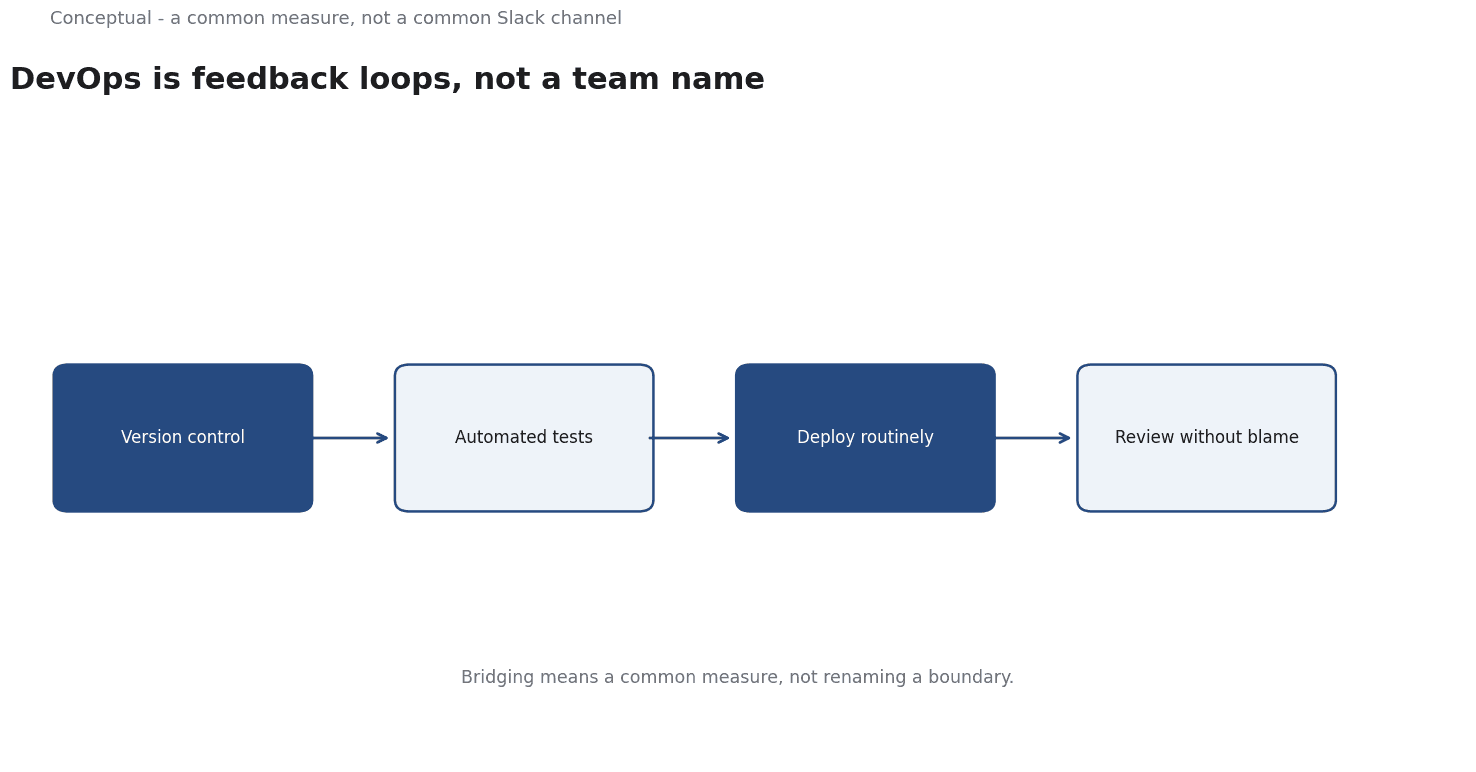
DevOps is often introduced with a diagram of a loop between development and operations, and the diagram is correct. What it leaves out is the mechanism: the loop is made of specific artefacts — version control, automated tests, deployment pipelines, shared metrics, and blameless review — and a team that adopts the word without those artefacts has renamed a boundary rather than removed it.
Direct answer: DevOps works when the feedback from production reaches the people who write the code, quickly and without a translation layer, and when the path from a commit to production is automated enough that deployment is routine. The practical instruments are continuous integration, automated deployment, shared service objectives, and incident review that produces changes to the system rather than conclusions about individuals. The test is simple: how long does it take a developer to learn that their change caused a problem, and can they fix it without asking another team for permission?
The loops, not the org chart
Three feedback loops matter, and each can be measured.
From code to production. The time from a commit to a running system. A long, manual release process means the team learns about integration problems late, and fixes are expensive. Automation is not an end in itself; it is what makes the loop short enough that the person who wrote the change still remembers the context when something breaks.
From production back to code. Observability, alerts, and incident data that reach the developers directly. If operations files a ticket and a developer picks it up days later, the loop is long and the learning is lost. The SRE practice of defining service level objectives and alerting on burn rate is one way of making the signal actionable rather than noisy.
From incidents to the system. A review that changes something — a test, a deployment guard, a rollback path, a design — rather than assigning a cause to a person. Without this loop, the same class of failure recurs, and each recurrence is handled as a new surprise.
What automation is for
Continuous integration is where the first loop is shortened. Every change is built and tested automatically, which means the question "does this work together?" is answered at the moment of the change rather than at a release meeting.
Continuous delivery extends that to deployment. The important property is not frequency for its own sake but small batch size: a change that touches twenty lines is easy to diagnose and easy to roll back; a release that touches twenty thousand is neither. Small, frequent changes reduce risk in a way that careful manual review of a large release does not.
Git hooks and CI configuration are the enforcement layer, and Git's own documentation describes hooks as scripts that run automatically on events such as commit and push. They are useful for cheap checks — formatting, a fast test, a secret scan — and the heavier checks belong in CI, where they run in a consistent environment rather than on a developer's laptop.
A slow, unreliable pipeline is worse than a manual process, because it adds ceremony without adding confidence.
Shared objectives are the cultural part
The reason "throw it over the wall" fails is not a lack of friendliness. It is that the two groups are measured on different things. If developers are rewarded for feature velocity and operations for uptime, the boundary is rational and the loop cannot form.
Shared service level objectives change the incentives. When both groups own the same availability target and the same error budget, a decision to ship becomes a joint judgement about risk rather than a negotiation between competing goals.
This is the practical meaning of "bridging" — a common measure, not a common Slack channel.
Blameless incident review is the companion practice. The purpose is to find the conditions that allowed a human action to cause an outage — a missing guard, an ambiguous interface, an unclear rollout — because those are the things that can be changed. A review that ends with "be more careful next time" has not produced a learning artefact.
What to measure, and what not to
The useful measures are about the loops: lead time from commit to production, deployment frequency, change failure rate, and time to restore service. These four together are more informative than any single one — optimising deployment frequency alone can produce a system that fails more often and recovers slowly.
The measures to distrust are activity metrics: number of pipelines, number of tickets closed, number of deploys in a week without a failure-rate denominator. A team can improve all of those while the system becomes less reliable.
A starting sequence
- Put the build and tests in CI, on every change, in a consistent environment.
- Make deployment repeatable and reversible before making it frequent.
- Define one service objective shared by development and operations.
- Route production signals to the developers, with alerting that is selective enough to be trusted.
- Run incident reviews that produce changes, and track whether the changes happened.
- Measure the four loop metrics together, so one cannot be improved at the expense of another.
- Remove one manual approval at a time, replacing it with an automated check where the risk is real.
For the reliability practice these loops support, see Site Reliability Engineering; for deterministic builds and data pipelines, see MLOps.
A worked example
The following is hypothetical and illustrative. Suppose a team ships a release touching twenty thousand lines, takes an hour to deploy, and learns from an operations ticket days later that a change broke production. Check 1: code to production. Build and tests move into CI as required status checks, with cheap checks in Git hooks, and the release is split into small batches that are reversible before they are made frequent; a twenty-line change is diagnosable, a twenty-thousand-line one is not. Check 2: production to code. A shared service objective and an error budget with burn-rate alerting are defined, and signals are routed to developers directly, so learning is measured as lead time from commit to production rather than ticket latency. Check 3: incidents to system. A blameless review produces a deployment guard rather than a caution, and the four loop metrics - lead time, deployment frequency, change failure rate, time to restore - are read together, so frequency cannot improve while reliability worsens. The outcome is bounded: one manual approval becomes an automated check, lead time falls from days to hours, and reliability is reported as observed, not assumed.
A counterargument
A reasonable critic can push back that the causal story is stronger than the sources support. The Google SRE texts describe SLOs, error budgets, and blameless review as recommended practice, and the GitHub and Git documents describe what the tools do; none of them establishes that shortening these loops causes higher reliability. The article presents the four loop metrics as diagnostic, but the same sources offer no threshold at which a long lead time becomes harmful, so a team could improve every metric and still fail in ways the framework does not capture.
The objection is not that the loops are meaningless; it is that treating a prescriptive framework as a measured law invites false confidence.
The framing is incomplete wherever the mechanism is asserted rather than demonstrated on the system at hand.
References & Further Reading
- Betsy Beyer et al., 2016. Google SRE - Site Reliability Engineering book Google Index — The book that defined SRE practice, including SLOs and error budgets.
- Google, 2016. Google SRE - Defining SLO: Service Level Objective Meaning — How to define SLIs and SLOs that are actually useful.
- GitHub, 2026. GitHub Actions Documentation — The CI platform's own documentation, including required status checks.
- Git Documentation, 2026. About Git hooks — How pre-commit and pre-push hooks are actually installed and run.