Documentation Design for Beginners
Documentation is a product with users and tasks. Read how to design it, a worked example, and why more pages can mean less help.
Documentation is often written as a record of everything known, which makes it hard to use. The Write the Docs material treats documentation as a practice with an audience, and the Cunningham & Cunningham wiki history shows how small, linked pages can accumulate usefully. The design starts from the reader's task.
Direct answer: Design documentation around the tasks readers need to complete, with a clear entry point and a test that someone can finish the task. The sources describe the practice; the design rule is a synthesis.
Delta: This article adds a claim-status table and a worked example, separating documented practice from local choices about structure.
The mechanism
Three points matter:
- The task is the unit. The documentation community describes writing for an audience. A page that answers no task is hard to justify.
- Entry points matter. The wiki tradition shows the value of linked, small pages. A reader needs to find the first page without knowing the structure.
- Staleness is a defect. A correct page that describes an old version misleads more reliably than a missing page.
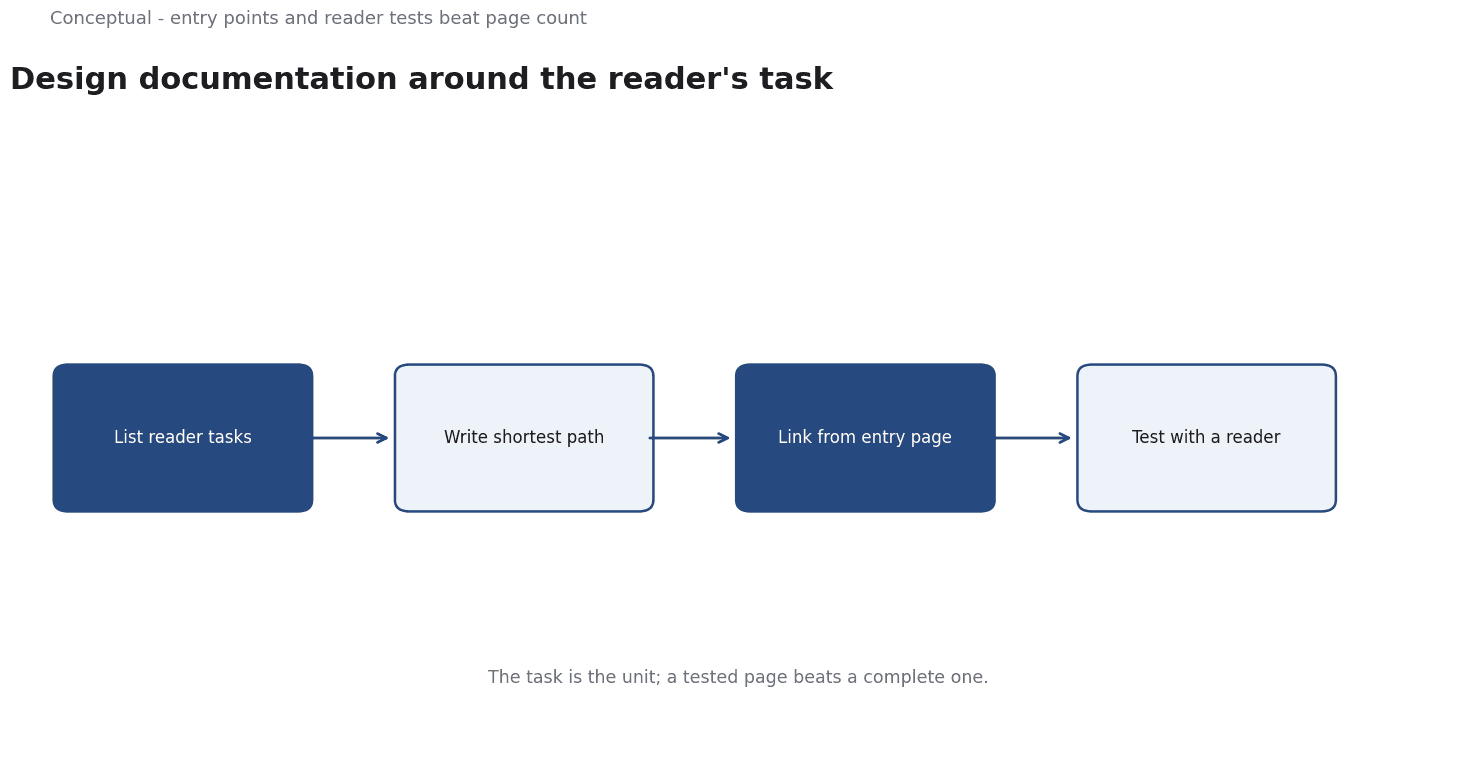
The sequence is: list the tasks, write the shortest path to each, link them, then test with a reader.
Listing tasks is local work, so it is inferred; the practice is source-reported.
A worked example
Illustrative. A team documents a new tool and produces ten pages covering every feature.
Three checks decide. First, what tasks will a new user try in the first hour? Second, can each task be completed from a single entry page without reading the other nine? Third, can a reader who has not seen the tool finish the task?
The outcome is a smaller set of task-focused pages. The scenario is hypothetical; the method is the contribution.
Why the reader's task comes first
The two orders rarely match. Listing the tasks a new user needs to complete produces an outline that is organised around use rather than around the codebase.
Why testing with a reader matters
A document can read clearly to its author and still leave a reader stuck. Watching someone attempt a task reveals the missing step, the ambiguous term, or the link that was never found. It is a small test with a large effect on whether the documentation does its job.
Evidence status
| Claim | Status | Source | Verified | Recheck when |
|---|---|---|---|---|
| Documentation is written for an audience | source-reported | Write the Docs | 2026-11-18 | Practice changes |
| Small linked pages support discovery | source-reported | Wiki history | 2026-11-18 | Platform changes |
| Design around tasks and test with readers | inferred | Derived from the practice | 2026-11-18 | Product changes |
Why more pages can help less
A large documentation set signals completeness but increases the distance from a question to an answer. A reader who cannot find the task page may give up, even though the information exists. Designing the entry point is therefore more valuable than adding coverage.
Documentation cannot make an unclear interface clear. When a task requires a workaround, the honest response is often to improve the product rather than describe the workaround in more detail. A documentation set that compensates for every flaw becomes a record of those flaws and a barrier to fixing them.
The practice also has a limit on coverage. A beginner page cannot serve an expert looking for a parameter reference, and mixing the two audiences produces a page that satisfies neither. Separating task-oriented pages from reference material is a structural decision that makes both easier to use.
A short page that solves one task is often more valuable than a complete guide that a reader never finishes.
A tested page is more valuable than a complete one that nobody can follow from start to finish.
The first page a reader sees is the most important one, and it deserves more attention than the deepest page in the set.
The structure should also accommodate the reader who arrives from a search result rather than the entry page. A page found that way needs enough context to stand on its own, which is a reason to state the task and the version at the top of each page rather than assume the reader came from the beginning.
A linked page should state its task in the first line so a search visitor knows they are in the right place.
What it cannot do
It cannot replace a usable product. It does not remove the need for examples. And it cannot stay correct without maintenance.
The counterargument that comprehensive documentation is safer is fair for reference material and incomplete for onboarding tasks.
A decision test
- List the first tasks.
- Write a short path for each.
- Link from a clear entry point.
- Test with a reader.
- Set a review condition.
- Record the decision and recheck date.
For the writing practice, see Technical Writing.
References & Further Reading
- Write the Docs, 2026. Write the Docs Documentation Guide — The practitioner guide to documentation structure and style.
- Ward Cunningham, 1992. Technical Debt — The concept Fowler popularised, and the practical argument for paying it down deliberately.