ESG Reporting Checklist
ESG reporting is a disclosure discipline, not a marketing exercise. Learn what a reporting checklist must cover, how carbon markets fit, and which claims to verify.
Teams often treat ESG reporting as a communications task and assemble the most favorable statistics they can find. The real problem is that reporting is a structured disclosure with defined boundaries, and an unstructured effort mixes scopes, double counts figures, and cannot explain its own choices to a reviewer. A checklist is the difference between a narrative and a record that can be examined.
Direct answer: An ESG reporting checklist is a control list that makes disclosures complete, consistent, and traceable to a standard. The IFRS Sustainability Standards Navigator organizes the sustainability disclosure standards that define what gets reported. Wikipedia's carbon market entry explains emissions trading, which matters when a report covers carbon. The boundary: a checklist enforces process; it does not make the underlying data true.
Delta: This article adds a mapping from disclosure-standard structure and emissions-trading mechanics to the specific decision a reporting team faces at publication, with claim status explicit.
The mechanism
The IFRS Sustainability Standards Navigator presents sustainability disclosure as a structured set of requirements rather than a free-form narrative. Governance, strategy, risk management, and metrics and targets form the recognizable skeleton. A checklist translates that structure into a sequence of steps a team can work through and a reviewer can audit. The practical consequence is that completeness becomes checkable: instead of asking whether the report feels thorough, the team asks whether each required element has an owner and a source.
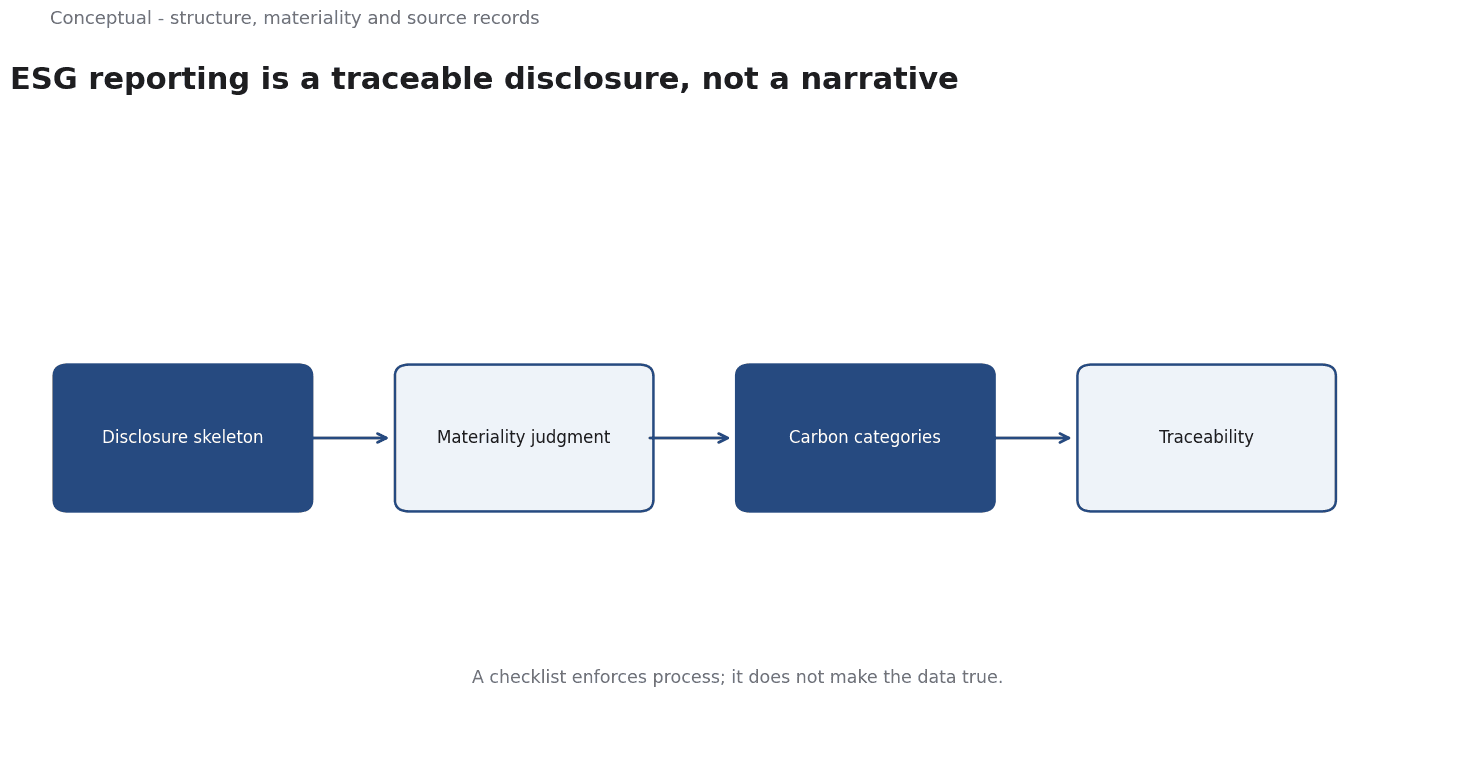
Materiality is the first real judgment. Disclosure standards emphasize information that matters to primary users, not every fact a company could collect. A checklist forces the team to record why an item is in or out, so the boundary is defensible later. This is where most first reports go wrong: they either disclose everything indiscriminately or omit the uncomfortable items without explanation. Writing the reasoning down converts a hidden choice into a documented one.
Carbon reporting shows why domain knowledge matters. Wikipedia's carbon market entry describes emissions trading systems, in which a cap is set and allowances are allocated and traded. For a reporting team this matters because carbon figures can involve direct emissions, purchased energy, offsets, and allowances, each treated differently. Understanding the mechanism prevents two common errors: counting a purchased allowance as an emissions reduction, and double counting the same tonne across two line items. A checklist that separates these categories turns a subtle accounting trap into a routine verification step.
Finally, traceability closes the loop. Each disclosed number should have a defined boundary, a named owner, and a recorded source. When an assurer asks why a figure changed between versions, a traceable report answers from its records rather than from memory. The checklist is the instrument that keeps those records consistent, and it is most valuable precisely when the report is challenged.
A worked example
The following is hypothetical and illustrative. A mid-size manufacturer prepares its first ESG report and uses a checklist before publication. Three checks are applied. First, the reporting boundary is documented, listing which facilities and leased sites are included. Second, each emissions figure is linked to a stated factor source, so a reviewer can reproduce the calculation. Third, purchased allowances are recorded separately from claimed reductions, preventing double counting. The outcome is that an assurer can trace every figure to a decision. One gap surfaces: a leased facility was excluded without explanation. The team adds it and documents the rationale, and the report moves from narrative to defensible record.
Evidence status
| Claim | Status | Source | Verified | Recheck when |
|---|---|---|---|---|
| The IFRS Sustainability Standards Navigator organizes sustainability disclosure standards | source-reported | IFRS Foundation | 2026-11-18 | IFRS revises the Navigator or its standards |
| Emissions trading systems set a cap and allow allowances to be traded | source-reported | Wikipedia Carbon market | 2026-11-18 | The carbon market entry changes materially |
| A checklist improves traceability of disclosed figures | inferred | Derived from the sources | 2026-11-18 | Assurance requirements or standards change |
The first two rows report what the cited sources state. The third is an inference connecting structured standards and emissions-trading mechanics to a practical effect on reporting quality. It is marked inferred because neither source claims that checklists themselves produce accurate disclosure; they describe the framework and the mechanism a checklist must respect.
What it cannot do
A checklist cannot make data accurate.
It ensures that questions were asked and recorded, not that the answers are correct. A team can complete every box with a plausible but wrong number, and the result will look disciplined while being misleading. The checklist is a process control, and process controls do not verify reality. Accuracy still depends on measurement systems, honest source data, and people willing to flag uncertainty rather than smooth it over.
It also cannot make the materiality judgment for you. Standards describe what materiality means, but applying it to a specific business requires understanding how stakeholders use the information. A checklist can require that the judgment be written down; it cannot supply the judgment. Teams that treat the checklist as a substitute for reasoning produce reports that are complete in form and empty in substance, listing items without saying why they matter.
There is a hidden cost worth naming. Data collection, especially for value chain emissions, consumes real time and expertise that a small team may not have. Building the traceability the checklist demands means reconciling systems that were never designed to talk to each other. The burden falls hardest on the categories least visible in operations, so the first report often costs far more than the team expected. That cost is not a reason to skip the work, but it should be budgeted rather than discovered midway.
Once the checklist becomes an end in itself, the team optimizes for having answers rather than for the quality of those answers. Boilerplate language appears, boundaries are copied from last year without review, and unused data fields are filled with estimates to avoid blank cells. The artifact passes inspection while defeating its purpose. Guarding against this means treating each box as a question to reconsider, not a slot to fill.
The boundary is that these disclosures sit inside a framework that continues to evolve and varies by jurisdiction. A checklist tuned to one reporting regime may not satisfy another, and standards change. Each reporting cycle therefore needs a review of the checklist itself, not just its completion. The tool is useful only while it reflects the current framework and the company's current operations.
The counterargument that a checklist encourages shallow box-ticking is fair for teams that want to appear compliant and incomplete for teams that use it to expose what they do not yet know.
A decision test
- Is the reporting boundary documented, including excluded operations?
- Has materiality been decided with reasons recorded for inclusions and exclusions?
- Does each figure have a named owner and a traceable source?
- Are carbon allowances, offsets, and direct emissions recorded in separate categories?
- Can a reviewer reproduce a disclosed calculation from the underlying data?
- Has the checklist itself been reviewed against the current framework?
- Is there a process for revisiting judgments when operations change?
A reporting checklist earns its keep when it makes the team's reasoning visible to someone who was not in the room. Use these questions as a final pass before publication: any item that fails is a place where the report asks the reader to trust rather than to check. Fixing those gaps is the difference between disclosure and assertion.
For further reading, see Data Governance.
References & Further Reading
- IFRS Foundation, 2026. IFRS Sustainability Standards Navigator — The disclosure standards that make ESG metrics comparable.
- Wikipedia contributors, 2026. Carbon emission trading - Wikipedia — Markets for trading emission allowances.