Green Bonds Costs Explained
Green bonds direct capital to environmental projects, but verification, reporting, and pricing carry costs. See the cost structure, a worked example, and a decision test.
Green bonds are presented as a clean way to fund environmental projects, but the label is not free. Issuers pay for verification, ongoing reporting, and the discipline of earmarking proceeds, and investors price the result. The real question is not whether a green bond is good in the abstract but what the structure costs and who bears it.
Direct answer: A green bond is a bond whose proceeds are explicitly directed to environmental or climate-related projects, usually with reporting obligations. Its costs are not a single fee: they sit in verification, disclosure, and pricing, including any yield difference investors demand. Carbon markets, which put a price on emissions, change the project economics that make the bond attractive in the first place.
Delta: This article adds a decision framing beyond the sources: it maps the green bond cost structure to a concrete issuance and investment decision, with claim status explicit.
The mechanism
A green bond is defined by the use of its proceeds. Rather than funding a general pool of activities, the issuer commits the money raised to projects with an environmental purpose, such as clean energy, efficiency, or other climate-related work. That earmarking is the point of the instrument and also the source of its administrative burden. Because the label makes a claim about where the money goes, the claim has to be supported by documentation and reporting that continues after issuance, not just at the moment of sale.
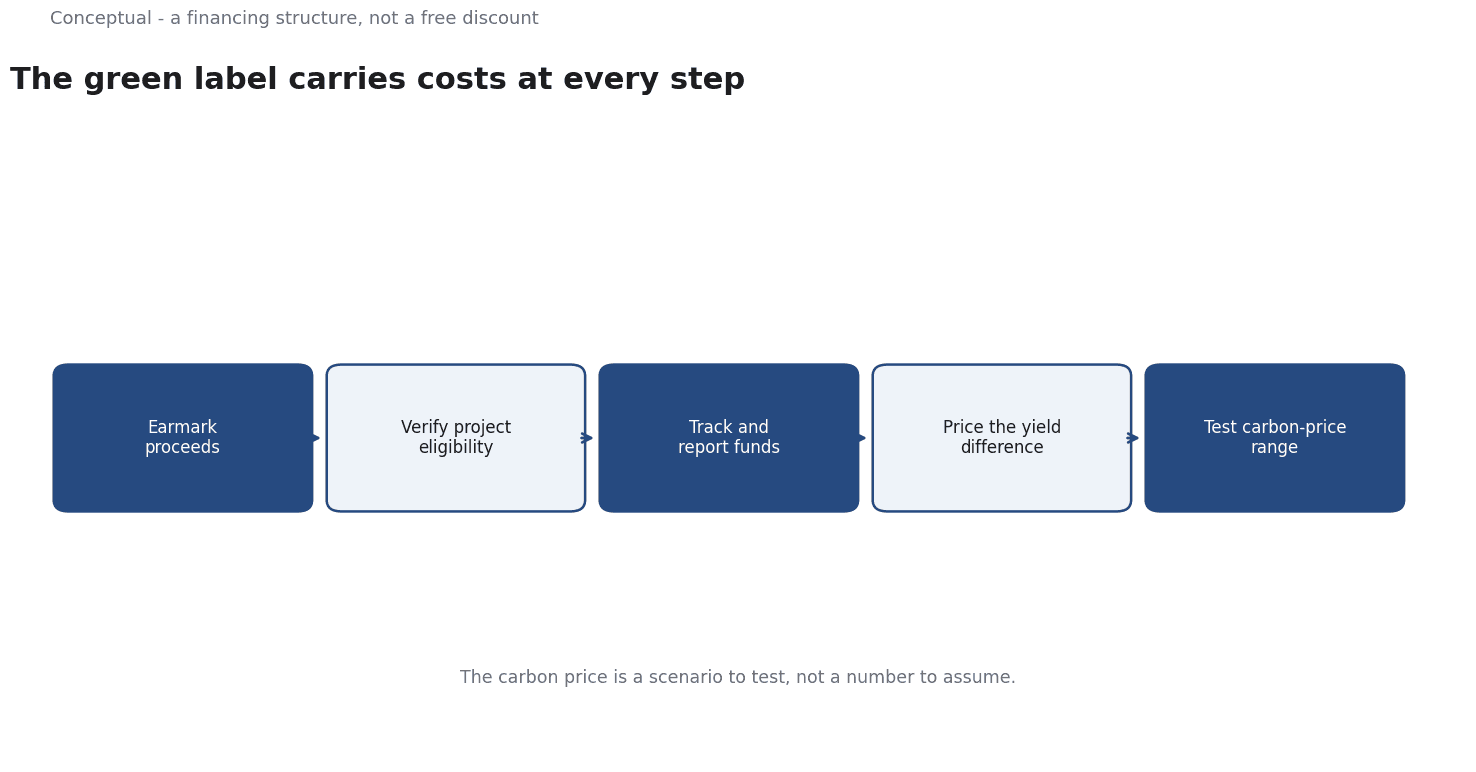
Those obligations are where much of the cost sits. An issuer typically needs to establish that the projects are eligible, track the proceeds so they are actually applied to those projects, and report on use of funds and, where expected, on environmental impact. Each step requires work and may involve outside verification. The label can also affect pricing: if investors have strong demand for green assets, the issuer may face a lower required yield, while weak demand offers no such benefit. That difference is a market outcome, not a fixed discount, and treating it as guaranteed is a common error.
Carbon emission trading changes the setting in which these projects compete. In a cap-and-trade system, a limit is set on emissions and allowances or credits can be traded, so emitting carries a price. A carbon price alters the relative economics of an emissions-reduction project: revenue from avoided emissions or sold allowances can improve the case for the project the bond is meant to fund. If the carbon price is low or unstable, that support weakens, and a bond that looked attractive under one assumption looks ordinary under another.
The practical consequence is that the two instruments should be read together.
The green bond is a financing structure with its own costs; the carbon market is a price signal that affects the underlying project.
A decision to issue or buy is sensible only when the full cost of the structure and the plausible range of carbon prices are considered side by side. The carbon price is a scenario to test, not a number to assume.
A worked example
The following is hypothetical and illustrative. A utility considers a green bond to fund an emissions-reduction project and runs three checks. First, it tests whether the project clearly qualifies for the use-of-proceeds claim, since a weak eligibility case undermines the label. Second, it totals the full cost, including verification, ongoing reporting, and administration, rather than comparing only the headline coupon. Third, it models the project under a range of carbon prices, because allowance revenue could support the economics or fail to. The outcome is that the bond is viable under the higher carbon price scenarios but not the lower ones, so the issuer records the assumption and sets a review point rather than committing on a single forecast. No figure here is measured data; the example only shows how the checks connect.
Evidence status
| Claim | Status | Source | Verified | Recheck when |
|---|---|---|---|---|
| Green bonds earmark proceeds to environmental projects | source-reported | Wikipedia: Green bond | 2026-11-18 | Standards or definitions change |
| Carbon markets trade emission allowances or credits | source-reported | Wikipedia: Carbon emission trading | 2026-11-18 | Market rules change |
| Total cost sits in verification, reporting, and pricing | inferred | Derived from the sources | 2026-11-18 | Pricing or reporting standards change |
The source-reported rows establish what the sources define: a bond tied to environmental uses and a market in which emission allowances are traded. Neither source gives a cost figure or guarantees a pricing benefit. The inferred row is this article's synthesis that the meaningful costs are administrative and pricing related, not a stated finding. Recheck it if reporting standards or market pricing conventions change the burden materially.
What it cannot do
The first limit is that these sources define the instruments but do not quantify anything. They explain what a green bond is and how carbon markets work; they do not provide verification fees, typical yield differences, or impact data. Any specific number in a real decision has to come from market quotes and service providers, not from this framing. Treating the structure as if its costs were known in advance is the first mistake this article is meant to prevent.
A hidden cost is the ongoing nature of the obligations. The label is earned at issuance but has to be maintained through tracking and reporting, which means staff time and systems that persist for the life of the bond. There is also a reputational exposure: if proceeds are not applied as promised, or reporting is weak, the claim can be challenged. That risk is not captured in a coupon comparison, and it is a cost that appears only if something goes wrong, which makes it easy to omit from a preliminary analysis.
Demand for green assets can compress yields, but that depends on market conditions and on how credible the label is. A team that builds a financing case around a guaranteed yield benefit will be exposed when demand is weak. A second failure is letting a favorable carbon price assumption carry the project economics without testing alternatives, so the bond looks sound only in one scenario. A third is confusing the financing structure with the project: a well-structured bond cannot rescue a project whose underlying economics do not work.
The boundary is the kind of project and market being considered. For projects with clear, measurable environmental outcomes and a functioning carbon price, the combined framing is useful. Where outcomes are hard to define, where no carbon market applies, or where reporting capacity is weak, the green label adds cost and risk without a clear benefit. The structure also assumes that investors can distinguish credible labels from weak ones; where they cannot, the pricing signal the issuer hopes for may not appear.
Costs and assumptions need review. Reporting standards evolve, carbon prices move, and investor demand shifts with sentiment. Set a trigger to revisit the full cost and the carbon price scenarios when standards change or when the project's economics move. Without that, a bond that was defensible at issuance becomes a set of unexamined assumptions carried forward year after year.
The counterargument that the premium makes the cost question academic is fair when demand for credible green assets is strong and reporting is routine, and incomplete when prices soften or the use-of-proceeds claim is contested.
A decision test
- Check eligibility. Confirm the project has a clear environmental use that supports the label.
- Total the structure. Add verification, reporting, and administration to the headline financing cost.
- Test the pricing assumption. Treat any yield benefit as a scenario, not a guaranteed input.
- Model carbon prices. Run the project across a range of allowance or credit prices.
- Check reporting capacity. Confirm the systems and staff to sustain disclosure exist.
- Decide on the full picture. Approve only if the project works without heroic assumptions.
- Set a review trigger. Revisit costs and carbon scenarios when standards or prices change.
Green bond costs are spread across verification, disclosure, and pricing, and the carbon price shapes the project underneath. The sources define the instruments but leave the numbers to the market. Make the full cost explicit, test the carbon assumption, and the decision becomes one a reviewer can reconstruct.
For further reading, see Data Governance: Managing Data as an Asset.
References & Further Reading
- Wikipedia contributors, 2026. Green bond - Wikipedia — Bond whose proceeds are earmarked for environmental projects.
- Wikipedia contributors, 2026. Carbon emission trading - Wikipedia — Markets for trading emission allowances.