Healthtech Explained
Healthtech is a broad label: learn how digital health and health informatics differ, a worked example, and what the label cannot establish.
Healthtech is used to describe everything from wellness apps to clinical decision systems, and the single label hides differences in purpose and risk. Digital health names the broad use of technology in health, while health informatics is the discipline that structures and governs health information. The problem is that unlike products sound equivalent when they share one category.
Direct answer:
Classify a healthtech product by its intended use, the data it handles, and the standards and obligations that apply, rather than by the label alone.
Digital health provides the categories; health informatics provides the data-handling discipline that shapes interoperability and governance.
Delta: This article adds a claim-status table beyond the two sources: it maps product categories to the checks they require, with claim status explicit.
The mechanism
Digital health describes the use of digital technologies to support health and healthcare. It is an umbrella that includes telemedicine, mobile health applications, wearable devices, electronic health records, and analytics applied to clinical data. Because the term spans consumer wellness and clinical care, it says little about what a specific product is expected to do. A step counter and a diagnostic support tool can both sit under the label, but they make very different claims and carry very different consequences when they fail.
Health informatics is the interdisciplinary field concerned with the structure, management, and use of health information, drawing on healthcare, information science, and computer science. Its tools include data standards, terminologies, and coding systems that allow records to be exchanged and compared. The discipline is concerned with whether data is complete, consistent, and interpretable across systems, and with the privacy and security obligations that follow from handling health information. That focus is about the data layer rather than the product surface.
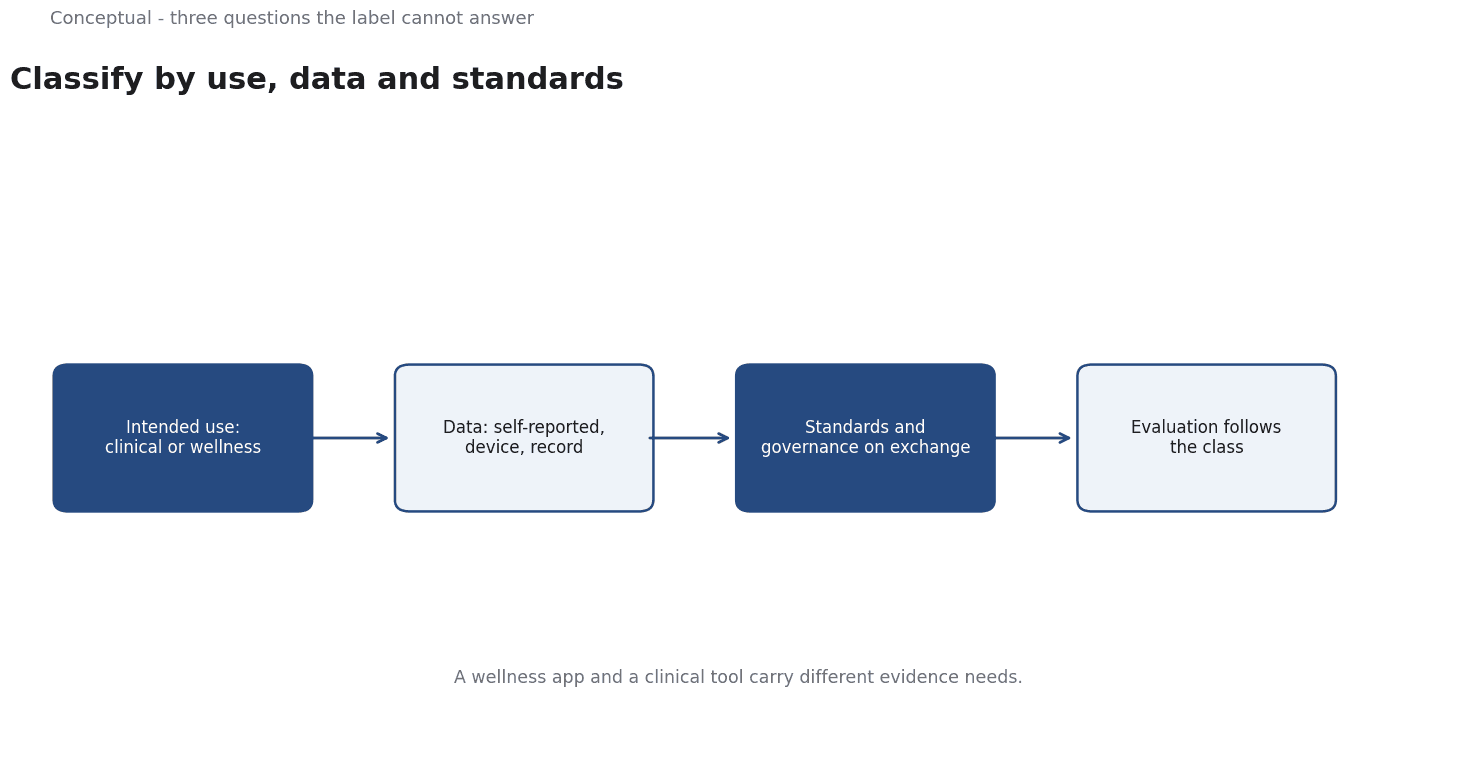
Putting the two together gives a practical classification method. The first question is intended use: does the product claim to diagnose, treat, or support clinical decisions, or does it aim at general wellness? The second is the data it handles: is it self-reported, device-generated, or part of a clinical record? The third is what standards and governance apply when that data moves between systems. These questions separate products that a single label merges.
The consequence is that evaluation should follow the classification. A wellness application is judged mostly on user experience and honest claims; a clinical tool additionally needs evidence of validity, interoperability with existing records, and a defined governance path. The label healthtech tells you none of this, which is why it is a starting point for questions rather than an answer.
A worked example
The following is hypothetical and illustrative. A clinic is choosing between a consumer wellness application and a clinical decision support tool, both described by vendors as healthtech.
Three checks decide. First, what is the intended use, and does the vendor make a diagnostic or treatment claim that would change the evidence required? Second, can the product exchange data using recognized standards and terminologies, or does it create an isolated record? Third, what privacy and security controls apply to the data, and who is accountable if it is exposed?
The outcome is that the wellness application is treated as a discretionary pilot with no clinical claim, while the decision support tool proceeds only after validation and an interoperability review. The scenario is hypothetical; the classification method is the contribution.
Evidence status
| Claim | Status | Source | Verified | Recheck when |
|---|---|---|---|---|
| Digital health covers digital technology used in health and healthcare | source-reported | Wikipedia Digital health | 2026-11-18 | Scope of term changes |
| Health informatics manages and structures health information | source-reported | Wikipedia Health informatics | 2026-11-18 | Standards change |
| Products should be classified by use, data, and governance | inferred | Derived from the sources | 2026-11-18 | Regulatory context changes |
The source-reported rows capture definitions of the two fields. The inferred row applies them: if one concept is an umbrella and the other is a data discipline, then the useful question about any product is which category it occupies and what that implies. That mapping is the article's judgement, not a statement either source makes.
What it cannot do
The label cannot establish clinical validity. Saying that a product uses digital health technology says nothing about whether it detects a condition accurately or improves an outcome. Evidence for that claim has to come from evaluation appropriate to the intended use, and a broad category cannot substitute for it. A product that is harmless as wellness support may be unsafe when relied on for a decision, and the label does not mark that boundary.
It cannot solve interoperability. Health informatics supplies standards and terminologies, but naming the discipline does not make two systems exchange data correctly. Interoperability depends on implementation choices, data quality, and the willingness of parties to use the same conventions. A vendor can describe a product as healthtech and still produce records that cannot be compared with existing ones. The check belongs at the data layer, not at the label.
It cannot guarantee privacy or security. Handling health information brings obligations, but the category name does not confirm that controls exist. Access rules, retention, and breach response are properties of a specific system and its operator.
The hidden cost is category error. When wellness and clinical products are evaluated with the same checklist, the clinical tool may be under-scrutinized and the wellness app over-burdened. Both mistakes waste effort: one risks patient safety, the other slows a low-risk product. Classification is therefore not bureaucracy; it is what keeps review effort proportionate to consequence.
The failure mode is following the label into the wrong decision. A team that hears healthtech and assumes clinical rigor may trust an unvalidated tool; a team that assumes consumer novelty may dismiss a genuine clinical system. Both errors come from treating an umbrella term as a specification. The boundary is that regulation and standards evolve, so a classification that was correct at purchase may need revisiting when a claim changes or a standard is updated.
The counterargument that simple labels help buyers is fair for orientation and incomplete for decisions, where intended use and data governance carry the weight.
A decision test
- State the product's intended use in one sentence.
- Identify the data it handles and where that data originates.
- Determine the standards and terminologies it supports.
- Check the privacy and security controls actually implemented.
- Match the evidence required to the intended use.
- Assign an owner for the classification decision.
- Recheck when claims, standards, or regulations change.
A category is useful only if it leads to the right questions. Healthtech is broad enough that the main value is knowing which narrower question to ask next: intended use, data structure, or governance. Keep the classification short and written down, so that a later reviewer can see why a product was treated the way it was. For further reading, see Data Governance: Managing Data as an Asset.
References & Further Reading
- Wikipedia contributors, 2026. Digital health - Wikipedia — Use of digital technology in health care.
- Wikipedia contributors, 2026. Health informatics - Wikipedia — The discipline of using data and information systems in healthcare delivery.