How to Build a Technical Portfolio That Demonstrates Real Skills
A technical portfolio proves skill through reproducible artifacts—code you can run, writing you can verify, systems you can explain—not through tool lists or certificates.
Most portfolio advice starts with the wrong unit: the tool list. "I know React, Python, and AWS" is a claim, not evidence. Anyone can list tools; very few can point to a running system and say, "I built this, and here is how to verify it."
Direct answer: A technical portfolio demonstrates real skill through reproducible artifacts—source code you can run, writing you can verify, systems you can explain—not through lists of tools, certificates, or screenshots of dashboards you did not build. The distinguishing question is not "what do you know?" It is "what can you reproduce, and can someone else check it?"
Evidence comes first, presentation second
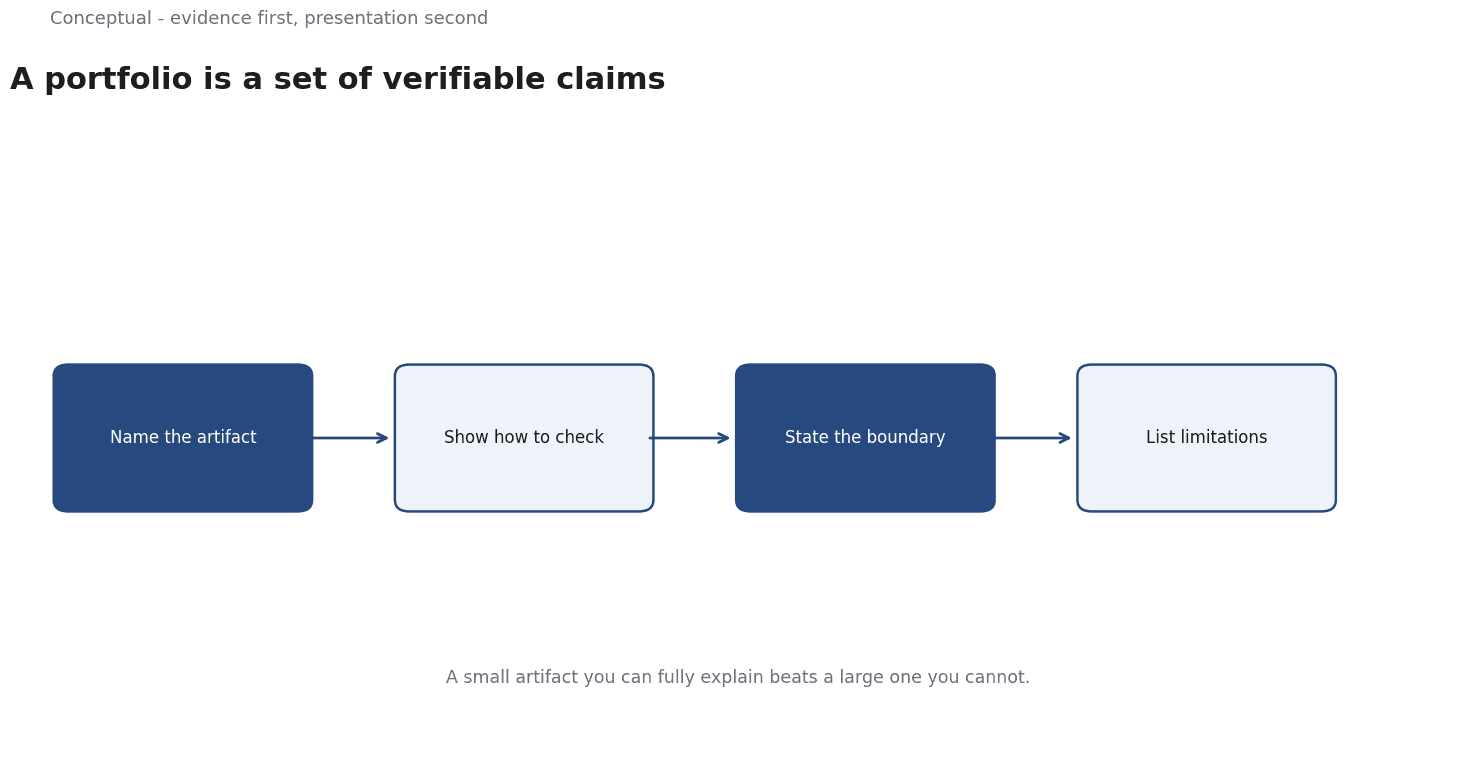
A portfolio is not a gallery of finished pictures. It is a collection of verifiable claims. Each item should answer three questions:
- What did you do? The specific artifact: a repository, a published article, a debugged production issue, a reproducible benchmark.
- How can I check it? A link to the source, a command to run, a document to read, or a test to reproduce.
- What is the boundary? What you did versus what a tool, framework, or teammate did. If you cannot separate your contribution from the platform's, the item does not belong in a skills portfolio.
That last point is where most portfolios fail. A screenshot of a deployed site proves you can click "deploy" on a template. It does not prove you understand DNS, TLS, caching, or the code underneath.
What counts as an artifact
Group portfolio items by what they verify, not by what tool they use:
| Verifies | Example artifact | How a reader checks |
|---|---|---|
| You can read and explain code | Annotated repository with README, tests, and a walkthrough | Clone, run tests, read the explanation |
| You can diagnose a system | Postmortem of a real or simulated failure, with logs and timeline | Reproduce the scenario, follow the diagnostic steps |
| You can write technical content | Published article with references and a reproducible example | Read the article, run the code snippet |
| You can operate infrastructure | Sanitized server config, CI workflow, monitoring alert | Review the config, validate syntax |
Each artifact should include provenance: date, context, and any limitations. "I reproduced this in a staging environment" is honest. "This is from a client production incident" without the client's permission is not.
The boundary problem
Examples:
- Publishing a SaaS dashboard screenshot and implying you built the analytics pipeline.
- Listing a framework in your skills section and implying you understand its internals.
- Showing a "project" that is a tutorial clone with your name attached.
A safer framing: "I configured X to do Y, and here is the configuration file and the command that verifies it." That is narrower than "I built X," but it is true, and truth compounds. A reader who verifies one small, honest claim trusts you more than a reader who suspects ten inflated ones.
Present without overclaiming
Present each item as a self-contained unit:
- Title: what the artifact demonstrates
- Context: why it exists, what problem it solves
- Your role: what you did, what you did not do
- Verification: how to reproduce or inspect it
- Limitations: what the artifact does not show
Do not invent metrics. Do not say "improved performance by 40%" unless you measured it with a defined baseline and method. Do not say "production-grade" unless you can show deployment, monitoring, and rollback evidence.
A practical structure
If you are starting from scratch, build in this order:
- One repository you can explain line by line. Include a README that states purpose, setup, and how to run tests.
- One piece of technical writing tied to that repository. Explain a decision you made and why.
- One diagnostic or troubleshooting write-up. Show a failure, the investigation, and the fix—even if it is a lab reproduction, label it as such.
- A homepage that links to the above with honest role statements, not a tool list.
Order matters less than honesty.
A small artifact you can fully explain beats a large one you cannot.
What this portfolio itself demonstrates
This publication's articles are its own portfolio evidence. Each one cites primary sources (RFCs, vendor documentation, peer-reviewed papers), includes reproducible commands or code, and states limitations explicitly. They are not client work; they are lab and research artifacts, labeled as such. That labeling is the point: a portfolio that says what it is not is more credible than one that pretends to be what it is not.
For the diagnostic discipline behind portfolio artifacts, see Server Logs for SEO: See What Googlebot Requests and SEO Observability: Turn Logs and Checks into Useful Alerts.
What the README is really for
The GitHub documentation on README files describes them as the front door of a repository: the place that explains what a project does, why it exists, and how a reader can use it. That framing turns the README into an evidence test rather than a formality. If each portfolio item must tell a reader how to check a claim, the README is where that check starts.
A reader who clones a repository should be able to answer, from the README alone, what problem the code solves, how to set it up, and what command confirms it works. This is why a portfolio item can fail on presentation rather than substance. Clever code with no setup instructions asks the reader to do the verification work, and most readers will not do it.
The README is part of the artifact, not decoration around it. A missing limitation or an unstated prerequisite undermines a claim as surely as a broken test. A README that documents the configuration you wrote, the commands you ran, and the outputs you observed makes the boundary between your work and the tool's work visible; one that merely describes a framework's features does not.
Choosing artifacts against adoption data
The following is hypothetical and illustrative. The Stack Overflow Developer Survey reports which tools developers actually adopt across stacks, and that makes it a useful check on tool claims. If a technology appears in a large share of respondents' toolchains, listing it says little about a candidate; the differentiator is what that candidate built and can reproduce with it.
Imagine two people who both list Python and a cloud platform. The first links to a repository whose README states the purpose, the setup steps, and a single test command, then documents one infrastructure decision with its configuration and observed output. The second links to a screenshot of a deployed dashboard. A reader can verify the first claim in minutes and the second not at all.
Popularity does not make a tool unworthy of a portfolio item; it makes the name a weak signal. A project that records a non-obvious decision or a reproduced failure says more than a bare skills list, because adoption data tells you which claims are cheap while the artifact tells you which are expensive. The first portfolio wins because each item states what was done, how to check it, and where the boundary sits.
A counterargument
A reasonable critic can argue that reproducible artifacts are a privilege, not a universal standard. The article itself notes that client production work often cannot be shown without permission, which excludes exactly the experience many candidates most need to demonstrate; GitHub's README guidance and Stack Overflow adoption data describe tooling and popularity, not hiring outcomes. The verification test also assumes a reader willing to clone a repository and run tests, while the article concedes most readers will not do that work. Finally, the claim that this publication's own articles constitute portfolio evidence is circular: the sources are selected and the claims are checked by the same author.
The model is a useful discipline, not proof that artifact-based portfolios are what employers actually reward.
References & Further Reading
- GitHub Docs, 2026. About the repository README file - GitHub Docs — The platform's own guidance on what a repository README should contain.
- GitHub, 2026. GitHub Engineering Blog — Primary engineering write-ups on developer tooling and productivity.
- Stack Overflow, 2026. Developer Survey — The recurring cross-stack developer survey used for adoption and tooling claims.