How to Evaluate International SEO
International SEO is about which pages engines choose for which audience. Read the checks, a worked audit, and why hreflang is not a ranking command.
International SEO is often reduced to adding language tags, which misses the actual question: does the engine serve the right version of a page to the right audience? Hreflang is a signal that helps answer that, not a command, as the hreflang guide explains for valid clusters, as the structured-data article warns about treating markup as a guarantee.
Direct answer:
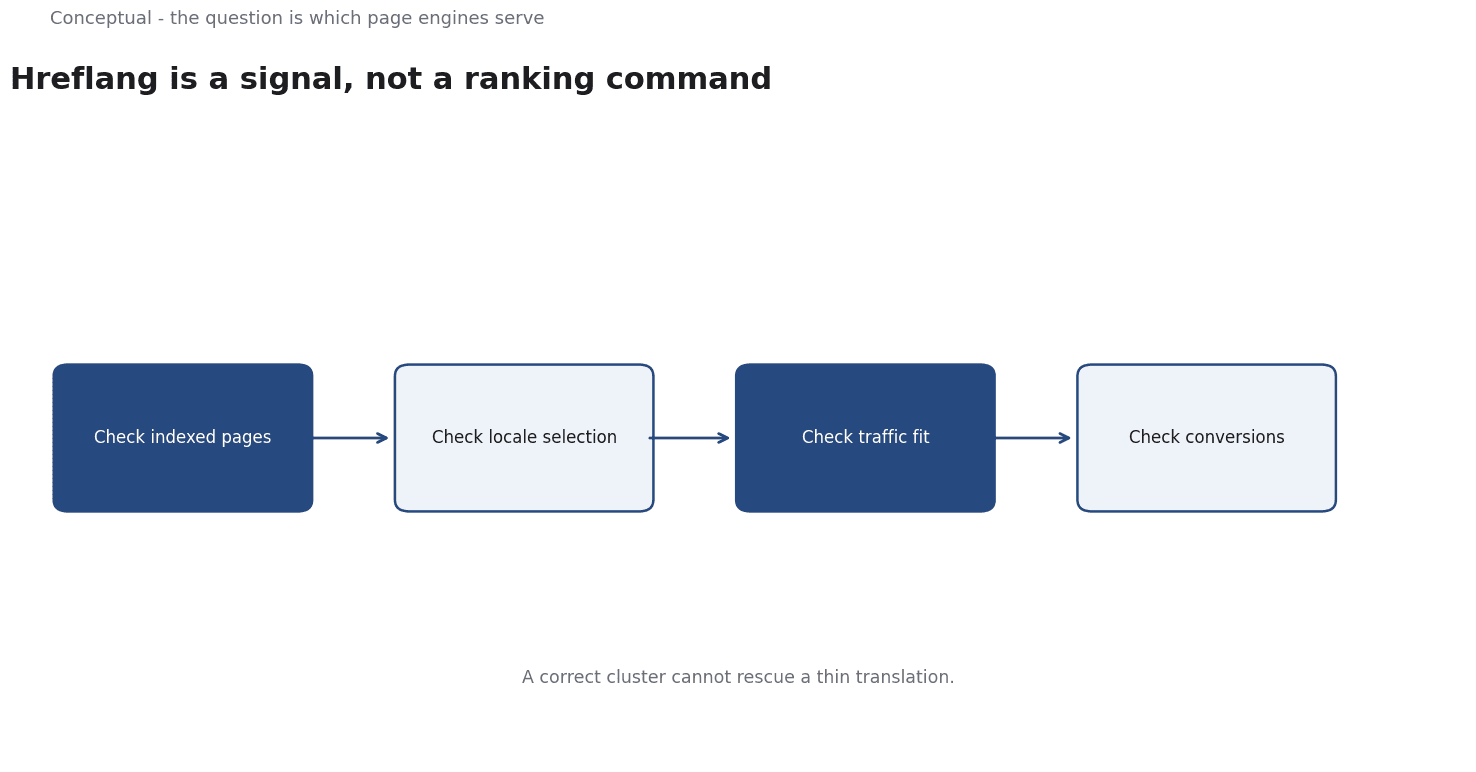
Evaluate international SEO by checking which pages are indexed, which version is selected for each locale, and whether traffic and conversions match the intended market.
Google's Search Console guidance is the primary source for diagnosis, and the hreflang guide covers the tag structure. The boundary: no structure guarantees a ranking, which the publication standard states for SEO, and hreflang does not fix thin or duplicated content, as the thin-content article warns.
The checks
Inventory the locales. Which languages and regions do you actually serve, and which pages are intended for each, which the hreflang guide requires for valid clusters, as the data-governance article requires for relied-upon records? A tag pointing to a page that does not exist is an error, as the hreflang guide warns about return tags.
Check indexing. Are the intended pages in the index, which the Search Console guide covers, as the discovered-crawled-rendered article explains for the stages? A locale page that is not indexed cannot be served, as the indexing article treats access and indexing as distinct, as the canonicalization article explains for signals.
Check selection. Which version appears for a query in a given locale, which the hreflang guide treats as the purpose of the tags, as the geo-experiment guidance recommends for a comparison? Manual checks from a locale are evidence, as the measuring-GEO article advises for observable signals.
Check outcomes. Do traffic and conversions match the intended market, which the funnel article treats as stage measures, as the analytics article advises for observed behaviour, as the attribution article warns about credit rules?
Three consequences follow. The tags should be consistent and reciprocal, as the hreflang guide requires, as the diagnostics article advises for verification. The content should be genuinely localized, which the international-expansion article treats as more than translation, as the thin-content article warns about duplicates. And the result should be rechecked after a template change, as the monitoring article treats as a trigger.
A worked audit
The following is hypothetical and illustrative. A site serves English, German, and Japanese versions of a product page.
Three checks decide. First, do all three versions return hreflang tags that point to each other, as the hreflang guide requires, and do the URLs resolve, as the diagnostics article advises? Second, which version appears for a German query from Germany, which the hreflang guide treats as the selection question, as the geo-experiment guidance recommends for a comparison? Third, do German visitors land on the German page and convert, which the analytics article advises for observed behaviour, as the funnel article treats as stage measures?
Three conclusions follow. Missing return tags would break the cluster, which the hreflang guide warns about.
And the result should be recorded with the checks, as the decision-memo article requires.
What international evaluation cannot do
It cannot guarantee a ranking, which the publication standard forbids claiming, as the status-codes article treats a correct response as necessary but not sufficient. It cannot fix weak content, which the content-marketing article treats as the value before distribution, as the thin-content article warns. And it does not remove the need for genuine localization, which the international-expansion article treats as adaptation to a market, as the industry lens requires scope.
The counterargument that hreflang alone solves international search is wrong about what a signal does, which the hreflang guide explains, as the structured-data article warns about treating markup as a guarantee.
A decision test
- Inventory locales and intended pages, as the hreflang guide requires.
- Verify reciprocal tags and resolving URLs, as the hreflang guide advises.
- Check indexing of each locale, as the Search Console guide covers.
- Observe which version is selected per locale, as the geo-experiment guidance recommends.
- Measure traffic and conversions per market, as the analytics article advises.
- Check that content is genuinely localized, as the international-expansion article requires.
- Record the audit, as the decision-memo article requires.
For the tag mechanics, see Hreflang for International SEO; for the diagnosis, see Search Console.
References & Further Reading
- Google, 2026. Localized Versions of your Pages — How hreflang, canonicals, and locale variants are supposed to work together.
- Google, 2026. SEO Starter Guide: The Basics — The search engine's own description of what it needs from a site.