Privacy Sandbox Metrics that Matter
Privacy Sandbox metrics promise measurement without third-party cookies, but what they capture depends on aggregation thresholds and noise.
The deprecation of third-party cookies pushed measurement toward new privacy-preserving mechanisms, and the term Privacy Sandbox is often used as if it named a single replacement metric. It does not. The sources describe a collection of technologies aimed at supporting use cases like advertising measurement while reducing cross-site tracking, and the practical problem is deciding which of its signals are worth trusting.
Direct answer:
Privacy Sandbox metrics measure aggregate or on-device signals intended to support advertising and analytics without cross-site identifiers.
They are bounded by aggregation thresholds, noise, and the specific API through which a signal is produced. What matters is whether a metric is precise enough for the decision it supports, not whether it looks like an old cookie-based number.
Delta: This article adds a decision map beyond the sources: it maps Privacy Sandbox signals to measurement decisions, with claim status explicit.
The mechanism
The reference entry on Privacy Sandbox describes it as a set of technologies intended to develop privacy-preserving alternatives to third-party cookies. The important structural point is that it is a collection, not one metric. Different parts address different needs, such as selecting an ad, measuring conversions, or segmenting audiences, and each part produces signals with its own granularity and limitations.
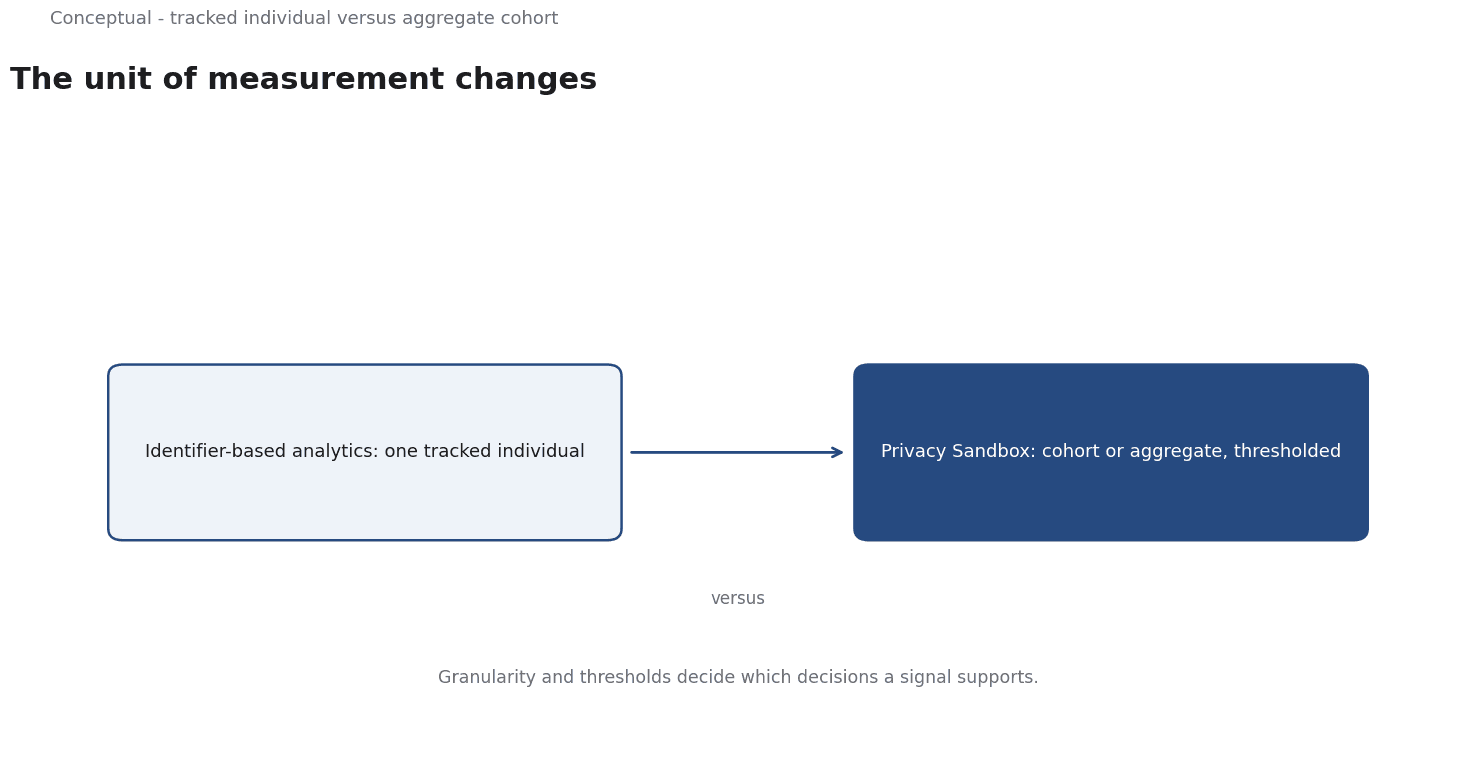
The web analytics entry provides the contrast that makes this concrete. Traditional web analytics measures visitor behavior by collecting data about sessions and often relies on identifiers that persist across sites. When those identifiers are removed, the unit of measurement changes from a tracked individual to an aggregate or a cohort. That shift is not cosmetic: a metric built around persistent identity cannot be reproduced exactly by one built around thresholds and noise, so the numbers will differ even when the underlying behavior does not.
The practical consequence is that metric selection becomes a question of fit. A signal smoothed to protect privacy may be adequate for a high-level trend and inadequate for a fine-grained attribution decision. The mechanism determines this because each API defines what is counted, what is thresholded, and what is suppressed when counts are small. Understanding those boundaries tells you which decisions a metric can support and which ones it cannot.
Read as a decision tool, the Privacy Sandbox is best approached by matching signal properties to decision needs. The sources establish what the technologies are and what web analytics traditionally measured; they do not guarantee that any given metric is accurate for a particular business question. The useful move is to state the decision first, then ask which available signal has the resolution and stability that decision requires.
A worked example
The following is hypothetical and illustrative. A hypothetical publisher compares a legacy cookie-based conversion count with a Privacy Sandbox measurement signal after the cookies disappear. Three checks guide the decision. First, the team checks whether the new signal reports at a granularity fine enough to distinguish the campaigns it actually manages, since coarse aggregates can collapse meaningful differences. Second, it checks how the signal behaves on low-volume segments, where thresholds and suppression can drop data entirely. Third, it runs both measurements in parallel for a period to see whether directional trends agree even if absolute values differ. In this scenario the trends align but small campaigns disappear from the new signal. The outcome is that the team uses it for budget allocation at the campaign-group level and keeps other evidence for small segments.
Evidence status
| Claim | Status | Source | Verified | Recheck when |
|---|---|---|---|---|
| Privacy Sandbox is a collection of privacy-preserving technologies replacing third-party cookies | source-reported | Privacy Sandbox overview | 2026-11-18 | If the APIs change |
| Traditional web analytics often relies on identifiers that persist across sites | source-reported | Web analytics overview | 2026-11-18 | If analytics practices change |
| Metric fit depends on granularity and thresholding of each signal | inferred | Derived from the sources | 2026-11-18 | If measurement APIs change |
The first two claims are reported by the reference entries and can be rechecked there. The third is an inference about how to use the signals, so it should be revisited when APIs or thresholds change. Marking that distinction keeps the guidance clear: the sources describe the mechanisms, while the decision rule is a reasoned extension rather than a quoted fact.
What it cannot do
Privacy Sandbox metrics cannot reproduce cookie-era numbers exactly, and expecting them to is a category error. The mechanisms deliberately trade resolution for privacy, which means some information is aggregated away or never collected. A dashboard that once showed a precise per-user path will not have an equivalent under a thresholded signal. Accepting that loss is part of using these metrics honestly, and denying it leads to comparisons that mislead.
The hidden cost is the instrumentation and interpretation work required to use the signals well. Switching measurement systems means redefining what a conversion is, revalidating event definitions, and accepting a period of overlapping measurement while comparisons are made. There is also a skills cost: analysts must understand which API produced a number and what suppression rules shaped it, or they will read a smoothed aggregate as if it were a raw count.
A recurring failure mode is comparing numbers from different mechanisms as if they were like for like. When a privacy-preserving signal and an identifier-based signal disagree, the difference is not necessarily error; it may be the expected consequence of aggregation and thresholds. Teams that treat the discrepancy as a bug tend to chase it without resolving anything, when the right response is to document which decision each number supports.
The evidence has a clear boundary. The sources describe the technologies and the history of web analytics; they do not certify that any specific metric is accurate for a given business. Claims about the precision or reliability of a particular signal are inferences that must be tested against observed behavior in the relevant context. This article supplies the questions to ask about a metric, not a verdict on any vendor or implementation.
For that reason metric definitions need periodic review. APIs change, thresholds move, and the mix of traffic can shift enough to change how often data is suppressed. A review should ask whether the signal still resolves the decision it was chosen for, whether low-volume segments are being lost, and whether the documentation of what the number means is still current.
Counterargument: "The counterargument that Privacy Sandbox metrics are still useful despite lost precision is fair for high-level trends and allocation and incomplete for individual-level attribution: they trade resolution for privacy, so some questions cannot be answered at all."
A decision test
- State the decision the metric must support before choosing any signal.
- Identify which Privacy Sandbox API produces the candidate signal and what it counts.
- Check the granularity so the signal can distinguish the units the decision concerns.
- Test behavior on low-volume segments where thresholds may suppress data.
- Run old and new measurements in parallel to compare directional trends.
- Document which decision each number supports rather than forcing a like-for-like match.
- Review metric definitions periodically as APIs, thresholds, and traffic mix change.
Used together, these steps turn a vague trust in a measurement number into a bounded claim about what it can do.
The goal is not a perfect replacement for cookies but a clear match between a signal and a decision.
A team that can answer each step knows what its metrics measure; one that cannot is likely reading aggregates as something they are not.
For further reading, see Data Governance: Managing Data as an Asset.
References & Further Reading
- Wikipedia contributors, 2026. Privacy Sandbox - Wikipedia — Browser proposals to limit tracking while supporting advertising.
- Wikipedia contributors, 2026. Web analytics - Wikipedia — Collection and interpretation of website behaviour data.