13-week Cash Flow Costs Explained
A thirteen-week cash flow forecast tracks weekly liquidity, not profit. Learn the source definitions, a worked timing example, and where the method breaks.
A thirteen-week cash flow forecast tracks the actual movement of cash, week by week. The cash flow entry describes inflows and outflows over a period, and the working capital entry covers current assets and liabilities. The real problem is that a short-term forecast is often read as a profit forecast, when what it actually measures is timing and liquidity.
Direct answer: Build the forecast from expected receipts and payments placed in the week cash actually moves, then compare each closing balance with the minimum needed to operate. The sources define cash flow and working capital; the weekly timing rule is a synthesis. The forecast is a liquidity instrument, not a measure of profitability.
Delta: This article adds a claim-status table and a weekly timing decision test beyond the sources: it maps each cash movement to a weekly liquidity decision, with claim status explicit.
The mechanism
Cash flow is the net movement of cash into and out of a business over a period. The Wikipedia entry distinguishes operating, investing, and financing flows, while the working capital entry describes current assets such as receivables and inventory set against current liabilities such as payables. A thirteen-week window is short enough that timing, rather than accounting categorization, dominates the picture.
In that window, the question is not whether a sale was made but when the cash from it arrives.
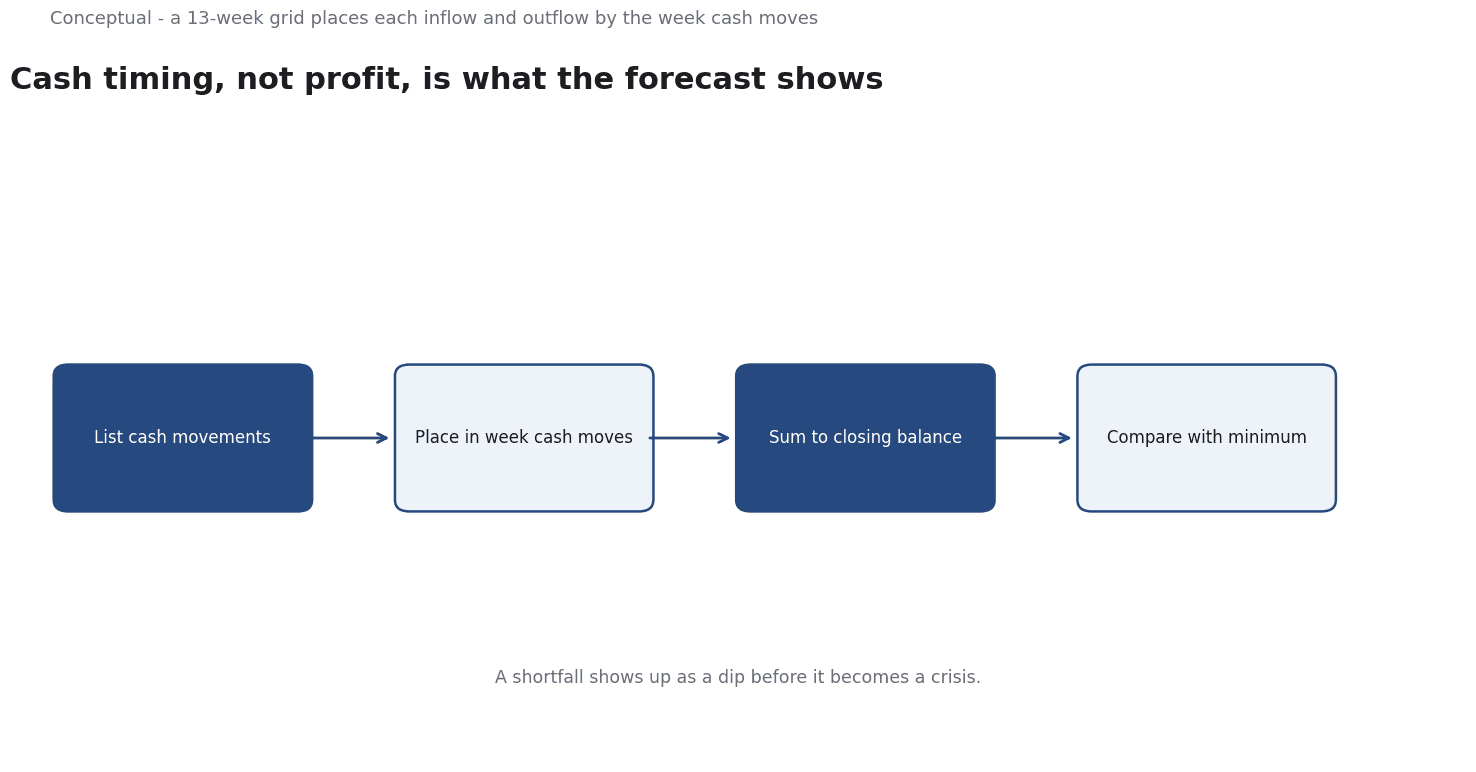
The practical consequence is that a profitable company can still run short of cash if receipts arrive after payments are due. The forecast lists each expected inflow and outflow in the week it occurs, so a delayed customer payment or a large supplier bill appears as a dip in the closing balance. Working capital changes are exactly the timing levers the weekly view reveals. Collecting receivables sooner, slowing a payment, or building inventory all shift cash between weeks, and the forecast makes that shift visible before it becomes a crisis.
The forecast is built from assumptions about when cash moves, not from revenue as it is recognized. Those assumptions are local choices and should be marked as inferred. The sources describe the categories of flow and the components of working capital; they do not prescribe a forecast horizon, a grid format, or a minimum balance. A thirteen-week structure is therefore a decision made by the team, not a requirement stated in the sources. The discipline is to keep each assumption explicit so that a reviewer can see what the projection rests on.
The output is a closing cash balance for each week, compared against a minimum threshold. That comparison, rather than the total, is the decision instrument. It tells a manager when a shortfall appears and how much lead time exists to act. The value of the method lies in the sequence: list the movements, place them in time, sum the balance, and compare.
A worked example
The following is hypothetical and illustrative. A small distributor builds a thirteen-week forecast from weekly customer receipts, payroll, and supplier payments. Three checks decide the review. First, are receipts placed in the week cash actually arrives rather than the week on the invoice? Second, does the largest supplier payment fall in the same week that a major customer payment is delayed? Third, does the lowest projected closing balance stay above the operating minimum? The forecast shows a dip in week six because a large payment lands one week before the matching receipt. The team moves the payment by a week and confirms the balance clears the minimum. The outcome is a timing decision, not a new financing product. The numbers are hypothetical; the verification method is the contribution.
Evidence status
| Claim | Status | Source | Verified | Recheck when |
|---|---|---|---|---|
| Cash flow tracks inflows and outflows over a period | source-reported | Wikipedia, Cash flow | 2026-11-18 | Definition revised |
| Working capital covers current assets and liabilities | source-reported | Wikipedia, Working capital | 2026-11-18 | Definition revised |
| A weekly timing view reveals a shortfall before it occurs | inferred | Derived from the sources | 2026-11-18 | Payment terms change |
The first two rows are factual claims drawn directly from the sources. The third is an inference about what a weekly view makes visible, because neither source endorses a particular forecast method. Recheck the definitions when the source entries change, and the inferred claim when payment terms or the pattern of receipts changes.
What it cannot do
A thirteen-week cash flow forecast does not measure profitability. Cash timing can look healthy while a business loses money on each sale, and it can look strained while the business is profitable overall. The sources describe flows and working capital, not earnings quality, so treating the forecast as a verdict on whether the business makes money is a category error. It answers when cash is available, not whether the underlying activity creates value.
The hidden cost is maintenance. A weekly forecast needs constant updating, because each week the actual numbers must replace the assumptions that were used when the forecast was built. Stale assumptions quietly corrupt the projection: a receipt that never arrived, or a payment that moved, distorts every week that follows. The labor is recurring rather than one-time, and small teams often abandon the discipline after a few weeks when the immediate crisis passes. The cost is paid in attention, not in software.
A thirteen-week grid looks exact, but every entry is an estimate. Treating the output as a statement of what will happen, rather than a scenario of what might happen, invites overconfidence. The farther out a week sits, the weaker its estimate, yet the format gives all thirteen weeks the same visual weight. A manager who reads week twelve with the same certainty as week one will make poor decisions. The grid should carry a visible marker of confidence that fades with distance.
There is a boundary around the method. It covers cash under current arrangements and assumptions. It does not model refinancing, a new credit line, or the sudden loss of a large customer beyond what was entered. It does not replace a longer-term plan, a balance sheet view, or a consideration of what happens after week thirteen. A shortfall that sits just outside the window is invisible to this instrument by design.
Because terms and timing change, the forecast needs a weekly refresh and a periodic review of the assumptions themselves. Each assumption should be recorded with a recheck condition, and the minimum balance should be treated as a local policy decision rather than a number the sources supply. Without that record, a future reviewer cannot tell which inputs were deliberate and which were guesses.
The counterargument that a thirteen-week horizon is fair for spotting near-term gaps is incomplete when a shortfall sits just beyond the window.
A decision test
- List expected cash receipts by week.
- List expected cash payments by week.
- Place each item in the week cash actually moves.
- Sum each week to a closing cash balance.
- Compare every balance with the operating minimum.
- Identify the first week that falls below that minimum.
- Decide which payment to move or collection to accelerate, then record the assumption and recheck date.
The forecast is useful only when its assumptions are owned and refreshed. The test turns a grid of numbers into a sequence of decisions with a visible lead time, so a reviewer can see which lever was pulled and when it must be revisited. For further reading, see Cash Flow Forecasting: A 13-Week Operating Model.
References & Further Reading
- Wikipedia contributors, 2026. Cash flow statement - Wikipedia — Operating, investing and financing activities, and why net income and cash flow differ.
- Wikipedia contributors, 2026. Working capital - Wikipedia — Current assets minus current liabilities, and why a growing business can be cash-constrained; secondary reference.