Cash Flow Forecasting: A 13-Week Operating Model
Profit is an opinion; cash is a bank balance. Read how to build a 13-week forecast, a worked example, and why the horizon is short.
A company can be profitable on paper and unable to pay its bills next month. The 13-week cash forecast exists to answer the short-term question that accounting statements do not: will there be enough cash to operate, week by week, through the next quarter. It is an operating tool, not a financial model of the business's future.
Direct answer: A 13-week cash forecast lists every expected cash inflow and outflow by week, with a closing balance, and compares it with the minimum balance the business needs. Investor education emphasises that returns are not guaranteed, and the financial-statement overview explains why accounting profit and cash diverge. The boundary: the model is only as good as the timing assumptions behind receivables and payables, which the working-capital article covers, and it is not a forecast of long-term value, as the DCF literature treats separately.
What goes into it
Opening balance and minimum threshold. The actual bank balance at the start, and the lowest balance the business can operate with before it must act. The threshold is a policy decision, not a calculation, as the emergency-fund article argues for a reserve sized to real constraints.
Receipts. Cash actually expected each week — customer payments, tax refunds, financing — not revenue recognised, which the revenue-recognition article distinguishes from cash. The timing of receivables matters more than the amount, as Working Capital: The Cash Constraint Growth Companies Miss explains for cash conversion cycles.
Payments. Payroll, rent, suppliers, tax, and debt service, each placed in the week it will leave the account. Annual or irregular items must be included when they fall in the window, which the fixed-income article treats as a maturity question in a different context.
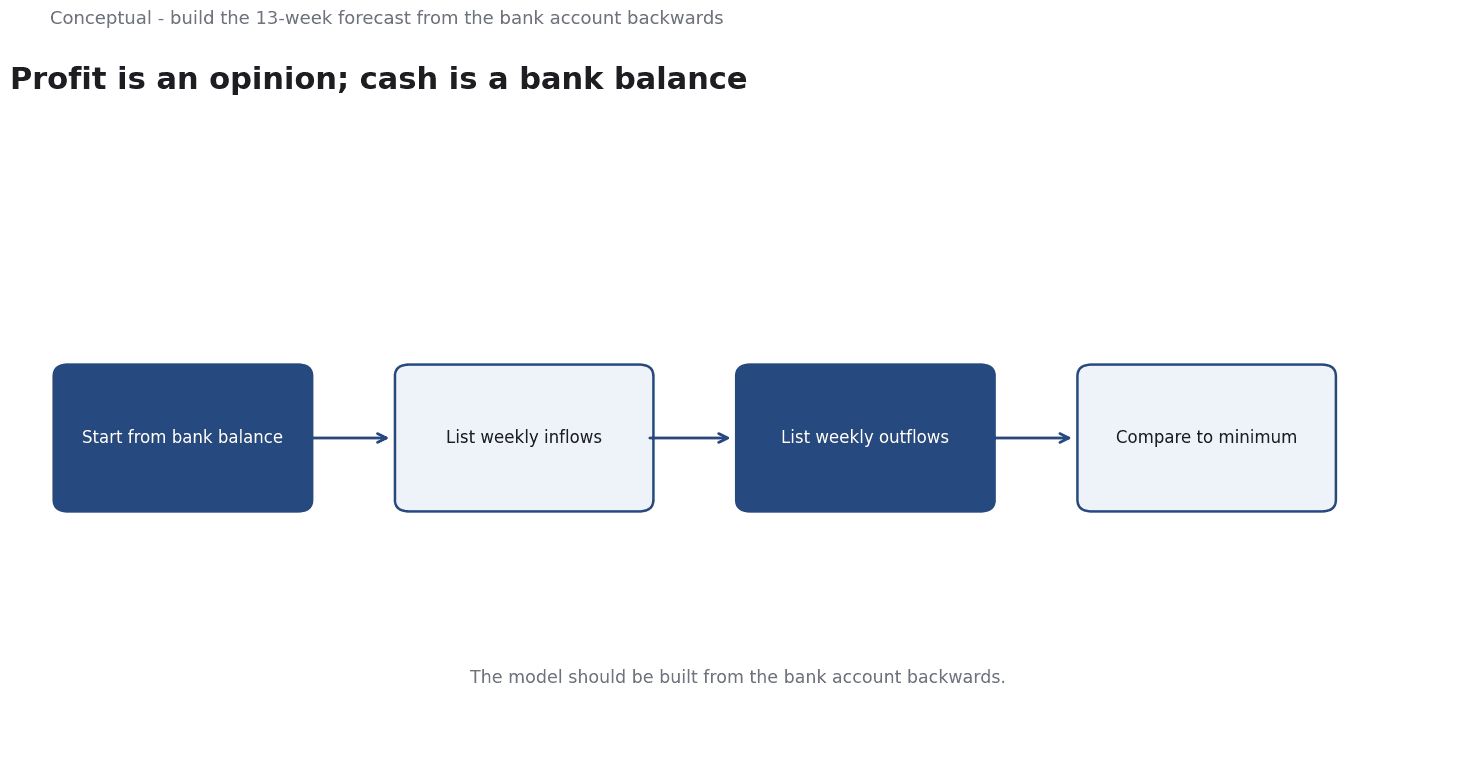
The model should be built from the bank account backwards.
A worked example
The following is hypothetical and illustrative. A company opens week one with 200,000 and a minimum threshold of 80,000. Weekly payroll is 60,000, other operating costs 30,000, and customer receipts average 100,000 but are concentrated in weeks three, six, nine, and twelve at 250,000 each.
In weeks one and two, receipts are zero, so the balance falls by 90,000 per week to 20,000 — below the threshold. The forecast shows a cash gap in week two, before the first large receipt arrives. Three actions follow: accelerate a customer payment, delay a non-critical supplier payment, or draw a committed facility. Each has a cost and an owner, which the risk-assessment article requires for any mitigation.
Three checks decide whether the model is useful. First, accuracy against actual bank movements: a forecast that misses by more than a defined tolerance each week needs better timing assumptions, which the monitoring article treats as a control failure. Second, coverage of irregular items: a tax payment or annual renewal omitted from the window can invalidate the whole forecast, as the budget article warns about unallocated spend. Third, action: a gap that is identified but not acted on is a report, not a control, which the decision-memo article argues for recorded decisions.
What the model cannot do
It cannot see beyond thirteen weeks, which is why it does not answer questions about investment or valuation, as the DCF article explains for longer horizons. It cannot fix a structural cash problem: if the business consistently collects later than it pays, a forecast merely reveals the gap each quarter, which the working-capital article addresses as a business-model question. And it cannot be trusted if the underlying data is stale, which the data-governance article treats as a provenance issue.
The counterargument that a budget already covers this is wrong about horizon and granularity.
A budget is an annual plan; a 13-week forecast is a weekly operating instrument, as the burn-rate article distinguishes the two.
A decision test
- Start from the actual bank balance and a stated minimum.
- List receipts by expected week, not by recognition date.
- List every payment in the week it leaves the account.
- Include irregular items that fall in the window.
- Flag any week below the threshold with an owner and an action.
- Compare forecast with actuals weekly and investigate gaps.
- Rebuild the forecast every week, as the monitoring article advises for a living control.
For the related measure, see Burn Rate and Runway; for the structural view, see Working Capital.
References & Further Reading
- U.S. Securities and Exchange Commission (Investor.gov), 2026. Introduction to Investing — Primary regulator guidance on market mechanics and investor protection.
- Aswath Damodaran, 2026. Damodaran Online: Home Page for Aswath Damodaran — Publicly maintained datasets for industry averages, WACC, and valuation.