Agent Evaluation Examples
An agent succeeds or fails across a whole trajectory. Read concrete evaluation examples, a worked test, and why a single final answer is weak evidence.
Evaluating an agent by its final answer is like evaluating a journey by where the traveller ended up. A correct answer can come from a lucky path, and a wrong one can follow a sensible process that hit a single bad tool result. The HELM framework's multi-metric approach is the right precedent: measure several properties, not one outcome, as the evaluation article advises for LLM systems.
Direct answer: HELM provides the multi-metric precedent, and the generative-agents work describes agent memory and behaviour. The boundary: an evaluation covers the tested tasks and conditions, which the benchmarks article warns about generalising, and no result guarantees deployment behaviour, as the publication standard requires for AI claims.
Evaluate agents on the trajectory — tool choices, intermediate states, recovery from failure, and the final result — against a fixed task set.
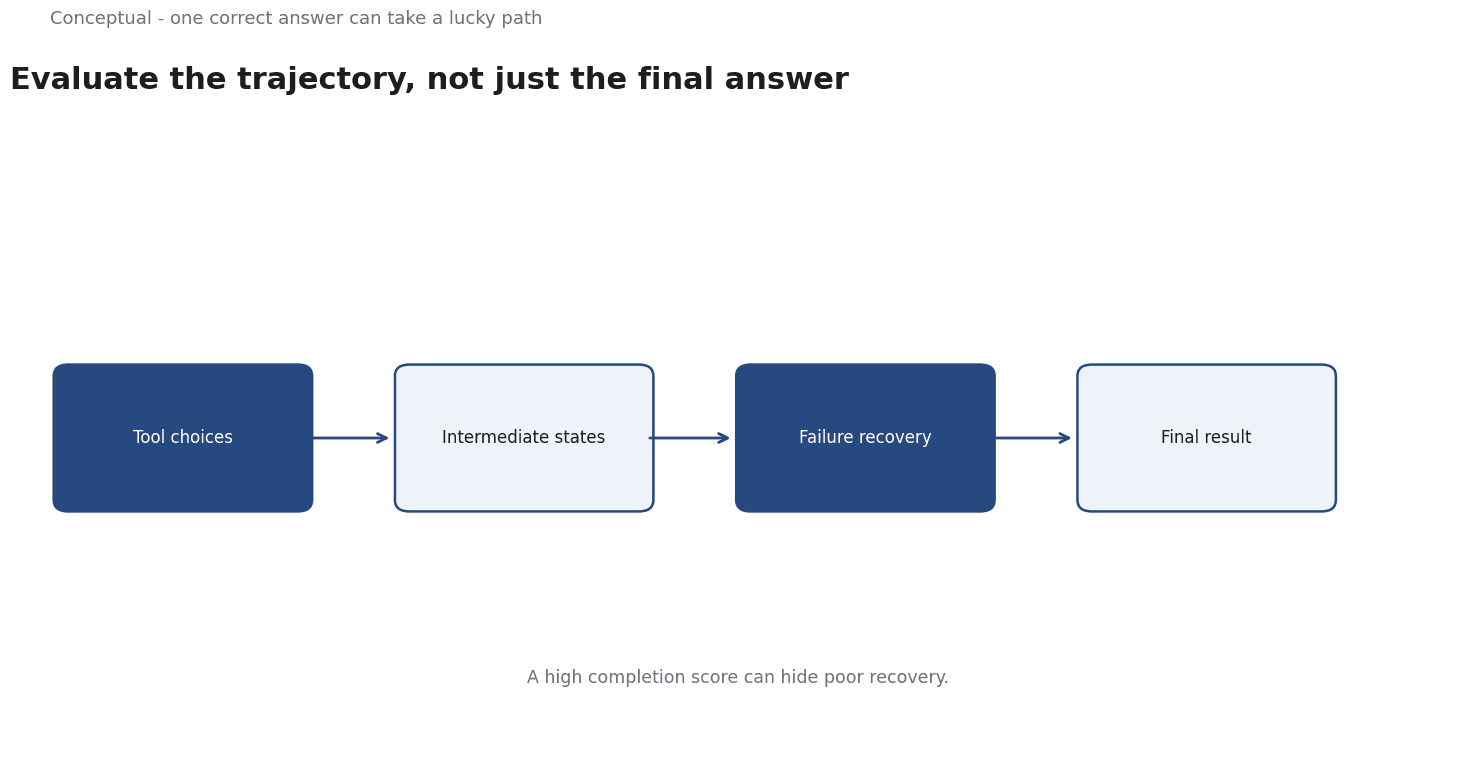
Examples of what to evaluate
Task completion. Did the agent reach the goal, measured against a labelled set of tasks with clear success conditions, as the evaluation-rubric article requires for concrete criteria? A vague goal produces a vague score, as the decision-memo article argues for specific definitions.
Tool selection. Did it call the right tool with valid arguments, as Tool Calling Reliability: When Function Calls Fail in Agent Systems treats schemas and authorisation as the boundary? A final answer can be correct despite a wrong call that happened to be harmless, which is a hidden failure worth recording.
Recovery. When a tool fails or returns a stale result, does the agent detect it and take a fallback, which the incident-response article treats as the core of resilience? The error-propagation arithmetic in the autonomous-business article shows why each step's reliability matters.
Provenance. Can a reviewer trace which sources and tool results led to the answer, which the data-governance article requires for relied-upon records, as the legal-research article treats citations as a control?
Three consequences follow. The task set should be fixed and representative, as AAPOR's standards require for comparable wording, as the evaluation article advises. Failures should be grouped by cause, which the voice-of-customer article recommends for feedback, as the rubric article argues for categories. And the cost of each run should be recorded, which the cost estimator requires, as the routing article treats cost per correct answer as the decision metric.
A worked example
The following is hypothetical and illustrative. An agent answers support questions using a knowledge-base tool and a refund tool across twenty labelled tasks.
Three checks decide. First, completion: did it solve the task within the allowed steps, as the evaluation-rubric article requires? Second, trajectory: on the tasks where the knowledge tool returned a stale passage, did it detect the mismatch and escalate, as Tool Calling Reliability: When Function Calls Fail in Agent Systems advises for failure boundaries? Third, cost: what was the token spend per successful task, which the cost estimator calculates, as the routing article treats cost per correct answer as the decision metric?
Three conclusions follow.
An agent that escalates safely is more valuable than one that guesses, as the human-in-the-loop article argues for meaningful review. And the result should be recorded with the failures grouped, as the decision-memo article requires.
What agent evaluation cannot do
It cannot cover every future task, which the benchmarks article warns about, as the evaluation article advises for held-out sets. It does not guarantee deployment behaviour when tools or data change, as the monitoring article treats as a review trigger. And it cannot prove safety, which the AI-safety article distinguishes from a test result, as the risk-assessment article requires for residual uncertainty.
The counterargument that a good final-answer score is enough is wrong for agents, which the trajectory examples show: the path matters when the next task has different tools, as Tool Calling Reliability: When Function Calls Fail in Agent Systems argues for boundaries outside the model.
A decision test
- Build a fixed task set with explicit success conditions, as the rubric article requires.
- Score completion and trajectory separately, as the multi-metric precedent advises.
- Check tool arguments and recovery, as Tool Calling Reliability: When Function Calls Fail in Agent Systems requires.
- Record provenance of sources and results, as the data-governance article requires.
- Group failures by cause, as the voice-of-customer article recommends.
- Measure cost per successful task, as the cost estimator advises.
- Record the decision and the limits, as the decision-memo article requires.
For the method, see Evaluating LLM Applications; for the boundary, see Tool Calling Reliability.
References & Further Reading
- Percy Liang et al., 2022. Holistic Evaluation of Language Models — HELM's multi-metric framework: 7 metrics across 16 core scenarios, 30 models, and the finding that models were previously evaluated on only 17.9% of shared scenarios.
- Joon Sung Park et al., 2023. Generative Agents: Interactive Simulacra of Human Behavior — An architecture for agent memory: observations, reflection and planning, with retrieval of stored experiences.