Affiliate Programs in Practice
An affiliate programme pays for referred outcomes. Read how it works, a worked review, and why a tracked sale is not always an incremental one.
An affiliate programme looks simple on a dashboard: a partner sends a customer, a sale is tracked, a commission is paid. Underneath that clean number sits a division of risk. The programme decides who pays when a referred visitor fails to convert, and it decides what the partner is rewarded for doing.
Direct answer: Run an affiliate programme with a defined outcome, a commission model whose risk you understand, and a check on incrementality. The sources describe the channel and its payment methods; the measurement rule is a synthesis.
Delta: This article adds a claim-status table, the risk shift across compensation models, and a worked review with labelled illustrative numbers, separating documented channel facts from local choices about credit.
The mechanism
Affiliate marketing pays for a credited outcome, but credit and cause are different things. The programme can only be judged by what changes because it exists, and by who carries the risk when a referral does not convert.
Three points matter:
- The channel is performance-based. The affiliate entry describes paying a commission for each visit, signup, or sale, usually a percentage of the price. It reports that about 80% of programmes use revenue sharing or pay per sale, 19% use cost per action, and the remainder use methods such as cost per click or cost per mille.
- Risk moves with the payment model. Under cost per mille or cost per click, the publisher is paid before the visitor converts, so the advertiser absorbs the loss on non-converting traffic. Under cost per action or pay per sale, the affiliate carries the risk: no conversion, no commission.
- Credit is not cause. A tracked sale can come from a customer who would have bought anyway. The comparison is the causal-inference correction that turns a report into a decision.
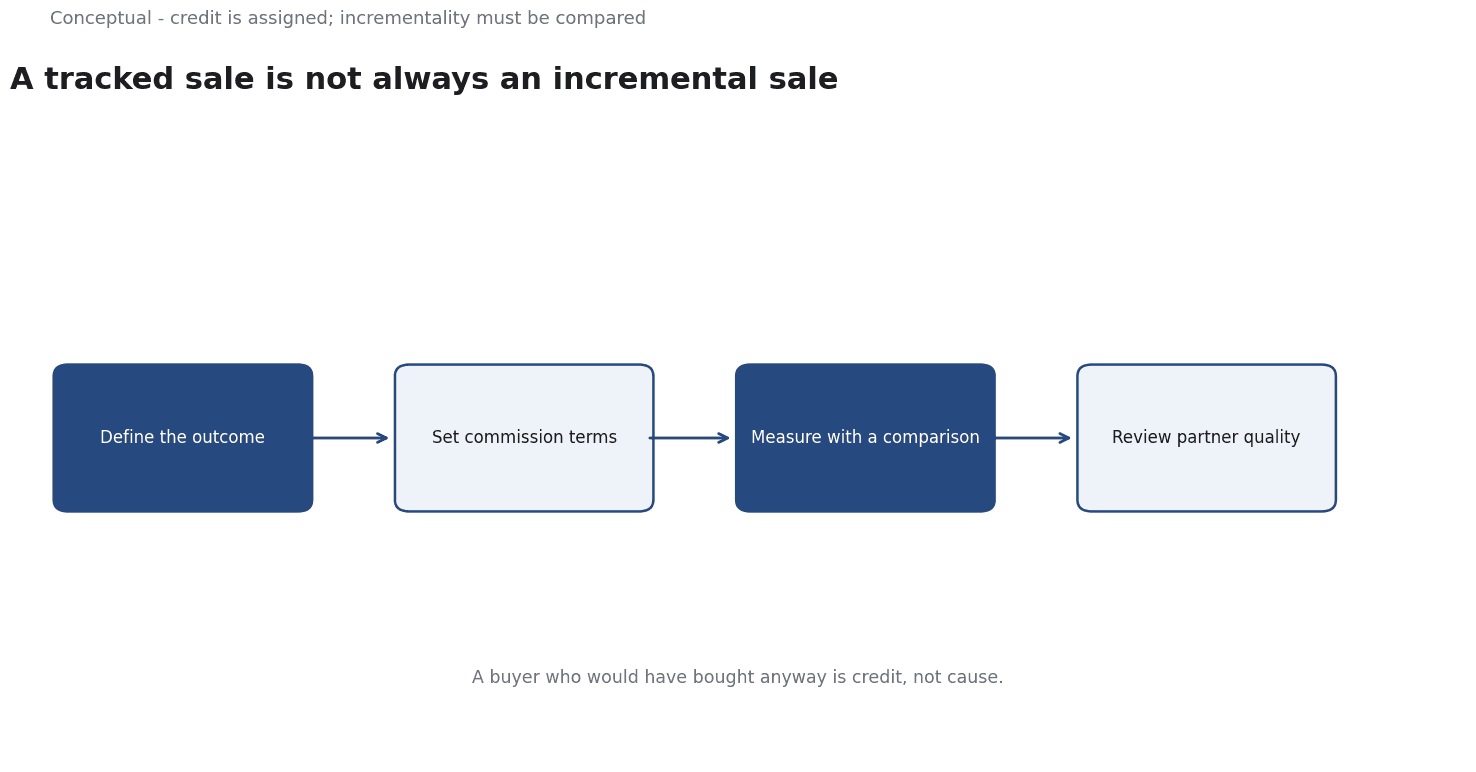
The sequence is: define the outcome, set terms, measure with a comparison, then review. The terms are local judgement, so they are inferred; the channel structure and payment mix are source-reported. Neither source states that a tracked sale proves a new sale.
Where the risk actually sits
The payment model is not an administrative choice. It decides which party pays for a visitor who is not in the target audience. With cost per mille, the publisher only has to display the ad, and the full risk of a bad match stays with the advertiser. With cost per click, the publisher earns when the visitor clicks, so the advertiser still carries the conversion risk. With cost per action, the affiliate sends traffic and is paid only if the visitor converts, which pushes the risk toward the partner and gives it a reason to target closely.
The source also notes that affiliates have limited influence once a prospect reaches the advertiser's site. An internal sales team can guide a buyer up to the signature or the purchase; an affiliate usually cannot. That boundary explains why the commission is tied to a referred outcome rather than to the whole sale conversation. It also explains why a partner can drive a click but cannot make the product convert.
A worked review
Illustrative. Assume a programme credits 100 sales in a month at a 10% commission. A matched comparison period with no affiliate activity records 60 of those customers buying anyway. The 40 remaining sales are the plausible incremental set, and the commission spend is judged against those 40, not against 100. The numbers in this scenario are hypothetical and are not evidence about any real programme.
Three checks decide. First, does the tracking window credit purchases that would have happened without the referral? A 30-day window after a click will capture routine repeat purchases that were already scheduled. Second, is the commission consistent with the value of a genuinely new customer? A flat 10% on every order pays the same rate for a first purchase and a loyal customer's tenth. Third, is there a period or region without affiliate activity that can serve as a comparison? Without one, the programme has no counterfactual and the 100 sales cannot be split.
The outcome is a qualified assessment, not a verdict. The method is the contribution. If the commission rate is set from the 100-sale report, the programme will look efficient on paper while paying for 60 sales it did not cause.
Why terms shape behaviour
A commission that pays for every signup will attract partners who optimise for signups, including ones that never become customers. A commission tied to a retained customer changes the incentive, because now the partner has a reason to send people who stay. The terms are therefore a product decision, not an administrative detail, and they should be reviewed against the outcome the programme wants.
The source describes multi-tier programmes where a publisher recruits other publishers and earns a lower commission on their activity. Two-tier arrangements are a minority; most programmes are one-tier. The practical point is that a referral chain can create a second incentive layer, and a review that only looks at the first partner will miss where the commission actually flows.
Why credibility beats reach
Two partners with the same audience size can produce very different results because their credibility differs. The mechanism is the same as word of mouth: a recommendation works because the source is trusted, not because the message reached many people. Selecting on reach alone misses this and tends to favour the loudest partner rather than the most persuasive one.
The source adds a commercial reason. High-traffic websites are more likely to want low-risk cost per mille or medium-risk cost per click deals than higher-risk revenue share or cost per action deals. A large publisher and a small reviewer may therefore be incompatible with the same programme, not because one is worse, but because they are being asked to carry different risk. The boundary is that credibility is hard to measure before the fact, so it has to be inferred from retained-customer rates and refund rates after a trial period.
Evidence status
| Claim | Status | Source | Verified | Recheck when |
|---|---|---|---|---|
| Affiliate marketing pays for referred outcomes | source-reported | Wikipedia, Affiliate marketing | 2026-11-18 | Practice changes |
| Payment mix is roughly 80% revenue share or pay per sale and 19% cost per action | source-reported | Wikipedia, Affiliate marketing | 2026-11-18 | Industry survey updates |
| Risk sits with the advertiser under CPM or CPC and with the affiliate under CPA | source-reported | Wikipedia, Affiliate marketing | 2026-11-18 | Definition changes |
| Recommendations spread through social influence | source-reported | Wikipedia, Word of mouth | 2026-11-18 | Definition changes |
| Use a comparison for incrementality | inferred | Derived from attribution logic | 2026-11-18 | Tracking changes |
| Cookie stuffing sets a tracking cookie without a click, so a sale can be credited to a partner that did not refer it | source-reported | Wikipedia, Cookie stuffing | 2026-11-18 | Platform rules change |
| A 2015 study of 11,700 cookie-stuffing domains found over 91% used redirects and over 84% obscured the referrer | source-reported | Wikipedia, Cookie stuffing (Chachra et al. 2015) | 2026-11-18 | New measurement published |
| Malicious browser extensions can generate fake affiliate clicks and overwrite tracking cookies | source-reported | USENIX, Hulk (Kapravelos et al. 2014) | 2026-11-18 | New threat research |
The parts that attract abuse
The affiliate entry is explicit that uncontrolled programmes attract rogue affiliates. Methods include email spam, trademark bidding, cookie stuffing, malicious browser extensions, and adware that overwrites tracking cookies so one affiliate takes credit for another's referral. Search engine spam produced a class of "thin affiliates" that Google began demoting in 2005. Compensation disclosure is also a live issue, with FTC guidelines affecting how bloggers disclose paid relationships.
Cookie stuffing is worth understanding in detail because it attacks the credit rule itself. The cookie-stuffing entry defines it as setting a tracking cookie without a click, typically through embedded frames or ads that open in a separate window, so a later purchase is credited to a partner that did not refer it. A 2015 study of 11,700 domains engaged in this practice found that over 91% used redirects and over 84% hid the referrer. The same entry documents two eBay cases: Shawn Hogan received more than 28 million dollars in commissions and was sentenced to five months in prison plus a 25,000 dollar fine, while Brian Dunning defrauded eBay of more than 5 million dollars and received fifteen months. Those are documented cases, not hypotheticals, and they show that the fraud can be large even when the underlying technique is simple.
The abuse is not limited to websites. USENIX Security 2014 published "Hulk", a study that elicited malicious behaviour in browser extensions, including extensions that generate fake affiliate clicks or overwrite cookies. For a merchant, the implication is that the tracking layer needs the same scrutiny as the partner list. The cookie-stuffing entry also notes that researchers in 2015 found the practice rare in practice and confined to a small group of affiliates, so the right response is targeted monitoring rather than treating every partner as a suspect.
These are not edge cases to mention once. They are the reason a programme needs terms of service, a way to review claims, and a record of what was reviewed. A programme that only reports sales has no way to tell a credible partner from one exploiting the tracking window.
What the programme actually changes
A programme cannot create demand for a product that does not convert. It also cannot remove the need to check fraud, which grows with the value of the commission. What it can do is lower the cost of reaching a customer who was already inclined to buy, and that is a real benefit, just not the same as new demand.
The measurement should be reviewed on a schedule. A channel that was incremental at one point can become a source of cannibalised sales as the audience overlaps more with existing customers, and a comparison is the only way to see that change. The comparison period should match the affiliate's typical conversion window, or the result will be false in a predictable direction.
There is also a cost that does not appear in the commission report. An affiliate who misrepresents the product may produce sales that are later refunded, and the damage to the brand is real even when the tracked sale looked clean. That is why the programme needs rules about claims and a way to review them, which is a governance decision rather than a detail of tracking.
A tracked sale is evidence of credit, not evidence of cause.
What it cannot do
It cannot guarantee incremental sales. It does not remove the need to check fraud. And it cannot replace a value proposition that converts the referred customer.
The counterargument that tracked sales are the whole result is fair as a record and incomplete as a cause.
A decision test
- Define the outcome the programme is meant to change.
- Choose a commission model and name who carries the conversion risk.
- Check the tracking window against the normal purchase cycle.
- Use a comparison with no affiliate activity.
- Review partner quality on retained customers and refunds, not volume.
- Write terms that cover claims, disclosure, and the abuse modes the source lists.
- Record the decision, the recheck date, and the rule that would reverse it.
For the incentive design, see Referral Programs.
References & Further Reading
- Wikipedia contributors, 2026. Affiliate marketing - Wikipedia — Commission-based promotion, tracking links and codes — the mechanism behind promo-code attribution.
- Wikipedia contributors, 2026. Word of mouth - Wikipedia — How recommendations spread between customers.
- Wikipedia contributors, 2026. Cookie stuffing - Wikipedia — Deceptive affiliate tactic that sets tracking cookies without a click; cites Chachra et al. 2015 and legal cases.
- Kapravelos et al., 2014. Hulk: Eliciting Malicious Behavior in Browser Extensions — USENIX Security paper on malicious browser extensions, including affiliate abuse.