AI Content Detection: What It Can and Cannot Prove
Detectors produce probabilities, not verdicts. Read the research on reliability, the watermark alternative, and why detection is a weak control.
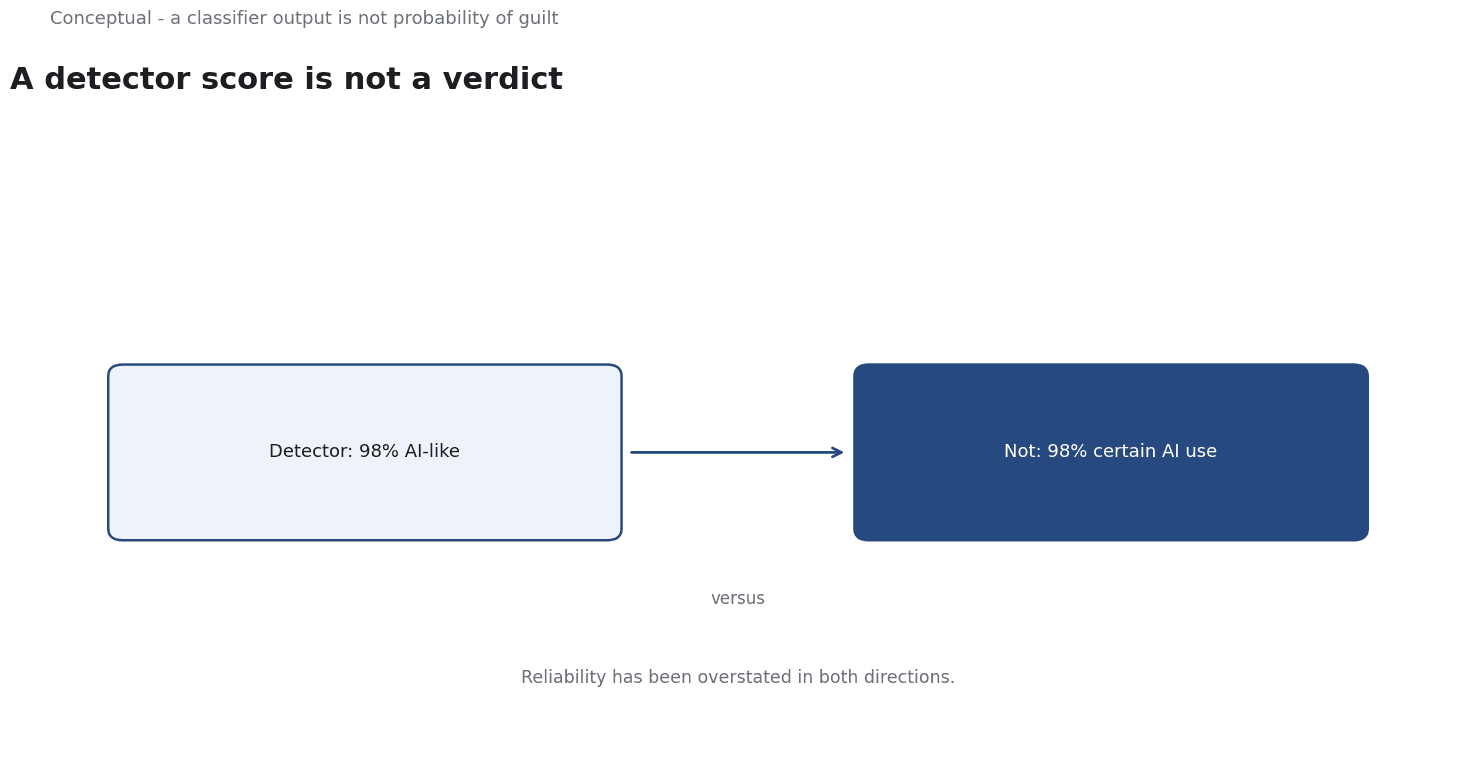
A teacher submits a student essay to a detector and receives "98% AI-generated". The number looks like evidence. It is not a probability that the student used AI — it is the output of a classifier that can be wrong in both directions, and the research on reliability explains why.
Direct answer: Research on AI-text detection found that detectors are not reliably robust to attacks and can produce false positives, especially for non-native writing. Watermarking offers a different property: a statistical signal embedded at generation time, which can prove origin only if the provider applied it and the text was not substantially edited. The boundary: neither detection nor watermarking establishes authorship or quality, and neither should be the sole basis for a consequential decision.
What detectors actually measure
A detector is a classifier trained to distinguish text from a reference distribution. It looks for statistical patterns — predictability, token choice, sentence structure — and outputs a score. Three limitations follow:
The score is not a probability of guilt. A "98%" output means the classifier placed the text far from its human-written reference.
Distribution shift breaks it. Text from a domain or author unlike the training reference can be flagged. Research on detection reliability documents false positives and the effect of adversarial paraphrasing.
Attacks degrade it. Simple edits — paraphrasing, adding errors, translation — can move text across the classifier's boundary. A detector that fails under trivial modification is a weak control.
The paper Can AI-Generated Text be Reliably Detected? is the clearest reference for these limits.
It is not an argument that detection is impossible in every setting; it is an argument that reliability has been overstated.
What watermarking offers
A watermark embeds a statistical pattern in generated text, as described in A Watermark for Large Language Models. Three properties distinguish it from detection:
It is applied at generation. The provider must cooperate, and the text must carry the signal from the start.
It supports a statistical test. A verifier can test whether the pattern is present, with a false-positive rate that can be stated. That is more defensible than a classifier's confidence.
It is fragile to editing. Rewriting, heavy paraphrasing, or mixing human and generated text can remove the signal. Absence of a watermark does not prove human authorship.
Watermarking is therefore useful for a narrow question — did this text come from a provider that watermarks? — and not for the broader question of who wrote it.
A worked example of a policy decision
The following is hypothetical and illustrative.
A university considers using a detector to flag AI-assisted essays. It runs a trial on 1,000 known essays: 500 human-written, 500 generated.
- The detector flags 480 of the generated essays correctly — 96% true positives.
- It also flags 50 of the human essays — a 10% false-positive rate.
Three consequences follow:
- Base rates dominate. If only 5% of submissions are actually AI-generated, the vast majority of flags are false positives. In a class of 1,000, that is roughly 50 true cases and 95 false ones.
- The cost is asymmetric. A false accusation damages a student and consumes appeal time. A missed case is a policy violation that may never be detected. The threshold should reflect that asymmetry, which means being far more conservative than "flag when score > 0.5".
- A score alone is not a process. Any flag must lead to a human review that considers evidence beyond the detector — drafts, writing history, an oral explanation.
The detector is a prompt for investigation, not a verdict.
Three decisions follow:
- Do not use a detector as automated evidence. Use it to prioritise review, with a stated false-positive rate.
- Publish the limitation so students and staff know what the tool can establish.
- Prefer process controls — drafting history, in-class writing, clear policies — which are more reliable than detection.
What neither approach proves
Not quality. AI-generated text can be accurate or wrong; human text can be brilliant or plagiarised. Detection says nothing about either.
Not intent. A student may have used a tool for spelling and not for ideas. A score cannot distinguish the two.
Not authorship in a legal sense. Ownership and responsibility are legal and institutional questions. A statistical test is not a determination.
The counterargument — that doing nothing is worse — is fair. The response is not to rely on a weak detector but to combine process controls, transparent policy, and human judgement, with the detector as one weak signal among several.
A decision test
- State the question you want the tool to answer — origin, quality, or intent.
- Check whether the tool actually answers it. Detection answers neither quality nor intent.
- Measure false positives on your population, not on the vendor's demo set.
- Account for the base rate of the behaviour you are looking for.
- Set a conservative threshold reflecting the cost of a false accusation.
- Require human review with evidence beyond the score.
- Prefer process controls where the stakes are high.
For the security context, see Prompt Injection in LLM Applications; for the policy side, see AI Governance.
References & Further Reading
- Sadasivan et al., 2023. Can AI-Generated Text be Reliably Detected? — The limits of AI-text detectors, including adversarial attacks and false positives.
- John Kirchenbauer et al., 2023. A Watermark for Large Language Models — A statistical watermarking method for generated text, with which it can and cannot prove.