AI for Code Review: What It Catches and What It Misses
AI review is good at patterns and weak at intent. Read the tasks it fits, a worked example, and why human review remains.
An AI code reviewer can spot a null check, a likely race condition, and a missing test in seconds. It cannot tell whether a change implements the right product decision. The useful way to deploy it is to assign it the pattern-matching work and leave the intent work to people.
Direct answer: Anthropic's use-case guides cover code-related assistance, and HELM's multi-metric approach is a reminder that performance must be measured on the specific task. The boundary: an AI reviewer's comments are suggestions, not verdicts — a false positive costs reviewer time, and a false negative is invisible until production.
Delta: This article adds a decision framing beyond the sources: it maps general AI use cases to a concrete logistics task decision, with claim status explicit.
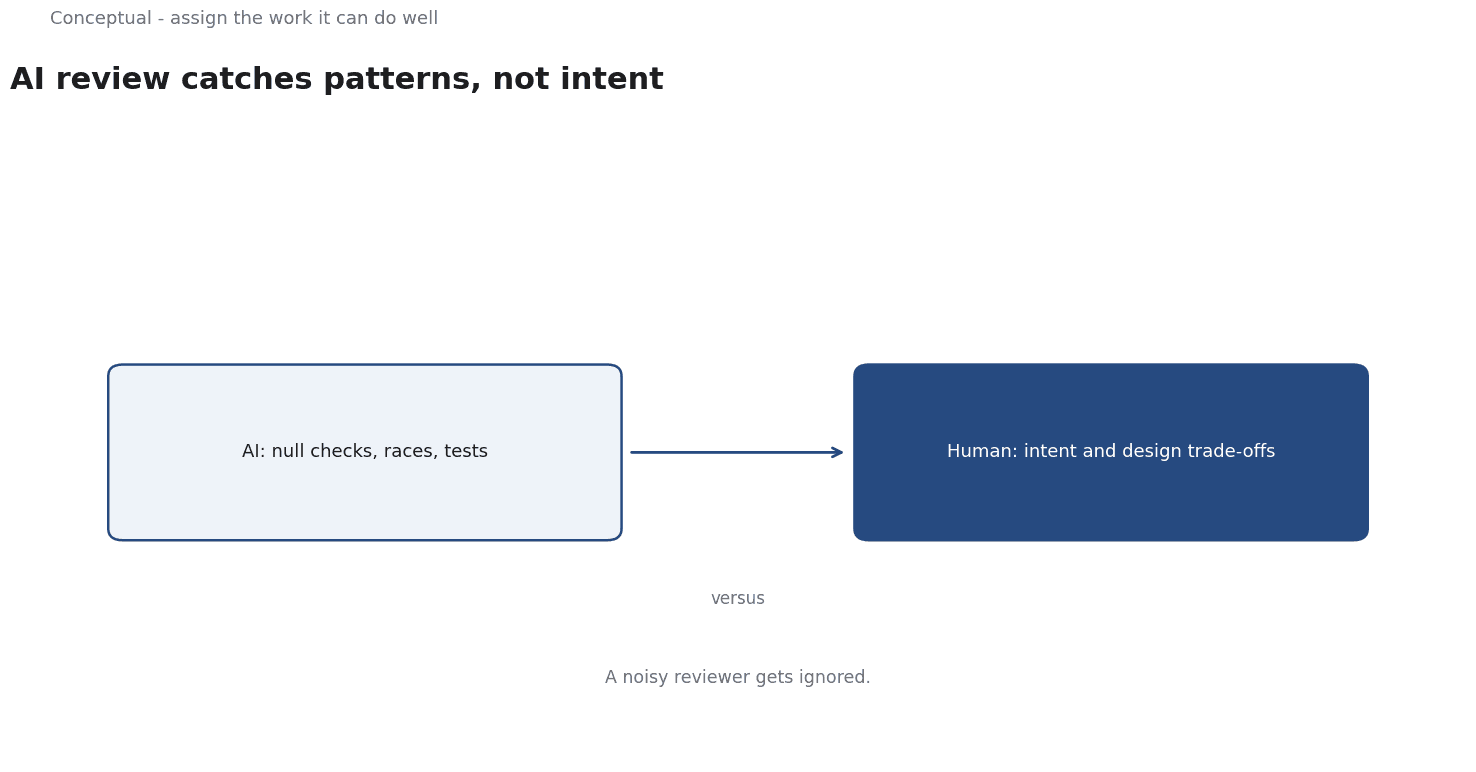
AI review helps on local, well-defined patterns — error handling, common vulnerabilities, style, test coverage — and misses issues that depend on business context, system-wide design, or trade-offs.
What it catches
Local correctness patterns. Missing null checks, unchecked returns, resource leaks, and off-by-one errors are often visible in a diff.
Security smells. Hard-coded secrets, unsanitised input, weak cryptography, and common injection patterns are well-represented in training data.
Consistency. Naming, style, and adherence to project conventions can be checked against examples, as the structured-output article explains for enforcing patterns.
Test coverage gaps. A new branch with no corresponding test is detectable from the diff, even if the test's quality needs a person.
What it misses
Intent. Whether the change solves the problem the ticket described requires context from the ticket, the product, and the users.
Systemic design. A change may be locally correct and accumulate technical debt across the system, as the technical-debt article explains.
Novel bugs. A failure mode nobody has described in text is unlikely to be in the model's pattern library.
Trade-offs. Choosing a simpler implementation with higher latency, or a faster one with more complexity, is a decision, not a pattern.
A worked review workflow
The following is hypothetical and illustrative.
A team adds AI review to its pull-request pipeline on 200 pull requests a month.
Stage 1 — automated suggestions. The AI reviewer comments on error handling, security patterns, and missing tests. Reviewers mark each comment as useful or noise.
Stage 2 — measurement. After 100 pull requests, 300 comments were made; 60% were marked useful. The 40% noise rate is high enough that reviewers are slowing down — a problem the review-fatigue discussion in the human-in-the-loop article warns about.
Stage 3 — tuning. The team restricts the reviewer to security patterns and test coverage, where usefulness was highest, and adds project-specific examples. False positives fall, and review time drops.
Three lessons follow:
- Precision matters more than coverage.
- Scope should follow evidence. The team kept the categories that worked rather than accepting all comments.
- Human review remains the decision point. The AI flags; a person judges, as the oversight article explains.
What to measure
Useful-comment rate — what fraction of suggestions reviewers accept or act on.
Missed-issue rate — measure periodically by having humans review a sample without AI comments, which the evaluation-rubric article recommends for catching false negatives.
Review time — the net effect on the team's cycle time, not the number of comments generated.
Defect escape rate — whether bugs reach production less often after the tool was introduced, which the observability article covers as an outcome metric.
What AI review cannot do
It cannot own a decision. Responsibility for a merge stays with a person, which the governance article requires.
It cannot replace tests. A pattern check is not an execution, as the testing discipline in the MLOps article explains.
It is not free. Inference cost and reviewer time spent dismissing comments are real, as the cost estimator shows.
The counterargument — that AI reviewers will keep improving and replace human review — is plausible at the margin and wrong about responsibility.
Even a highly accurate suggestion system does not hold accountability for a merge.
A decision test
- Choose the review categories — start with security and missing tests.
- Label usefulness of each comment over a sample period.
- Restrict scope to categories that earn their keep.
- Measure human review time and defect escape rate.
- Keep a human decision point on every merge.
- Re-evaluate after a model change, as HELM's cross-model comparisons imply.
- Document the tool's role so reviewers know what it does not do.
For the broader use cases, see What LLMs Actually Solve; for the review design, see Human in the Loop by Design.
References & Further Reading
- Anthropic, 2026. Guides to common use cases - Claude Platform Docs — Production use-case guides for ticket routing, customer support agents, content moderation, legal summarization and commerce agents.
- Percy Liang et al., 2022. Holistic Evaluation of Language Models — HELM's multi-metric framework: 7 metrics across 16 core scenarios, 30 models, and the finding that models were previously evaluated on only 17.9% of shared scenarios.