AI Customer Support Examples
AI customer support examples span drafting, routing, and answers. Read how they map to the full customer experience, a worked example, and a decision test.
AI support is usually introduced by listing tasks a model can perform. The real problem is that these tasks are judged in isolation, while a customer experiences a single journey across many touchpoints. A faster answer can still leave the overall experience worse if the handoff, the accuracy, or the tone is wrong.
Direct answer: Anthropic's use-case guides organize common applications for assistants, including support work such as drafting replies, summarizing conversations, and finding answers from a knowledge base; Wikipedia's customer experience entry describes the overall perception a customer forms across all interactions. The boundary is that an assistant performing a support task well is not the same as improving the experience as a whole.
Delta: This article adds a measurement decision beyond the sources: it maps common support examples to the touchpoints that shape customer experience, with claim status explicit.
The mechanism
Anthropic's documentation groups guidance around common use cases for a Claude assistant, and customer support appears among them. The recurring pattern is that the model contributes to a workflow rather than replacing it: it can draft a reply for an agent to review, summarize a long conversation, classify an incoming request, or retrieve an answer from an approved knowledge base. The practical consequence is that output quality depends on the surrounding system. A good draft is useless if the agent must rewrite it entirely, and a retrieved answer is only as reliable as the source it draws from.
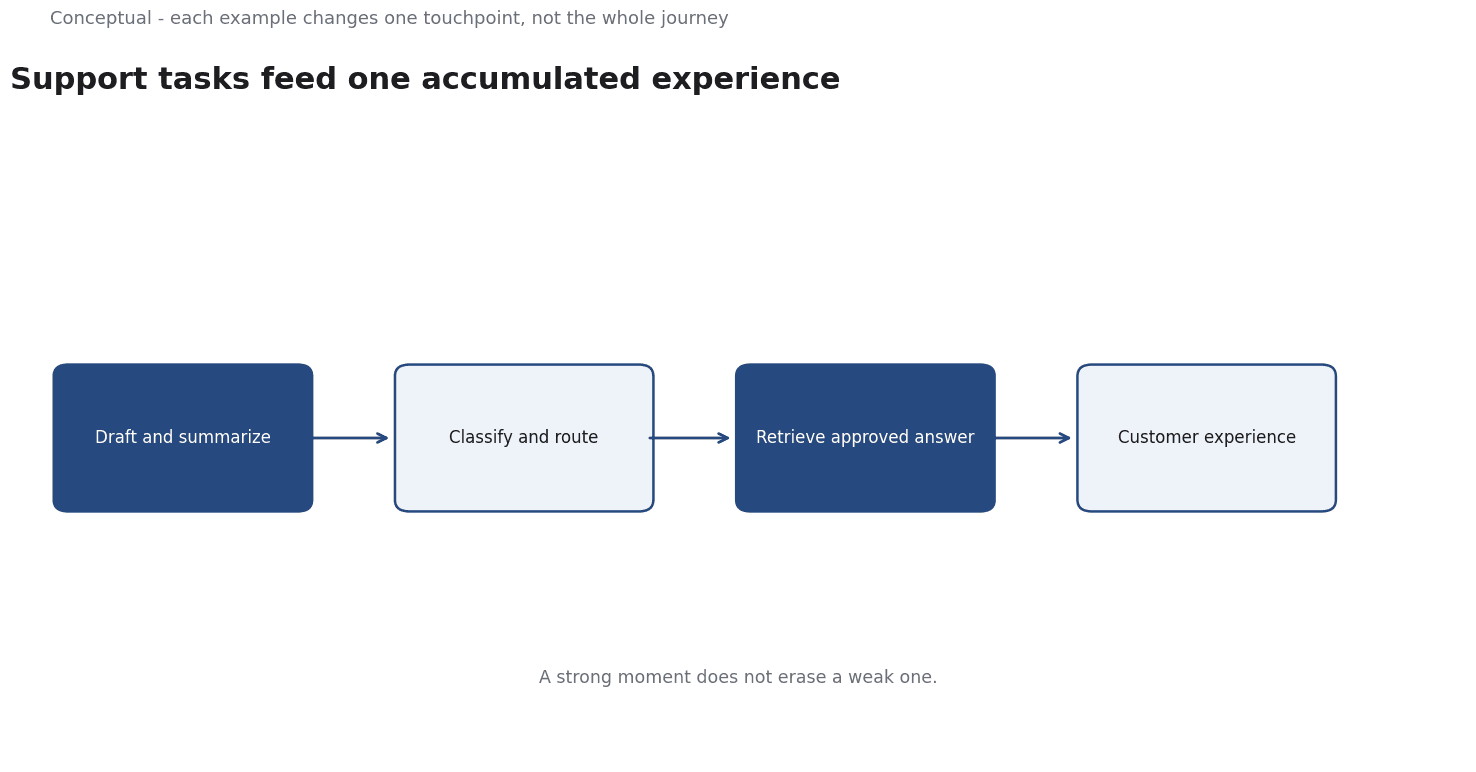
Wikipedia's customer experience entry describes the overall perception and response that results from a customer's interactions with a company.
The mechanism here is accumulation: every touchpoint contributes to a single impression, so a strong moment does not erase a weak one.
The practical consequence is that support cannot be evaluated only by the speed of a reply. A quick answer that sends a customer into a transfer loop, or that states something confidently and wrongly, can damage the total experience even while a task-level timer shows improvement.
Combining the sources means mapping each example to the touchpoint it changes. Drafting and summarization affect how fast and how consistently an agent responds. Routing affects how long a customer waits before reaching the right person. Self-serve answers affect whether a question is resolved without a human at all. Each of these has a distinct failure mode and a distinct measure, so bundling them under one label of support hides where a problem actually sits.
The decision that follows is about where the experience is breaking. If the complaint is a slow first response, routing and drafting may help most. If the complaint is incorrect information, grounding answers in an approved knowledge base and keeping a review step matter more. The sources describe the tools and the goal; choosing which example to adopt requires locating the weak touchpoint first, then matching the tool to it.
A worked example
The following is hypothetical and illustrative. A support team handles a high volume of repetitive questions and wants to shorten first response time. Three checks structure the trial. First, the grounding check: does each suggested answer come from an approved knowledge base, and can the source be inspected before the reply is sent? Second, the escalation check: is there human review on sensitive topics and a clear path to a person when the assistant is uncertain? Third, the outcome check: does the change reduce first response time or transfer rate without lowering satisfaction scores? The outcome is that drafting and routing are introduced for common questions with review retained, and satisfaction is monitored across the whole journey. The limitation is that a confident but wrong answer can erode trust faster than a slow human reply, so speed alone is an unsafe measure.
Evidence status
| Claim | Status | Source | Verified | Recheck when |
|---|---|---|---|---|
| Assistants can draft, summarize, and retrieve answers in support use cases | source-reported | Claude Platform Docs | 2026-11-18 | the documented use cases change |
| Customer experience is the overall perception formed across interactions | source-reported | Customer experience - Wikipedia | 2026-11-18 | the entry's definition is revised |
| Support automation should be judged by its effect on the whole experience, not task speed | inferred | Derived from the sources | 2026-11-18 | measurement approach or product changes |
The first two rows report what the sources state directly and can be checked against them. The third is an inference: it follows from combining a set of support tasks with a multi-touchpoint view of experience, but neither source states it as a rule. Recheck conditions point back to the sources or to changed measurement, so each row's status remains explicit rather than implied.
What it cannot do
An assistant cannot repair a product that is the real source of dissatisfaction. Customer experience is formed across the whole journey, and support is only one touchpoint within it. A perfect reply to a customer whose underlying problem keeps recurring will not improve the overall perception. The sources make this boundary clear: one documents support tasks, and the other describes an experience built from every interaction. Claiming that better support answers automatically produce a better experience overstates the connection.
The hidden cost sits in the system around the model. Knowledge bases must be maintained, suggested answers need review, and agents require training on when to trust or override a draft. Integration into existing tools takes work that does not appear in a list of use cases. A model is only as reliable as the content it draws from, so an out-of-date knowledge base turns a fast answer into a fast error. The expense is not the model call but the ongoing discipline that keeps its output grounded.
A characteristic failure mode is confident incorrectness.
Related failures include the loss of empathy on sensitive issues and a handoff loop in which the customer repeats information to each new channel. Each of these can raise a task-level success rate while lowering satisfaction, which is why task metrics alone are a misleading guide.
The boundary of the sources is worth stating plainly. They offer a set of documented applications and a definition of customer experience; they do not provide validated performance figures, a guarantee of improved satisfaction, or a rule for deployment. Any specific claim about how much an assistant will improve support would be an invention. What the sources support is a way of mapping tasks to touchpoints, not a promise about outcomes.
Because content, models, and expectations all move, the setup needs scheduled review. A knowledge base drifts as products change, model behavior shifts with updates, and customers grow used to a new baseline of speed. A practical cadence is to revisit the approved sources, the review rules, and the experience measures together, recording which change prompted each adjustment. Without that review, the assistant keeps producing answers that were correct for an earlier version of the product.
The counterargument that AI support devalues the human touch is fair for emotionally sensitive cases and incomplete for routine, high-volume questions where speed and consistency dominate the customer's judgment.
A decision test
- Identify which touchpoint in the journey is actually failing.
- Match one support example to that touchpoint.
- Ground suggested answers in an approved, inspectable source.
- Define when a human must review or take over.
- Measure the whole experience, not only task speed.
- Check that escalation works without repeating the customer's information.
- Schedule review of sources, review rules, and measures together.
These steps connect a list of examples to the experience they are meant to improve. The mapping from support tasks to customer touchpoints is what makes the choice reviewable rather than a matter of enthusiasm. A passed test leaves a defined touchpoint, a grounded answer source, a working escalation path, and a measure that reflects the whole journey.
For further reading, see Voice of Customer: Turning Feedback Into Decisions.
References & Further Reading
- Anthropic, 2026. Guides to common use cases - Claude Platform Docs — Production use-case guides for ticket routing, customer support agents, content moderation, legal summarization and commerce agents.
- Wikipedia contributors, 2026. Customer experience - Wikipedia — The overall perception customers form across interactions.