Voice of Customer: Turning Feedback into Decisions
Collecting feedback is easy; using it is not. Read the loop from signal to decision, a worked example, and why volume is not value.
Organisations collect enormous amounts of customer feedback and often act on very little of it. The gap is not storage — it is the absence of a loop that turns a comment into a decision with an owner. Voice of customer is a discipline about that loop, not a dashboard of quotes.
Direct answer: Turn feedback into decisions by grouping it into themes, linking each theme to a decision and an owner, and checking whether the change affected the outcome. AAPOR's standards govern any survey used, and the demand-generation article explains which decision a piece of feedback relates to. The boundary: a customer quote is evidence of one experience, not a directive, and acting on the loudest voice without a pattern is a common failure, as the NPS article warns about over-reading a single score.
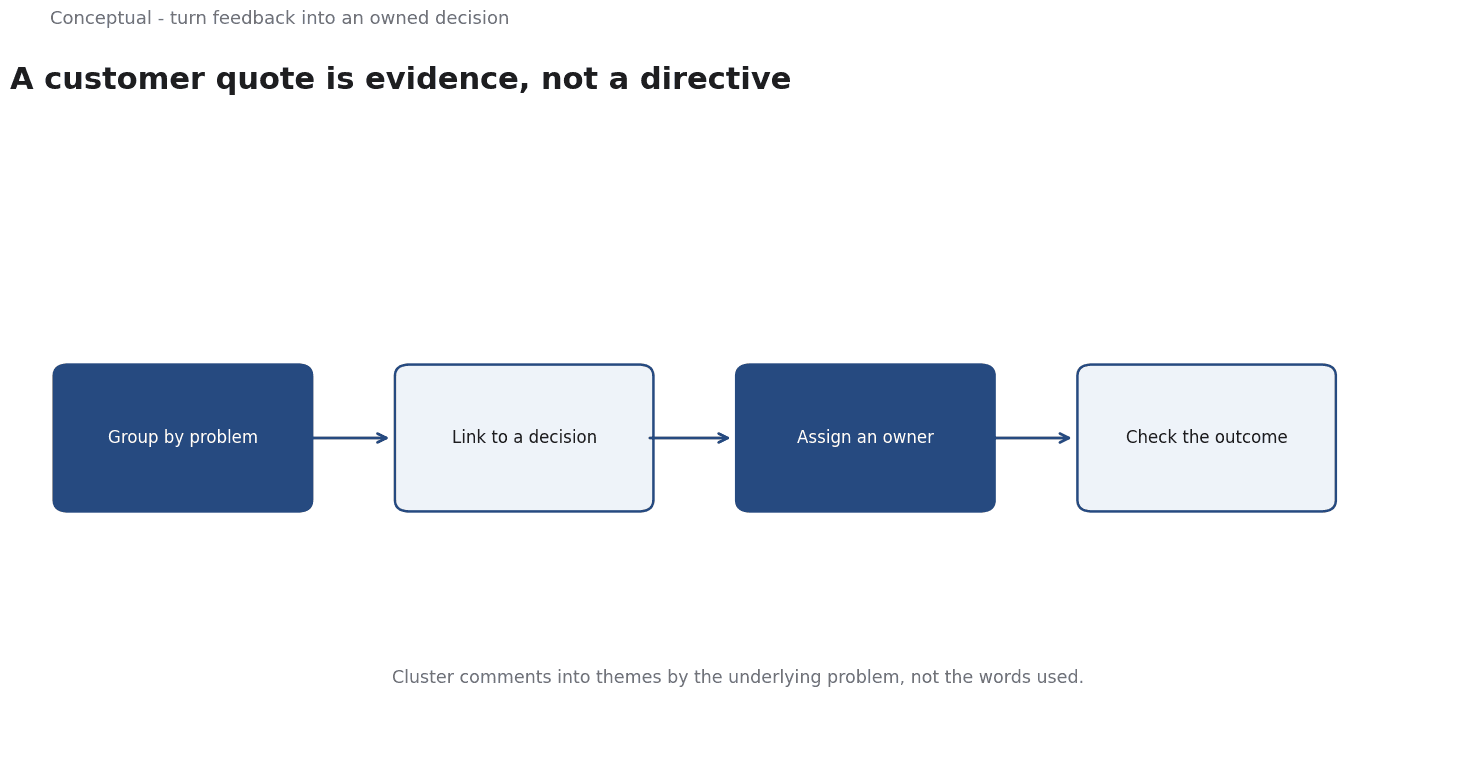
The loop
Collect. Gather feedback from support tickets, reviews, surveys, and interviews. Each source has a bias — surveyed respondents self-select, as AAPOR's standards require you to state — so treat them as different signals, not one pool.
Group.
Cluster comments into themes by the underlying problem, not by the words used.
The clustering step is where interpretation enters, which the evaluation-rubric article argues for making explicit.
Decide. For each theme, name the decision it informs and who owns it. A theme with no decision is an observation, as Decision Memos That Survive Review requires for a record that changes something.
Verify. After a change, check whether the theme diminished, which the monitoring article treats as a measured outcome rather than an assumption.
A worked example
The following is hypothetical and illustrative.
A product team reads 1,000 support tickets and 200 survey responses in a quarter. Three themes emerge: confusing setup, slow export, and missing integration.
Three decisions follow:
- Setup has 300 mentions and blocks activation, which the customer-success article treats as the first value moment. It gets an owner and a 90-day target, as Decision Memos That Survive Review recommends.
- Export has 80 mentions and affects a high-value segment, which the customer-segmentation article argues for weighting by real difference. It gets a smaller fix.
- Integration has 40 mentions from one large customer. It is logged but not prioritised, which the risk-assessment article treats as a decision with stated reasoning.
Verification after the quarter: setup mentions fall by 60%, export mentions by 20%, and activation improves for the relevant cohort, as the funnel article recommends for stage metrics.
Three conclusions follow:
- Themes are prioritised by impact and segment, not by raw count, which the NPS article warns about for averages.
- Each theme has an owner, which the governance checklist requires.
- The result is checked, which the monitoring article treats as closing the loop.
Closing the loop with customers
A programme that collects feedback without telling anyone what changed loses participation. Three practices keep the loop alive:
Acknowledge receipt. A short note that feedback was received and read sets the expectation that it may lead somewhere, which the reputation article recommends for public responses.
Report back. When a theme leads to a change, tell the people who raised it, which the retention article treats as closing the loop on an issue.
Show the record. A visible list of what changed and what did not, with reasons, gives participants a reason to keep contributing, as Decision Memos That Survive Review recommends for recorded decisions.
These practices are cheap and determine whether the next round of feedback is as useful as the last, which the survey standards treat as a matter of maintaining a relationship with respondents.
What voice of customer cannot do
It cannot decide strategy.
Customers describe problems; they do not choose the market, which the strategy article argues is a leadership decision.
It is self-selected.
It is not the same as behaviour. What people say they want differs from what they use, which the product-analytics article argues for observed metrics.
The counterargument — that customers know what they need — is partly true for problems and unreliable for solutions, which the startup-validation article distinguishes as a reason to test rather than ask.
A decision test
- State the source and its bias for every signal, as AAPOR's standards require.
- Group by underlying problem, as the evaluation-rubric article recommends for themes.
- Link each theme to a decision and an owner, as Decision Memos That Survive Review requires.
- Prioritise by impact and segment, not count, as the segmentation article advises.
- Check outcomes after a change, as the monitoring article recommends.
- Pair stated feedback with behaviour, as the product-analytics article argues.
- Review the loop quarterly with a record, which the governance checklist requires.
For the survey standard, see AAPOR; for the decision record, see Decision Memos.
References & Further Reading
- American Association for Public Opinion Research, 2026. AAPOR — The professional association for public opinion and survey research; its standards and resources underpin the survey-design discussion.
- Wikipedia contributors, 2026. Demand generation - Wikipedia — An overview of demand generation as a marketing discipline distinct from lead generation; secondary reference used with the lead-generation entry.