AI for Agriculture Checklist
Farm AI works on bounded tasks with local evidence. Read the checklist, a worked example, and why a global model cannot replace a field trial.
AI in agriculture is often sold as a general transformation, which obscures the bounded tasks where it actually works. The precision-agriculture entry describes sensing and varied action in farming, and the FAO material covers digital tools in the sector. The checklist starts with the task and its local conditions.
Direct answer: Apply AI to a defined agricultural task with local validation, dated data, and a person responsible for the decision. The sources describe the practice; the checklist is a synthesis.
Delta: This article adds a claim-status table and a worked example, separating documented tools from the local choices about validation and use.
The mechanism
Three checks matter:
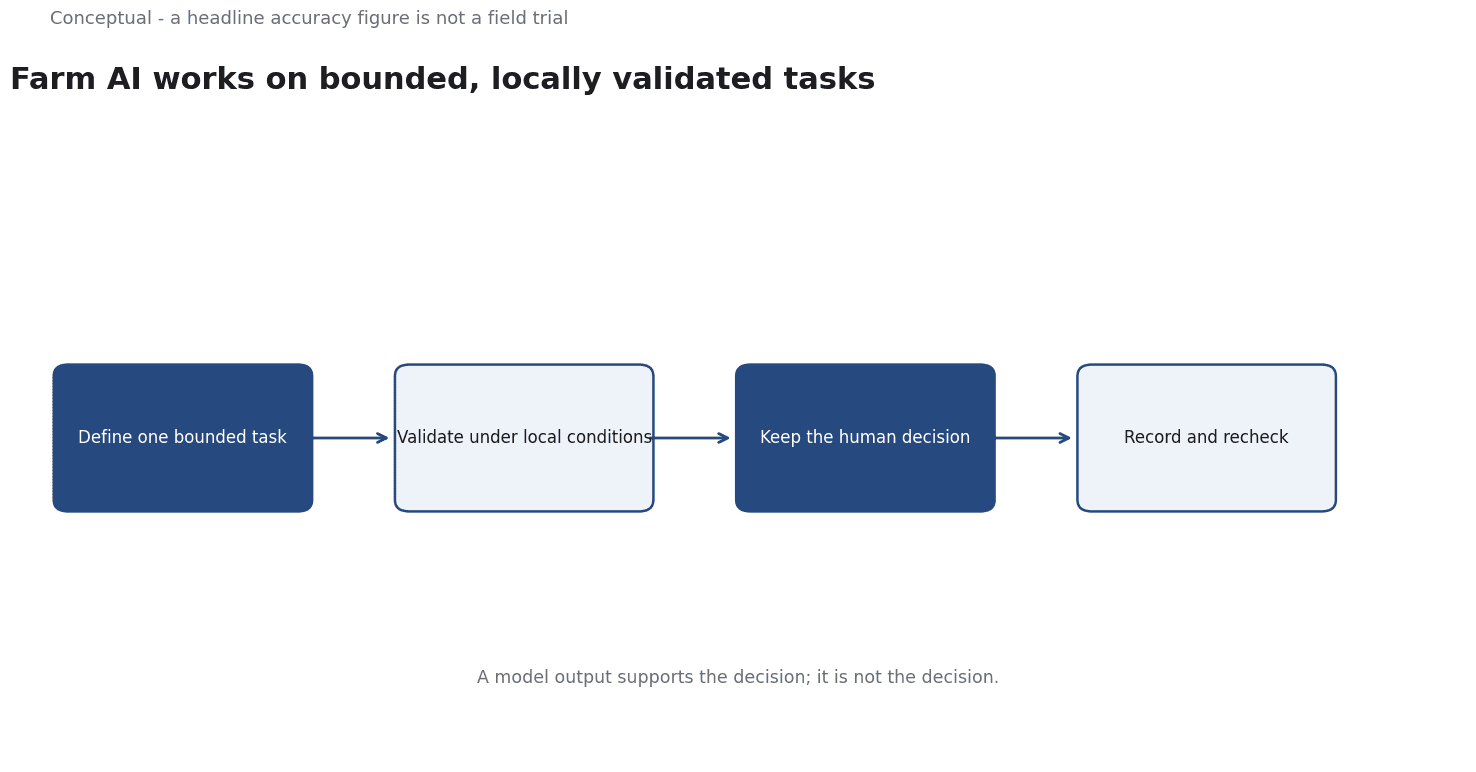
- The task is bounded. The precision-agriculture entry describes sensing and targeted action. Disease detection and input scheduling are different tasks with different evidence needs.
- Conditions are local. A model trained elsewhere may not transfer to a different crop, season, or climate. The FAO material describes digital tools, not a guarantee of local accuracy.
- The decision stays with a person. A model output is support for a decision, not the decision itself.
The sequence is: define the task, validate locally, keep the human decision, then record the result.
Local validation is judgement, so it is inferred; the tools are source-reported.
A worked example
Illustrative. A tool claims high accuracy detecting a crop disease from leaf photos in a trial elsewhere.
Three checks decide. First, do the trial conditions resemble the local fields? Second, what is the cost of a false positive or a false negative in this crop? Third, who makes the treatment decision, and what happens when the tool is uncertain?
The outcome is a local validation plan. The scenario is hypothetical; the check sequence is the contribution.
Why local validation comes first
A headline accuracy figure is a property of a dataset, not of a field. It tells you how a model performed under the conditions someone else recorded. A field trial with local crops, lighting, and disease pressure answers the question the operator actually has, even if the sample is small.
The cost of errors decides how much validation is enough. A false positive that leads to an unnecessary treatment is different from a false negative that lets a disease spread. Recording which error matters more turns a vague accuracy target into a decision about acceptable risk.
Why the human decision remains
A model output can support a decision, but the responsibility for acting belongs to the grower. That distinction matters when the tool is uncertain or when local knowledge contradicts it. An escalation path is part of the design, not a sign that the model failed. Recording when it was used provides evidence for the next season.
Evidence status
| Claim | Status | Source | Verified | Recheck when |
|---|---|---|---|---|
| Precision agriculture uses sensing and varied action | source-reported | Wikipedia, Precision agriculture | 2026-11-18 | Practice changes |
| Digital tools are available in agriculture | source-reported | FAO e-Agriculture | 2026-11-18 | Programmes change |
| Validate locally before use | inferred | Derived from condition differences | 2026-11-18 | Season or crop changes |
Why a global model is not a local trial
A local trial is the only way to learn whether the tool works where it will be used. It can be small, but it must include the conditions the operator actually faces.
Another constraint is data provenance. A recommendation based on sensor readings or images is only as reliable as the records behind them, and a missing timestamp can make a local validation impossible to reconstruct. Recording the source and date of the data is therefore part of the checklist, not a separate documentation task.
The checklist also needs a review trigger. Crops, seasons, and varieties change, and a tool validated in one season may not hold up in the next. A short note stating what would require a new trial is more useful than a one-time approval, because it turns the decision into something that can be revisited when conditions change.
The result of each local trial should be kept with its conditions, so the next season can compare like with like rather than starting again.
A recorded trial is more useful than a remembered impression, especially when the next decision has to be made by someone else.
What it cannot do
It cannot guarantee a yield. It does not remove the need for agronomic knowledge. And it cannot replace local evidence with a headline accuracy figure.
The counterargument that a global model removes the need for trials is fair for general patterns and incomplete for local decisions.
A decision test
- Define one bounded task.
- Validate under local conditions.
- Use dated data.
- Weigh the cost of errors.
- Keep the decision with a person.
- Record the result and the recheck trigger.
For the broader context, see AI for Agriculture: Common Questions.
References & Further Reading
- Wikipedia contributors, 2026. Precision agriculture - Wikipedia — How sensing, data and automation are applied to farming.
- FAO, 2026. e-Agriculture - Food and Agriculture Organization of the United Nations — Primary source on digital tools in agriculture.