AI for Agriculture: Common Questions
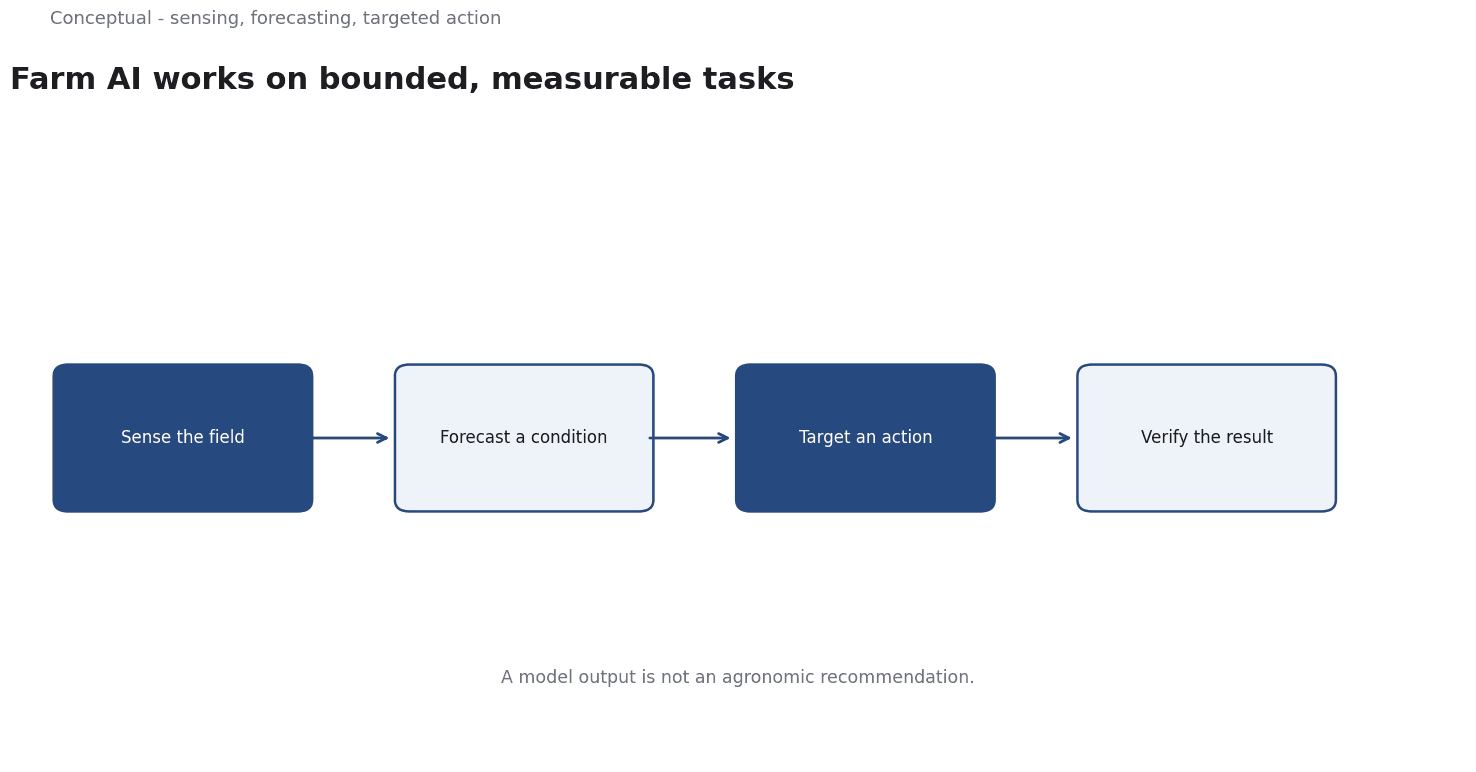
Farm AI works on bounded, measurable tasks. Read the common questions, a worked example, and why a model is not an agronomic recommendation.
AI in agriculture is often presented as a general transformation, which obscures the actual applications: sensing, forecasting, and targeted intervention on defined tasks. Precision agriculture is the practice of using data to vary actions across a field, which the precision-agriculture entry explains, as the FAO e-agriculture material covers digital tools in the sector, as the industry lens requires scope and limits.
Direct answer: Use AI in agriculture for bounded tasks with measurable outcomes — detection, estimation, scheduling — with local validation and a human decision. The precision-agriculture entry provides the practice context, and FAO covers digital tools. The boundary: this is educational orientation, not agronomic advice — conditions, crops, and regulations differ by region and season, as the data-governance article requires sources and dates, as the publication standard forbids guaranteed outcomes.
Common questions
What can AI actually do on a farm? Detect disease or pests from images, estimate yield, and support irrigation or input scheduling, which the precision-agriculture entry describes for sensing and variable action, as the FAO material covers digital tools, as the evaluation-rubric article requires for concrete measures.
Does a model transfer between regions? Not necessarily. Conditions, crops, and practices differ, which the benchmarks article warns about applying results beyond their conditions, as the embedding-selection article advises for local evaluation, as the data-governance article requires for dated data.
Who makes the decision? The grower, which the human-in-the-loop article treats as meaningful review, as the AI-safety article treats the system as a support, as the decision-memo article requires for a recorded judgement.
A model output is not a recommendation by itself, as the legal and safety articles treat high-impact decisions as formal.
What data is needed? Local, dated observations with a source, which the data-governance article requires, as the data-quality article warns about bad inputs, as the FRED-style discipline of dated series applies to external data, as the monitoring article advises for review on change.
Three consequences follow. The task should be narrow and measurable, as the rubric article requires. Local validation should precede use, as the benchmarks article advises. And the decision should remain with a person, as the oversight article requires, as the decision-memo article requires for a record.
A worked example
The following is hypothetical and illustrative. A tool claims to detect a crop disease from leaf photos with high accuracy in a trial.
Three checks decide whether to use it. First, was the trial conducted under conditions comparable to the local farm, as the benchmarks article asks, with a dated source, as the data-governance article requires? Second, what is the cost of a false positive or a false negative, as the risk-assessment article requires, with a measure tied to the decision, as the evaluation-rubric article requires? Third, does a grower review the result before acting, as the oversight article advises, with a record of the decision, as the decision-memo article requires?
Three conclusions follow.
The cost of an error matters more than the headline score, as the risk article requires. And the decision stays with a person, as the oversight article advises, as the FAO material treats digital tools as support.
What agricultural AI cannot do
It cannot remove local uncertainty, which the risk-assessment article requires you to state, as the benchmark article warns about transfer, as the publication standard forbids guaranteed outcomes. It does not replace agronomic knowledge, which the human-in-the-loop article treats as the decision-maker's role, as the FAO material covers tools rather than judgement. And it cannot guarantee a yield, which the publication standard forbids claiming, as the industry lens requires scope.
The counterargument that a global model removes the need for local trials is fair for general patterns and wrong for local decisions, which the worked example shows, as the benchmarks article advises.
A decision test
- Define one bounded task with a measure, as the rubric article requires.
- Check that evidence matches local conditions, as the benchmarks article advises.
- Source and date all data, as the data-governance article requires.
- Weigh the cost of errors, as the risk-assessment article requires.
- Keep the decision with a grower, as the oversight article advises.
- Check current regional rules, as the legal article requires.
- Record the decision and review on change, as the decision-memo article requires.
For the practice, see AI for Agriculture Checklist; for the boundary, see Human-in-the-Loop by Design.
References & Further Reading
- Wikipedia contributors, 2026. Precision agriculture - Wikipedia — How sensing, data and automation are applied to farming.
- FAO, 2026. e-Agriculture - Food and Agriculture Organization of the United Nations — Primary source on digital tools in agriculture.