AI for Cybersecurity Metrics that Matter
AI can correlate security events, not decide what they mean. Read the metrics, a worked review, and why alert count is a poor measure.
AI is added to security tooling to find patterns in large event streams, which sounds like a clear win. The SIEM entry describes collection and correlation, as the NIST incident-handling guide covers the response lifecycle, as the alert-fatigue literature treats noise as a failure, as the observability article treats signals as evidence, as the risk article requires residual risk.
Direct answer: Wikipedia's SIEM entry provides the structure, and NIST SP 800-61 covers handling. The boundary: no tool guarantees security, which the publication standard forbids claiming, as the red-teaming article treats testing as partial, as the risk article requires residual risk.
Judge AI security tooling by detection quality, false-positive rate, and response time against a defined threat set — not by the number of alerts.
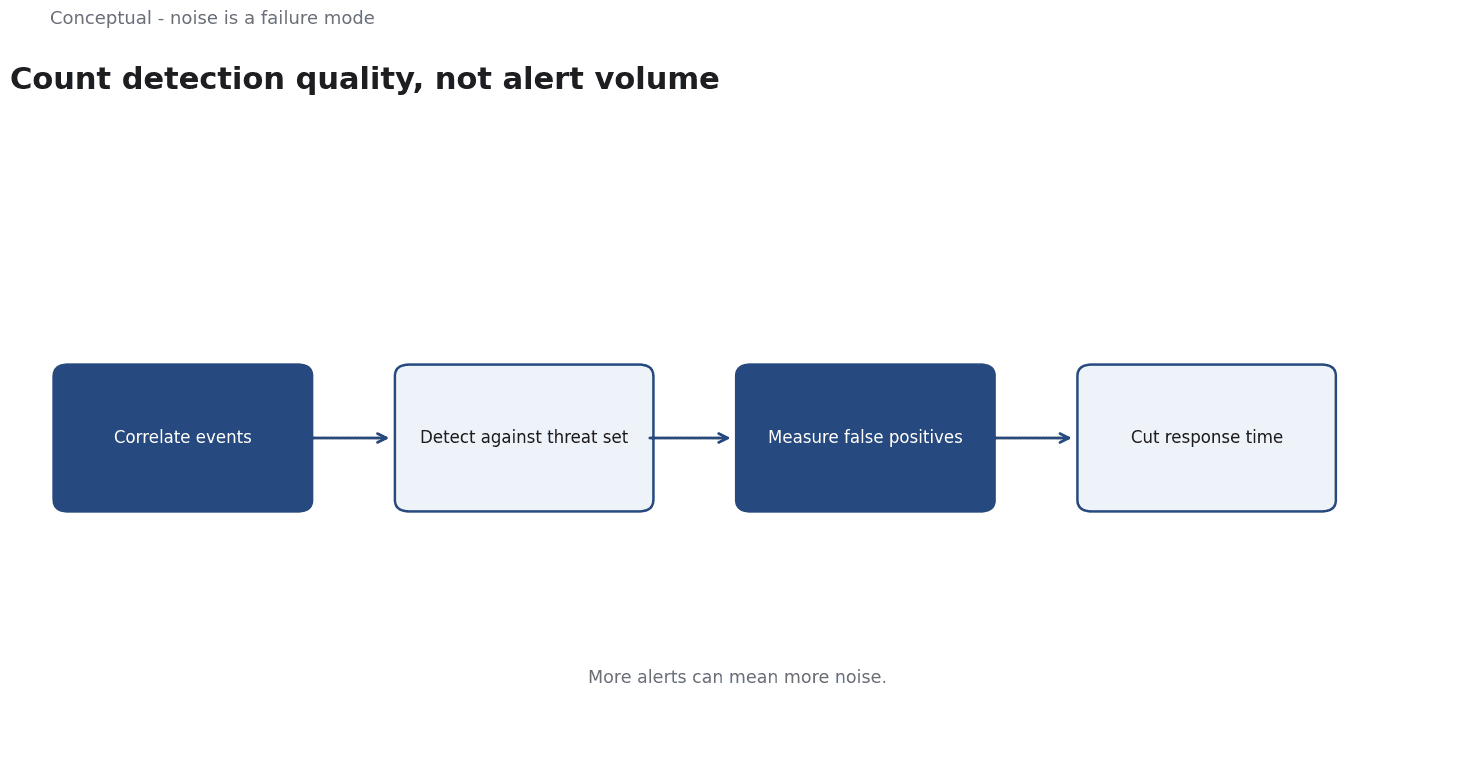
The metrics
Detection quality. Which of a defined set of scenarios does the system detect, which the evaluation-rubric article requires for concrete criteria, as the SIEM entry describes correlation, as the benchmarks article warns about easy cases, as the data-governance article requires dated data, as the risk article requires residual risk.
False positives. A noisy system shifts work to responders, which the alert-fatigue literature treats, as the SRE alerting workbook ties signals to objectives, as the SIEM evaluation article advises, as the dashboard article argues for metrics tied to decisions, as the rubric article requires for criteria, as the monitoring article advises for review.
Response time. Detection without action is limited, which the NIST guide treats as part of the lifecycle, as Site Reliability Engineering: SLOs, Error Budgets, and Incident Response requires for containment, as the approval-gates article places a boundary on high-impact actions, as the decision-memo article requires for a record, as the governance checklist requires an owner.
Cost and provenance. Each tool has licensing and tuning costs, which the cost estimator requires, as the SIEM evaluation article advises, as the data-governance article requires for provenance, as the observability article treats signals as evidence, as the risk article requires residual risk, as the rubric article requires concrete criteria.
Three consequences follow. The threat set should be defined before evaluation, as the rubric article requires, as the SIEM evaluation article advises, as the benchmarks article warns, as the data-governance article requires dated figures, as the monitoring article advises for review, as the decision-memo article requires for a record, as the risk article requires residual risk, as the NIST guide treats the lifecycle, as Site Reliability Engineering: SLOs, Error Budgets, and Incident Response requires containment, as the approval-gates article sets a boundary.
A worked review
The following is hypothetical and illustrative. A team evaluates an AI security add-on against twenty incident scenarios.
Three checks decide. First, how many scenarios were detected and how many false positives appeared, as the rubric and SIEM evaluation articles require, with a measure tied to an objective, as the SRE workbook advises? Second, could responders act on each alert, as the NIST guide and incident article require, with provenance, as data governance requires? Third, what are the licensing and tuning costs, as the cost estimator requires, with residual risk, as the risk article requires, as the decision-memo article requires for a record?
Three conclusions follow. Response context matters, as the NIST guide advises. And the decision should be recorded with residual risk, as the decision-memo and risk articles require.
What AI security metrics cannot do
They cannot prove security, which the publication standard forbids claiming, as the red-teaming article treats testing as partial, as the risk article requires residual risk. They do not guarantee detection of future threats, which the benchmarks article warns about, as the monitoring article advises for change, as the data-governance article requires dated figures, as the decision-memo article requires a reversal condition. And they cannot replace response, which the NIST guide treats as a lifecycle, as Site Reliability Engineering: SLOs, Error Budgets, and Incident Response requires containment, as the approval-gates article sets a boundary, as the governance checklist requires an owner.
The counterargument that more alerts mean better coverage is fair for breadth and incomplete for false positives, which the worked review shows, as the SRE workbook and SIEM evaluation article advise, as the dashboard article argues for metrics tied to decisions, as the rubric article requires criteria, as the risk article requires residual risk.
A decision test
- Define a threat set, as the rubric article requires.
- Measure detection and false positives, as the SIEM evaluation article advises.
- Tie signals to objectives, as the SRE workbook advises.
- Check response context, as the NIST guide advises.
- Count costs, as the cost estimator requires.
- Source and date the data, as data governance requires.
- Record the decision and residual risk, as the decision-memo and risk articles require.
For the tool, see How to Evaluate SIEM; for the lifecycle, see Incident Response.
References & Further Reading
- Wikipedia contributors, 2026. Security information and event management - Wikipedia — How SIEM systems collect and correlate security events.
- Paul Cichonski, Thomas Millar, Tim Grance, Karen Scarfone (NIST), 2012. SP 800-61 Rev. 2, Computer Security Incident Handling Guide — The incident-response capability lifecycle: preparation, detection and analysis, containment/eradication/recovery, and post-incident activity.