AI for DevOps for Small Teams
AI assists small-team DevOps where human review stays in the loop. Read the mechanism, a worked example, the evidence table, and the limits of automating operations.
Small DevOps teams are often told that AI will automate away toil, but the binding constraint is rarely how fast a task can be generated. It is who stays accountable when an automated suggestion enters a deployment pipeline. The DevOps literature describes shared ownership and continuous delivery, while the Anthropic use-case guides describe what an assistant can draft and summarize; the real problem is deciding where generation ends and review begins.
Direct answer: AI for DevOps on a small team means delegating low-risk drafting, explanation, and summarization while keeping deployment decisions and system ownership with people. The sources describe DevOps practice and the assistant's documented use cases; the delegation boundary is a synthesis, not a source claim. An assistant can draft a runbook, but it cannot own the failure that runbook is meant to prevent.
Delta: This article adds a claim-status table and a delegation test beyond the sources: it maps each AI use case to a deployment decision, with claim status explicit.
The mechanism
DevOps is described as a set of practices that combines software development and IT operations, with the goals of shortening the development lifecycle and delivering software continuously at high quality. The literature treats it as both a tooling pattern and a cultural one: automation is paired with measurement, sharing, and shared ownership of the path from commit to production. The practical consequence for a small team is that DevOps is a feedback system, not a stack of scripts. A change is valuable only if the team can see its effect and correct it quickly. Any tool that hides or delays that feedback works against the practice, regardless of how much time it appears to save.
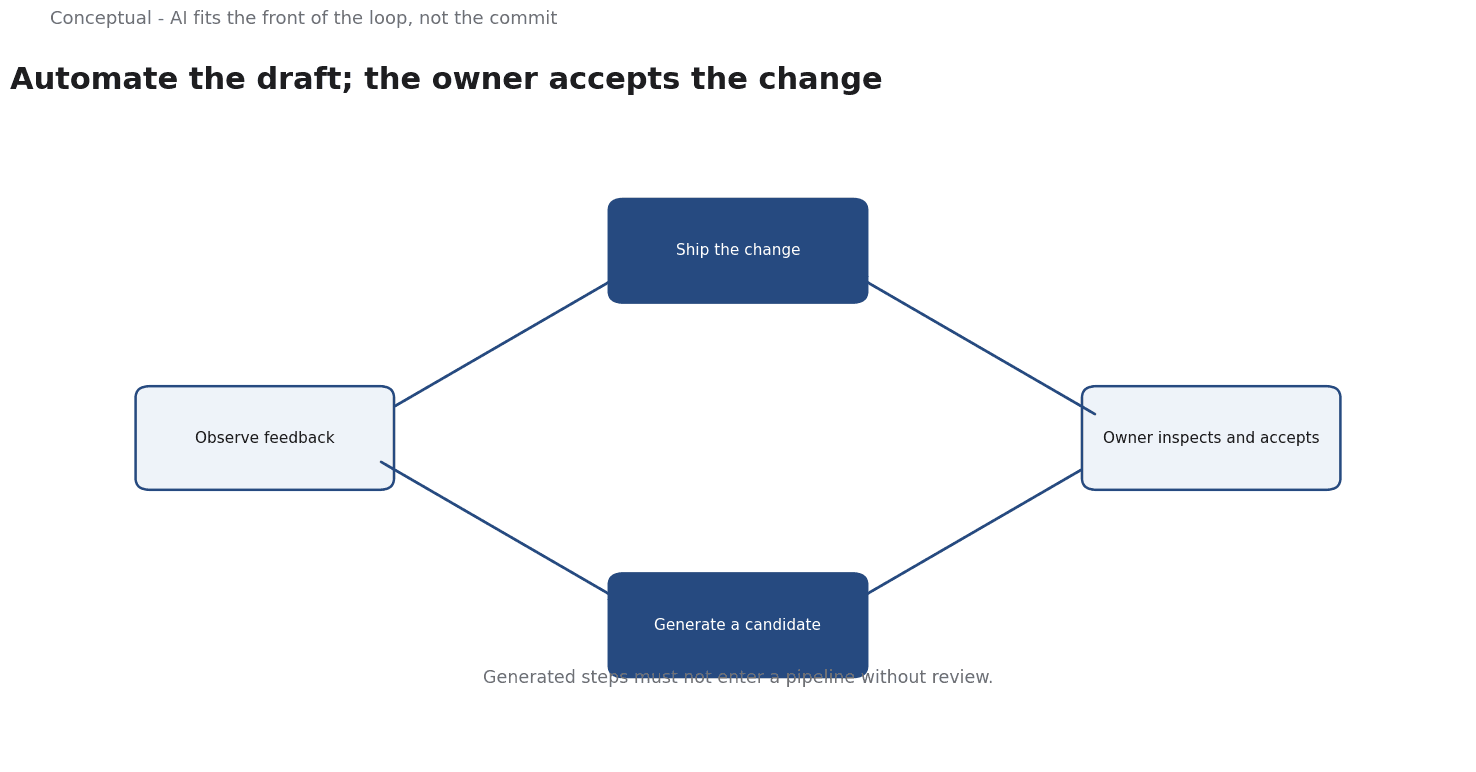
The Anthropic use-case guides document tasks an assistant can perform, including generating and editing text, explaining material, summarizing information, and helping with code. These are drafting and sensemaking tasks: they produce a candidate artifact that a person can inspect. The practical consequence is that the assistant fits naturally at the front of a workflow, where a first draft, a log summary, or an explanation of a configuration change reduces the blank-page cost. It does not fit at the point where a decision must be committed, because the guides describe assistance with work, not assumption of responsibility for a system.
The two sources meet at a boundary neither states explicitly. DevOps assigns accountability for the production path to the team; the use-case guides assign generation to the assistant. A generated incident summary is useful because an engineer reads and corrects it; a generated deployment step is dangerous if it enters a pipeline without review. The rule is inferred, because neither source prescribes a specific delegation for a specific team. It should be recorded as a local decision and revisited when the team's risk profile changes.
Combining them gives a rule: automate the production of candidates, keep the acceptance of candidates with an owner.
The output is a small delegation map: for each recurring task, who generates the candidate, who accepts it, and what evidence is required before acceptance. That map, rather than a count of automated steps, is the decision instrument. It shows where AI shortens a feedback loop and where it would sever one. A team that can name the reviewer for each generated artifact can audit its own automation later, because the boundary and its reason are recorded together.
A worked example
The following is hypothetical and illustrative. A three-person team wants to use an assistant in its release process. Three checks decide the delegation. First, does the task produce a candidate that a person can inspect before it matters, or does it act directly on production? Second, who is the named owner who accepts the output? Third, if the output were wrong, would the feedback loop catch it before users were affected? The team applies the assistant to draft release notes and summarize a failed build log, with the on-call engineer accepting both. It does not apply the assistant to merge changes or alter deployment configuration. The outcome is time saved on drafting with the acceptance step intact. The scenario is hypothetical; the verification method is the contribution.
Evidence status
| Claim | Status | Source | Verified | Recheck when |
|---|---|---|---|---|
| DevOps combines development and operations around continuous delivery | source-reported | Wikipedia, DevOps | 2026-11-18 | Entry revised |
| The use-case guides document drafting, explaining and summarizing tasks | source-reported | Anthropic, Use case guides | 2026-11-18 | Guide updated |
| Delegate candidate generation and keep acceptance with an owner | inferred | Derived from the sources | 2026-11-18 | Team risk profile changes |
The first two rows restate claims the sources make directly. The third is an inference about where generation should stop, because neither source assigns a specific task to a specific team. Recheck the first row when the DevOps entry changes, the second when the guide is updated, and the third whenever the team's ownership or risk profile changes.
What it cannot do
A delegation map does not make an automated suggestion correct. It establishes who generates a candidate and who accepts it, but the accepted output can still be wrong. The sources describe DevOps practice and the assistant's documented use cases; neither supplies a method for verifying the truth of a generated artifact. Treating a reviewed draft as a validated one is a category error: review answers whether a person inspected the output, not whether the output is accurate. A team that needs assurance about a generated configuration or summary must verify it against the system itself, not against the fact that it was reviewed.
The hidden cost is that review does not scale down as easily as generation does. An assistant can produce ten candidate runbooks in the time it takes a person to write one, but the team still has to read ten. For a small team, the bottleneck moves from production to acceptance, and the apparent speedup can disappear under the weight of checking. That asymmetry is why a delegation map is more useful than an automation target: it forces the team to count reviewer attention as a finite resource and to automate only where acceptance is cheap.
A task that begins with a human accepting each output gradually becomes one where outputs are accepted by default, because the review step feels like friction. When that happens, the feedback loop that DevOps depends on is broken: errors reach production before anyone interprets them. The sources do not describe this drift, so it must be watched locally. A defensible practice records which tasks require explicit acceptance and treats any move to default acceptance as a decision that needs its own review.
There is a boundary around the method. It covers tasks where a candidate can be inspected before it matters, not actions that change a live system irreversibly. It does not validate a deployment, restore a broken service, or replace the on-call judgment that a production incident demands. It does not supply domain knowledge; it draws on the team's knowledge to decide what to delegate. A delegation map cannot tell an engineer whether a change is safe; it can only show whether the decision to generate and accept that change was made deliberately.
Because both the practice and the tooling evolve, the map needs a refresh. Each delegated task should carry a recheck condition, and the acceptance rule should be treated as a local decision rather than a value the sources provide. Product updates can change what an assistant does reliably, and a change in team size changes how much review capacity exists. Without that record, a future reviewer cannot tell which tasks were delegated deliberately and which were automated by default. The map will still exist; the reasoning behind each boundary is what makes it reviewable.
The counterargument that AI delegation is fair for routine drafting is incomplete when the same assistant is quietly put in charge of deployment actions.
A decision test
- List the recurring tasks in the release path.
- Mark which tasks produce an inspectable candidate.
- Name an owner who accepts each candidate.
- Check that acceptance happens before the change matters.
- Verify that a wrong output would be caught by the feedback loop.
- Record each delegation with a recheck condition.
- Revisit the map whenever ownership or tooling changes.
A delegation map is useful only when generation and acceptance are both recorded. The test turns a vague goal such as automate DevOps into a sequence of decisions with a visible rationale, so a reviewer can see who accepts each artifact and when the boundary must be revisited. For further reading, see AI Risk Assessment.
References & Further Reading
- Anthropic, 2026. Guides to common use cases - Claude Platform Docs — Production use-case guides for ticket routing, customer support agents, content moderation, legal summarization and commerce agents.
- Wikipedia contributors, 2026. DevOps - Wikipedia — Practices combining development and operations.