AI for Education Checklist
AI in education should support learning, not just automate tasks. Read the checklist, a worked example, and why a correct answer is not the goal.
AI in education is often evaluated by whether it produces correct answers, which misses the purpose of learning. The educational-technology entry describes technology used in teaching, and the NIST AI RMF provides a risk frame. The checklist starts with what a learner should be able to do.
Direct answer: Use AI in education when it helps a learner practise, receive feedback, or understand a concept, with a clear boundary around what must be learned. The sources describe the context; the method is a synthesis.
Delta: This article adds a claim-status table and a worked example, separating documented context from local choices about learning goals.
The mechanism
The first item is the learning goal. The educational-technology entry describes tools used in learning, but a tool is not a goal. A system that completes a task for a learner may produce the right answer while preventing the practice that creates understanding. Naming what the learner should be able to do unaided is the first decision.
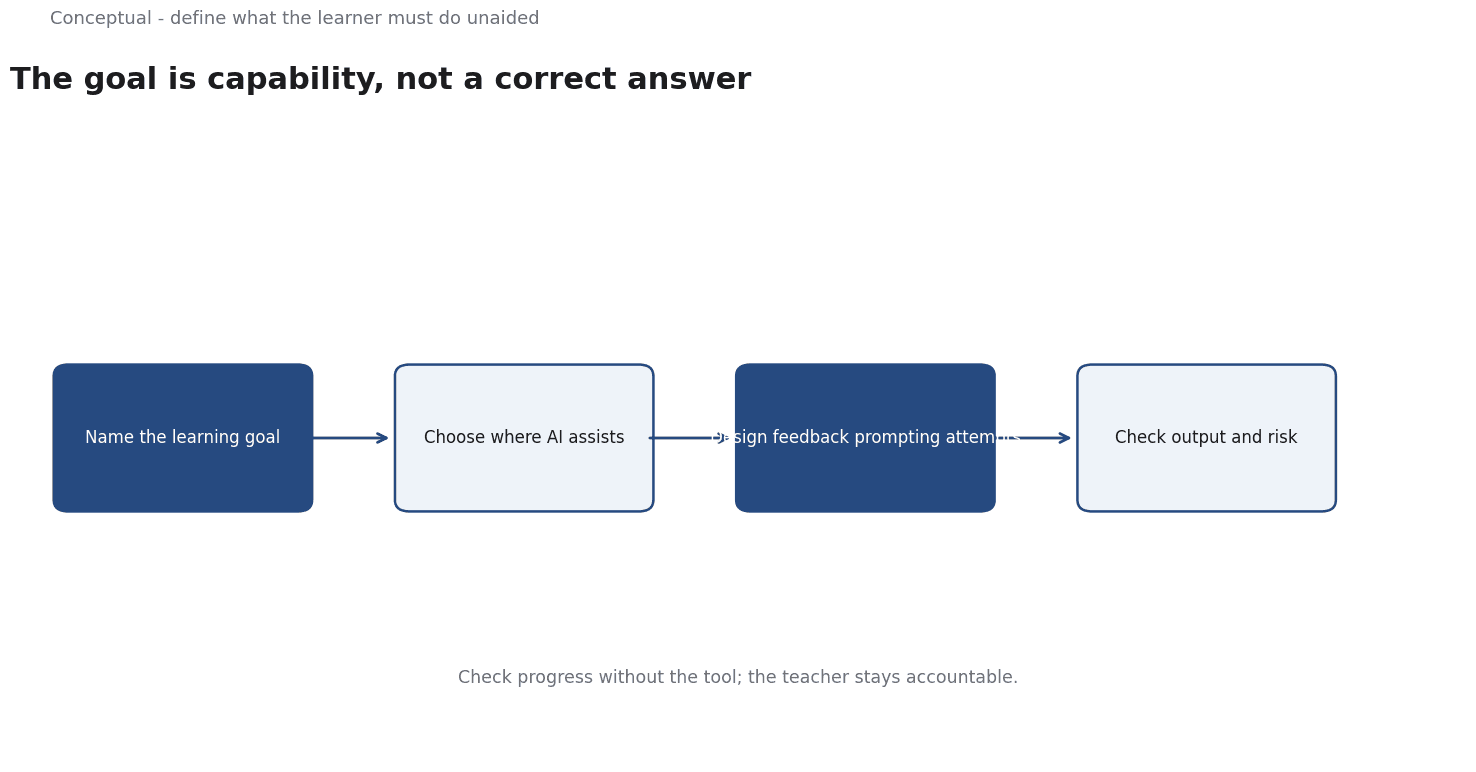
The second item is feedback. AI can give immediate, specific feedback, which is useful when it points to a mistake and a next step. Feedback that only supplies the answer is less useful, because it removes the attempt. The distinction is a design choice, not a property of the model.
The third item is risk. The NIST RMF provides a frame for trustworthiness, which includes how a system might mislead a learner. An AI system that is confidently wrong can teach an error, and the cost is borne by the learner. Checking outputs against reliable sources is part of the design.
The sequence is: define the goal, choose where AI assists, design feedback, then check risk. The choices are local, so the conclusions are inferred; the context is source-reported.
A worked example
Illustrative. A tutor uses an assistant to help students with problem sets.
Three checks decide. First, what should a student be able to do without help at the end of the unit? Second, does the assistant hint at a method or supply the answer? Third, is there a check that its explanations are correct, with a route to report an error?
The outcome is a design with a clear boundary. The scenario is hypothetical; the method is the contribution.
Evidence status
| Claim | Status | Source | Verified | Recheck when |
|---|---|---|---|---|
| Educational technology supports learning and teaching | source-reported | Wikipedia, Educational technology | 2026-11-18 | Definition changes |
| AI risk includes trustworthiness | source-reported | NIST AI RMF | 2026-11-18 | Framework updated |
| Design around the learning goal | inferred | Derived from the context | 2026-11-18 | Goals change |
Why a correct answer is not the goal
A learner's goal is capability, not a single correct response.
A system that optimises the answer can undermine the practice that builds capability, which is why the boundary has to be defined before the tool is chosen.
A further consideration is fairness. A tool that works well for one group of learners may fail for another, and an education setting makes that difference consequential. Checking performance across groups before a broad rollout is part of the risk work, not an optional exercise.
The tool also changes the role of the teacher, which should be planned rather than assumed. If the system handles routine feedback, the teacher's time can go to the learners who need more help, but that only happens if the workflow is redesigned.
Finally, a learner's work can become dependent on the system in ways that are hard to see. Checking what students can do without the tool, at intervals, is the only way to know whether the boundary is holding.
The boundary should be stated where learners can see it, so they know when to work without assistance.
Progress should be checked without the tool, since that is the condition the learning goal describes.
The teacher remains accountable for the learning, whatever the tool reports.
What it cannot do
It cannot replace a teacher. It does not guarantee learning. And it cannot remove the need to check its output.
The counterargument that instant answers are always helpful is fair for curiosity and incomplete for a skill that requires practice.
A decision test
- Define the learning goal.
- Choose where AI assists.
- Design feedback that prompts attempts.
- Check outputs against sources.
- Give learners a route to report errors.
- Record the design and recheck condition.
For the frame, see AI Risk Assessment.
References & Further Reading
- Wikipedia contributors, 2026. Educational technology - Wikipedia — Technology used in learning and teaching.
- NIST, 2023. AI Risk Management Framework | NIST — The governance framework referenced in AI risk and compliance work.