AI for Government Costs Explained
Government AI carries costs beyond licences. Read where they come from, a worked example, and why a pilot is not a deployment.
AI in government is often discussed in terms of efficiency, which hides the costs that appear after a pilot. The Wikipedia entry describes the structure of public administration, and the NIST AI RMF provides a risk frame. The accounting should include the work that a pilot does not reveal.
Direct answer: Count the full cost — data, governance, integration, and oversight — and judge a pilot against the conditions of a real deployment. The sources describe the context; the cost rule is a synthesis.
Delta: This article adds a claim-status table and a worked example, separating documented context from local choices about scope.
The mechanism
The first cost is data. The government entry describes public administration, which typically holds records across many systems. Bringing those records together for a model is work that a pilot on a clean sample does not represent. The effort appears before any benefit.
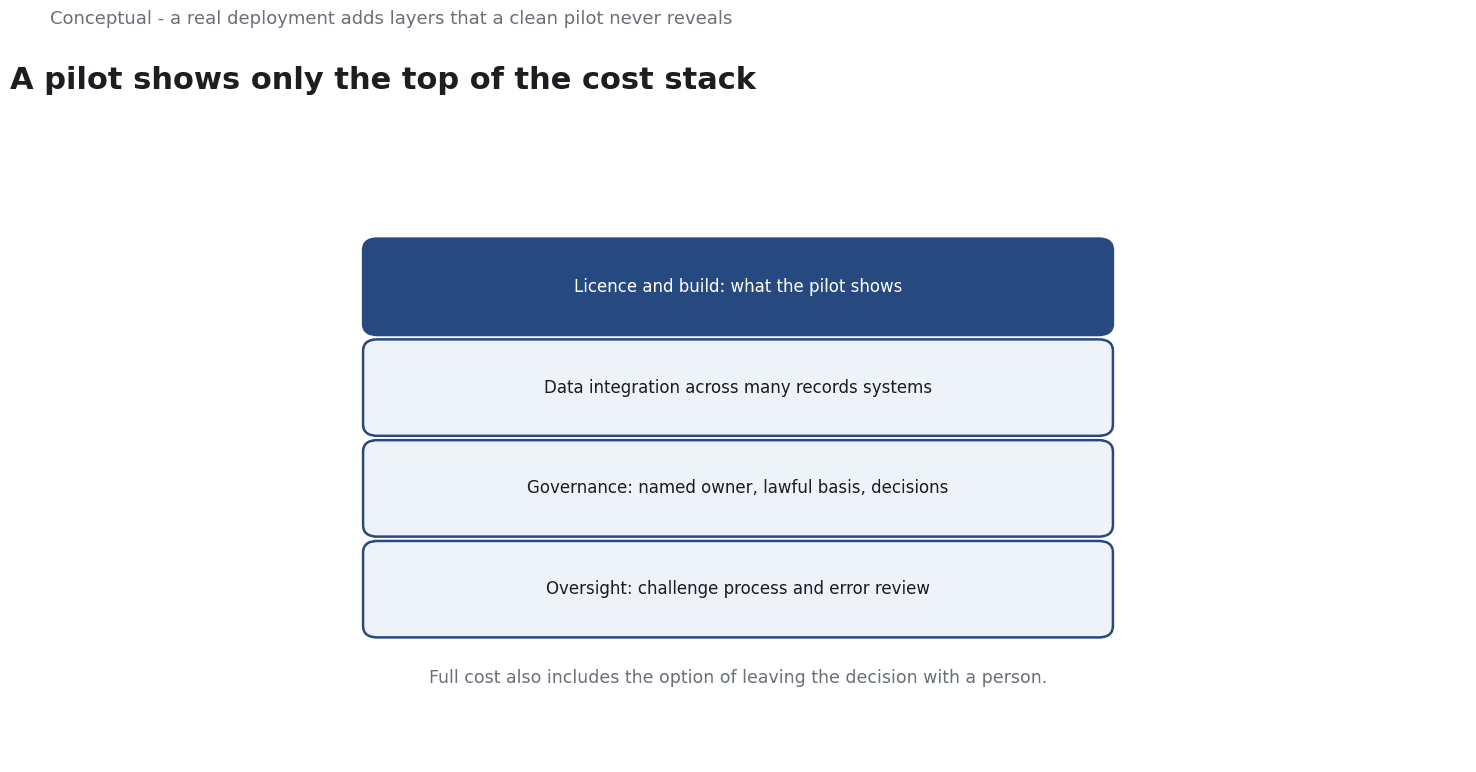
The second cost is governance. The NIST RMF treats governance as a distinct function, which means named accountability and documented decisions. A pilot can proceed without much of it; a deployment cannot. The cost of establishing it belongs in the comparison, otherwise the pilot's economics are misleading.
The third cost is oversight. A system used in a public process needs a way to challenge its decisions and a person accountable for them. That is an operating cost that continues after implementation, and it is larger than the initial build in many cases.
The sequence is: define the decision the system supports, list the data and governance it requires, then compare the full cost with the benefit. The estimates are local, so the conclusions are inferred; the context is source-reported.
A worked example
Illustrative. A team pilots a model to triage public enquiries.
Three checks decide. First, does the pilot data represent the real volume and variety of enquiries? Second, what governance is required for a live system — an owner, a lawful basis, a challenge process? Third, who reviews errors after deployment, and at what cost?
The outcome is a full-cost view rather than a pilot headline. The scenario is hypothetical; the method is the contribution.
Evidence status
| Claim | Status | Source | Verified | Recheck when |
|---|---|---|---|---|
| Government is structured public administration | source-reported | Wikipedia, Government | 2026-11-18 | Definition changes |
| AI risk includes governance | source-reported | NIST AI RMF | 2026-11-18 | Framework updated |
| Count governance and oversight in the cost | inferred | Derived from the frame | 2026-11-18 | Scope changes |
Why a pilot is not a deployment
Extrapolating its results without adding the missing costs produces a favourable number that cannot be achieved in practice.
A pilot runs on chosen data with limited oversight, which is precisely the condition a deployment will not have.
A pilot also cannot reveal the cost of public scrutiny. A system used in a public process will be questioned by people who were not part of the pilot, and answering those questions takes time that does not appear in a technical plan. Building that capacity early is cheaper than discovering it after a decision is challenged.
The full cost should also include the possibility that the system will not be used.
Measuring adoption after deployment is the only way to know whether the benefit was realised.
Finally, the comparison should include the alternative of not automating. Some processes are clearer and more accountable when a person makes the decision, and the cost of that clarity is a genuine benefit rather than an inefficiency to be removed.
The cost comparison should include the alternative of leaving the process with a person, which is a real option rather than a failure.
An owner should be named for the system's decisions, since an unowned system cannot be challenged effectively.
The recheck should include whether the system is still used as intended, since adoption is evidence of realised value.
What it cannot do
It cannot remove the need for lawful process. It does not guarantee efficiency. And it cannot replace the accountability that public decisions require.
The counterargument that a cheap pilot proves the idea is fair for feasibility and incomplete for cost.
A decision test
- Define the decision.
- List the data required.
- Add governance and oversight costs.
- Check the pilot's representativeness.
- Record the full comparison.
- Set a recheck condition.
For the risk frame, see AI Risk Assessment.
References & Further Reading
- Wikipedia contributors, 2026. Government - Wikipedia — The structure and functions of public administration.
- NIST, 2023. AI Risk Management Framework | NIST — The governance framework referenced in AI risk and compliance work.