AI for Healthcare Operations Pitfalls
Clinical AI gets the attention, but operations AI touches scheduling, coding, and documentation. Read the failure modes and the controls.
Most discussion of AI in healthcare focuses on diagnosis, which is the highest-stakes and most regulated application. The operational uses — scheduling, coding, prior authorisation, documentation — are less dramatic and more widespread. They still touch patient care indirectly, which means the failure modes deserve the same seriousness.
Direct answer:
Apply AI to healthcare operations where the output is checkable, the clinical boundary is explicit, and a person remains accountable.
Health informatics provides the systems context, and the AI RMF frames governance. The boundary: an operational tool that produces a wrong code or a missed escalation can harm a patient indirectly, which the clinical-AI article treats as a reason for validation, as the risk-assessment article requires for known failure modes.
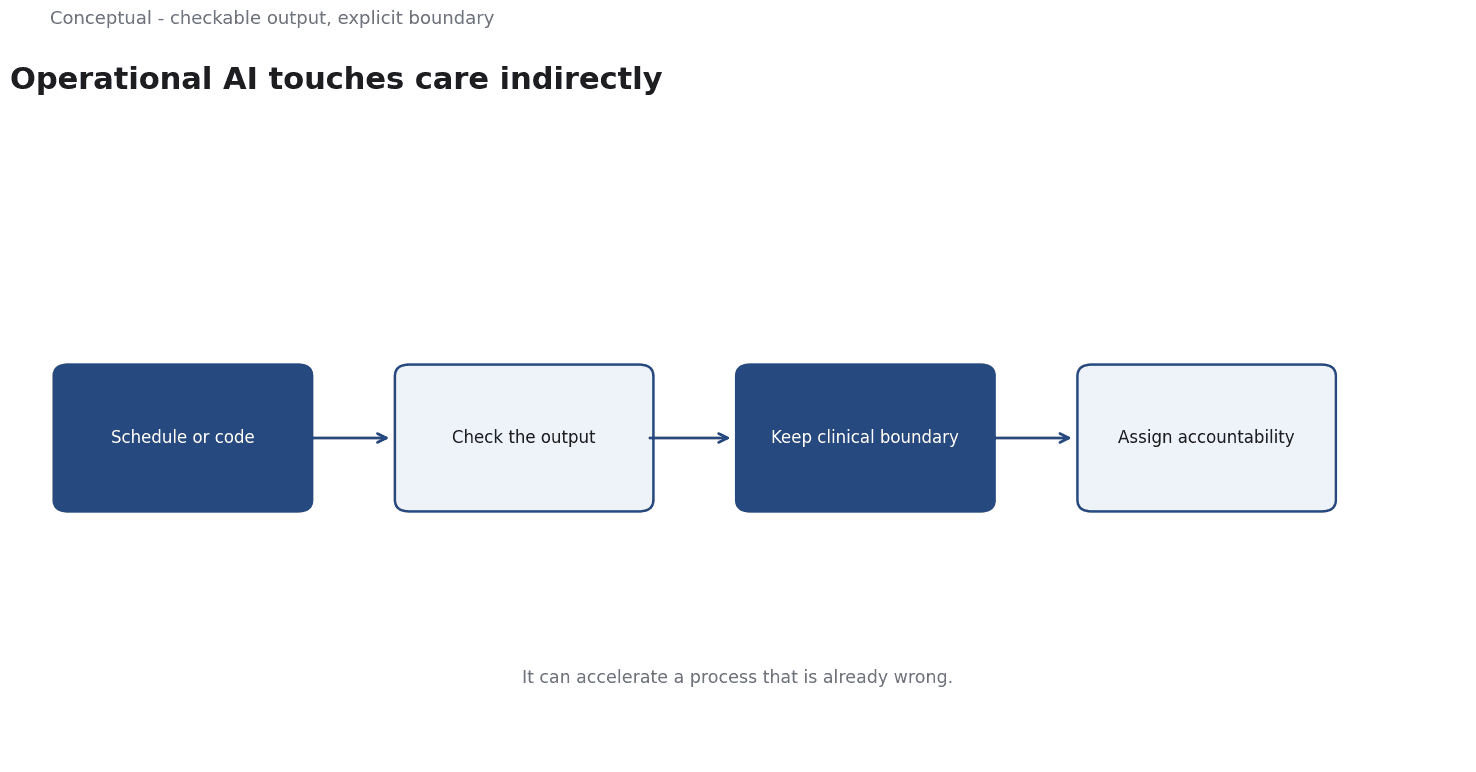
The pitfalls
Hidden clinical effect. A scheduling model that optimises throughput may change how much time a clinician has with a patient, which is a clinical consequence of an operational decision, as the health-informatics article treats the system as interconnected. The metric should include that effect, which the evaluation-rubric article argues for measuring more than the target number.
Automation bias in documentation. A model that drafts notes can introduce a plausible but wrong detail, and a clinician who reviews under time pressure may accept it, as the reduce-hallucinations article warns about confident text. The control is a real review step, which the human-in-the-loop article describes for high-impact outputs.
Coding and billing drift. Automated coding trained on historical patterns can encode past errors or inconsistencies, which the data-quality article treats as a problem with training data, as the provenance guidance requires records of origin.
Privacy and provenance. Health data has strict obligations, which the data-privacy article makes jurisdiction-specific, and the model's inputs and outputs must be recorded, as the data-governance article requires for relied-upon systems.
Three consequences follow. The tool's boundary should be written down — what it decides and what it only suggests, which the clinical-AI article argues for defining intended use. Evaluation should include indirect effects, as the health-informatics context implies. And an accountable person should own the output, as the governance checklist requires.
A worked example
The following is hypothetical and illustrative. A hospital deploys a model that drafts discharge summaries for clinician approval.
Three checks decide whether it is safe. First, factual grounding: does every statement in the draft trace to the record, as the reduce-hallucinations article requires for citations? Second, review quality: do clinicians have time to check, and do they actually change errors, as the human-in-the-loop article asks for a meaningful review? Third, indirect effect: has documentation time fallen without reducing the detail a receiving clinician needs, which the health-informatics article treats as a system-level measure?
Three conclusions follow. A faster draft that introduces unchecked detail is a net harm, which the clinical-AI article's validation argument implies. The review step is the control, not the model's fluency, as the oversight article argues. And the result should be recorded with the limits, as the decision-memo article requires.
What operational AI cannot do
It cannot replace clinical judgement, which the clinical-AI article treats as a boundary, as the governance article requires an accountable person.
And it does not remove privacy duties, which the data-privacy article makes a legal obligation.
The counterargument that operational AI is low-risk because it does not diagnose misses the indirect path from a wrong code to a wrong care decision, which the health-informatics context makes visible, as the risk-assessment article argues for tracing consequences.
A decision test
- Define the clinical boundary and what the tool may suggest, as the clinical-AI article advises.
- Check factual grounding of outputs, as the reduce-hallucinations article requires.
- Design a review with time and authority, as the oversight article requires.
- Measure indirect effects on care, as the health-informatics context implies.
- Record provenance of data and model changes, as the governance article requires.
- Check privacy obligations with current law, as the privacy article advises.
- Review after any model or workflow change, as the monitoring article recommends.
For the clinical context, see AI in Healthcare; for the oversight design, see Human in the Loop.
References & Further Reading
- Wikipedia contributors, 2026. Health informatics - Wikipedia — The discipline of using data and information systems in healthcare delivery.
- NIST, 2023. AI Risk Management Framework | NIST — The governance framework referenced in AI risk and compliance work.