AI for Logistics Explained
AI can help with the document-heavy, analytical work in logistics. See which tasks fit, a worked example, the limits of generated output, and a deployment decision test.
Logistics runs on documents and coordination: shipping records, manifests, invoices, status updates, and exception reports. Teams are under pressure to apply AI to that workload, but the general capabilities described in AI guides do not map cleanly onto a specific operational task. The gap between a tool that can analyze documents and a delivery process that is actually better is where most pilots stall.
Direct answer: AI assistants can help with document understanding, summarization, data extraction, and analysis, which are all common in logistics work. Logistics itself is the coordination of moving goods from origin to consumption across transport, warehousing, and fulfillment. The useful question is which specific logistics task has enough document or analytical load to justify an AI step, with a human review of the output.
Delta: This article adds a decision framing beyond the sources: it maps general AI use cases to a concrete logistics task decision, with claim status explicit.
The mechanism
Logistics is the planning and coordination of how goods move from origin to consumption. It spans transport, warehousing, inventory, and order fulfillment, and it depends as much on information as on physical movement. Every shipment generates records: manifests, invoices, delivery confirmations, and status messages that must be read, reconciled, and acted on. That information load is the part of logistics most open to assistance, because the documents are text-heavy and repetitive even when the physical operations are not.
The AI use-case guides describe what these systems are good at in general terms: working with documents, summarizing and extracting information, analyzing content, and generating written output. These are capabilities, not logistics solutions. The guides say, in effect, that a model can help with tasks that involve reading and producing text and with some forms of analysis. Applied to logistics, that suggests candidates such as pulling fields from carrier documents, summarizing exception reports, or drafting routine communications. The list is a starting point, not a recommendation for any one process.
The overlap between the two is real but narrow. Logistics has a high volume of document handling, and the described capabilities match document handling well. What the guides do not establish is accuracy on a specific company's documents, cost per task, or how errors propagate into operations. An extracted field that is wrong can reroute a shipment or misstate an inventory position, so the value of the assistant depends on how its output is checked, not just on what it can produce in a demo.
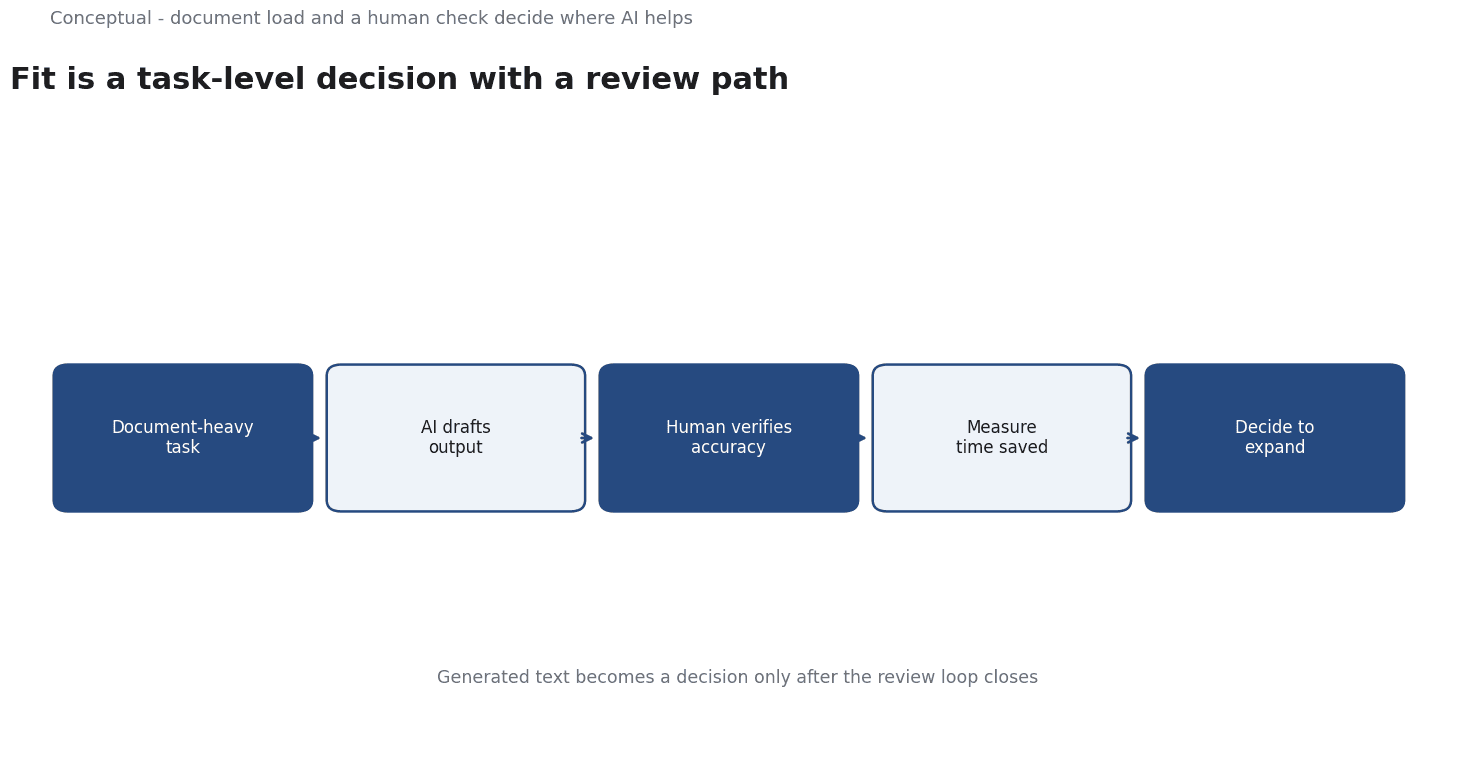
The practical consequence is that the decision has to be made at the task level. Pick a task with a high document load, a clear definition of a correct result, and a natural review point. Run it with a human checking the output, and measure whether the review still saves time. A task that fails any of those conditions is a poor first candidate, however impressive the general capability looks.
The AI step is justified only when it fits a specific workflow and the review path closes the loop.
A worked example
The following is hypothetical and illustrative. A freight coordinator wants to reduce the time spent reading carrier status reports and runs three checks. First, a task-fit check confirms the work is repetitive document extraction with a clear correct answer for each field. Second, an accuracy check compares the extracted fields against a manually read set before any output is used downstream, so the error rate is known rather than assumed. Third, a review-path check assigns a person to verify each extracted summary and confirms that the verified result still saves time overall. The outcome is that the assistant drafts the summaries and the coordinator approves them, saving effort without letting generated text drive a decision on its own. No number here is measured data; the example only shows how the checks connect.
Evidence status
| Claim | Status | Source | Verified | Recheck when |
|---|---|---|---|---|
| Logistics coordinates the movement of goods and related information | source-reported | Wikipedia: Logistics | 2026-11-18 | Scope definition changes |
| AI guides describe document and analysis use cases | source-reported | Anthropic use-case guides | 2026-11-18 | Capabilities or guidance change |
| Fit depends on task document load and a review path | inferred | Derived from the sources | 2026-11-18 | Accuracy or policy changes |
The source-reported rows establish what the sources offer: a description of logistics as a coordination function and a set of general AI use cases. Neither source evaluates a logistics deployment. The inferred row is this article's synthesis that fit is determined at the task level by document load and review, not a stated finding. Recheck it if model accuracy or internal policy on automated decisions changes the review requirement.
What it cannot do
The first limit is that the sources are general. They describe logistics as a field and AI capabilities as a category; they do not document any specific deployment, its results, or its cost. This framing can narrow the list of plausible tasks, but it cannot tell a team whether a particular pilot will pay off. Expecting a ready-made case study from these sources would be a misunderstanding of what they provide.
A hidden cost is verification. Generated output looks authoritative and is fast to produce, which makes it tempting to use directly. In logistics, a plausible but wrong extraction can flow into a shipment instruction or an inventory record, so someone has to check the result. That review consumes time and attention, and it has to be built into the process from the start. If review eats most of the time saved, the assistant is not value-adding no matter how well it performs in isolation.
Models can produce confident errors, and a system that extracts from unfamiliar document formats can fail quietly. A second failure is choosing a task with no clear definition of correctness, where the team cannot tell whether the output is right. A third is scope creep: starting with document summaries and drifting toward autonomous routing or scheduling decisions that carry real operational risk and need a different kind of oversight.
The boundary is the kind of task. Document-heavy work with a verifiable answer and a review point is a reasonable candidate. Tasks that require current operational data the model cannot see, that involve physical safety, or that have no practical review path are not. The distinction matters because the guides describe capabilities in general terms and will not flag where a capability becomes unsuitable. That judgment belongs to the team running the process.
Deployment also needs review. Document formats change, models are updated, and an error pattern that was rare can become common when inputs shift. Set a trigger to recheck accuracy when document sources change or when the review step starts catching more errors. Without that, a pilot that once saved time quietly becomes a source of rework, and nobody notices because the output still looks fine.
The counterargument that general AI capabilities are broadly applicable is fair for drafting and summarization where errors are cheap to catch, and incomplete for logistics steps where a wrong extracted value propagates into physical operations and real cost.
A decision test
- Name the task. Pick one logistics activity with a high document or analysis load.
- Define correctness. State what a correct output looks like and how it will be checked.
- Confirm a review path. Identify who verifies the output and confirm the verification is feasible.
- Run a small pilot. Process a limited set of real documents with human review in place.
- Measure before trusting. Compare accuracy and time against the current manual process.
- Keep humans in the loop. Use generated output as a draft, never as an unchecked decision.
- Set a review trigger. Recheck accuracy when formats, models, or error rates change.
AI for logistics is a task-selection decision more than a technology decision. The sources describe a document-heavy field and a set of general capabilities; the team decides where they meet. Choose a task with a verifiable result and a review path, measure the pilot, and expand only where the checked output genuinely saves effort.
For further reading, see AI Risk Assessment: A Pre-Deployment Checklist.
References & Further Reading
- Anthropic, 2026. Guides to common use cases - Claude Platform Docs — Production use-case guides for ticket routing, customer support agents, content moderation, legal summarization and commerce agents.
- Wikipedia contributors, 2026. Logistics - Wikipedia — Planning and execution of goods movement and storage.