AI in Customer Support: Routing, Drafting, and Handoff
Support AI works at three points: where a ticket goes, what reply is drafted, and when a person takes over. Read each with its metric.
Support is where AI assistance is most visible and most easily measured. Three points matter: routing the ticket to the right queue, drafting a reply from the knowledge base, and deciding when a person must take over. Each has a different failure mode and a different metric, which is why treating them as one "AI support" feature produces confusing results.
Direct answer: Use AI to classify and route tickets, draft replies grounded in the knowledge base, and flag cases for human handoff — with a distinct metric for each stage. Anthropic's customer-support agent guide is the primary use-case reference, and the O*NET task descriptions help identify what the work actually involves. The boundary: a fluent reply is not a correct one, and a handoff that loses context is worse than no automation, as How to Build an AI Chatbot That Does Not Fail explains.
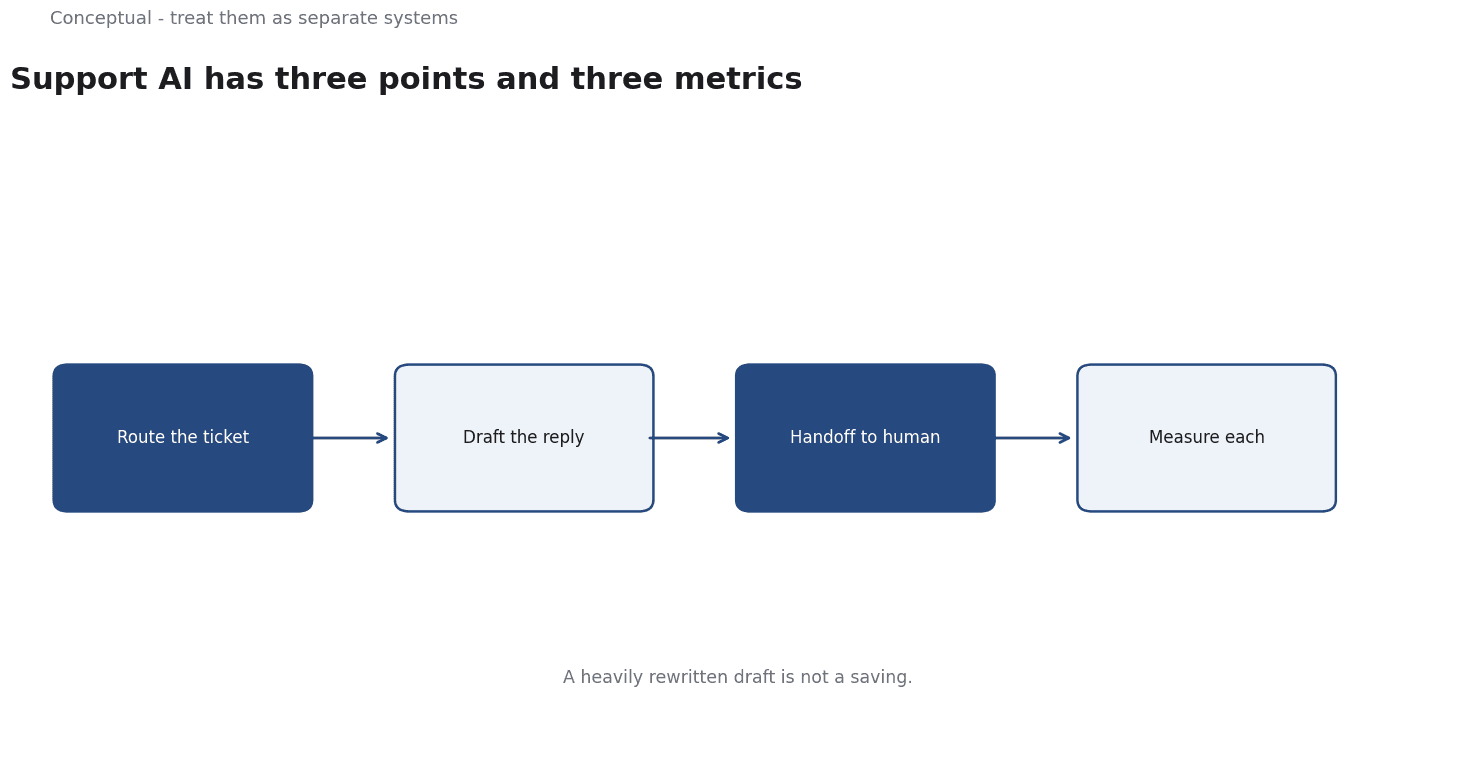
Three points
Routing. Classify the ticket into a queue with a confidence score. Errors are recoverable — the ticket can be rerouted — but they cost time, as the classification-pattern article explains.
Drafting. Produce a reply from the knowledge base with a citation, so an agent can check it quickly. The reduce-hallucinations article covers the grounding mechanism. A draft sent without review is a different risk category.
Handoff. Decide when a person must take over — low confidence, an angry customer, a money-related decision — and pass the structured state, not just the transcript, as How to Build an AI Chatbot That Does Not Fail recommends.
A worked workflow
The following is hypothetical and illustrative.
A support team handles 3,000 tickets a day. The AI workflow:
- Routes tickets into four queues with a confidence score. Low-confidence cases go to a triage queue.
- Drafts replies for the two highest-volume queues, with a cited source passage.
- Escalates to a person when confidence is low, the customer asks for a human, or the topic involves refunds.
Measured over a month:
- 85% of tickets routed correctly on first pass; 5% needed rerouting.
- Drafts accepted with minor edits in 60% of eligible cases.
- Escalation rate of 25%, with context carried in the handoff.
Three checks decide the result:
- Rerouting time — do the 5% misrouted tickets cost more than routing saves? The workflow-automation article explains the arithmetic.
- Edit distance — are the accepted drafts genuinely close, or are agents rewriting them while marking them accepted? The evaluation-rubric article warns about proxy metrics.
- Handoff quality — do escalated tickets arrive with structured context, so customers do not repeat themselves, as Human in the Loop by Design: Overrides, Escalation, and Failure States requires.
Three conclusions follow:
- Each stage needs its own metric, and a single "AI satisfaction score" would hide a failing stage.
- The handoff is a control, not a fallback, which the security checklist explains for tool boundaries.
- Low-confidence routing is a feature, reducing wrong replies at the cost of more human work, as How to Build an AI Chatbot That Does Not Fail argues.
What to instrument
A support AI system needs metrics at each stage, and the right ones differ from generic model scores.
Four are worth tracking:
Routing accuracy by queue. Aggregate accuracy hides a queue that consistently receives the wrong tickets, which the funnel article warns about for blended rates.
Draft acceptance with edit distance.
Measure how much text actually changed, as the evaluation-rubric article explains for proxy metrics.
Handoff completeness. Does the escalated ticket carry the structured state — issue, attempts, sentiment — or just the chat log? The chatbot article explains why context loss is the failure to watch.
Customer effort. Track repeat contacts on the same issue, which the retention article identifies as a leading indicator of a problem that was closed but not solved.
These metrics make the combined system visible, which the evaluation article argues is the only meaningful unit of analysis.
What support AI cannot do
It cannot replace accountability. A person must own the reply and the decision, as the governance checklist requires.
It cannot fix a weak knowledge base. A draft grounded in outdated documentation gives confident wrong answers, which the data-governance article covers.
It cannot handle every customer. Some conversations need empathy and judgement that a system should not simulate, as the humanizer guidance on voice would caution in a different context — here the point is simply that escalation is legitimate.
The counterargument — that support AI reduces headcount — is a business framing that ignores the shift in work.
Agents move from writing routine replies to handling harder cases, which may require more skill and better tools, as the future-of-work article discusses.
A decision test
- Separate routing, drafting, and handoff with a metric for each.
- Ground drafts in a cited source from the knowledge base.
- Define escalation triggers explicitly, including low confidence and high-stakes topics.
- Carry structured context across the handoff.
- Audit the rerouted and escalated cases, not just the successful ones.
- Keep the knowledge base current with an owner.
- Measure combined-system outcomes, as the evaluation article recommends.
For the chatbot design, see How to Build an AI Chatbot That Does Not Fail; for the review design, see Human in the Loop by Design.
References & Further Reading
- Anthropic, 2026. Guides to common use cases - Claude Platform Docs — Production use-case guides for ticket routing, customer support agents, content moderation, legal summarization and commerce agents.
- U.S. Department of Labor, 2026. O*NET OnLine — The standard occupational taxonomy used to compare roles across industries.