AI in Finance Operations: Reconciliation, Reporting, Controls
Finance AI works where rules are explicit and exceptions are reviewable. Read the three uses, a worked reconciliation, and why controls stay human.
Finance operations is a natural fit for AI assistance because much of the work is rule-based: matching records, assembling reports, and checking for anomalies. It is also a domain where a confident error is expensive, which means the human and control layer matters more than the model.
Direct answer: Use AI to match records, draft narrative reports from verified numbers, and flag anomalies for review — with the reconciliation rule and the final approval kept explicit. Anthropic's use-case guides cover analysis and extraction patterns, and revenue-recognition guidance explains why definitions and timing matter. The boundary: a model can propose a match or a flag, but the control — the rule that decides whether a discrepancy is acceptable — must be independent of the model, as the security checklist explains for tool boundaries.
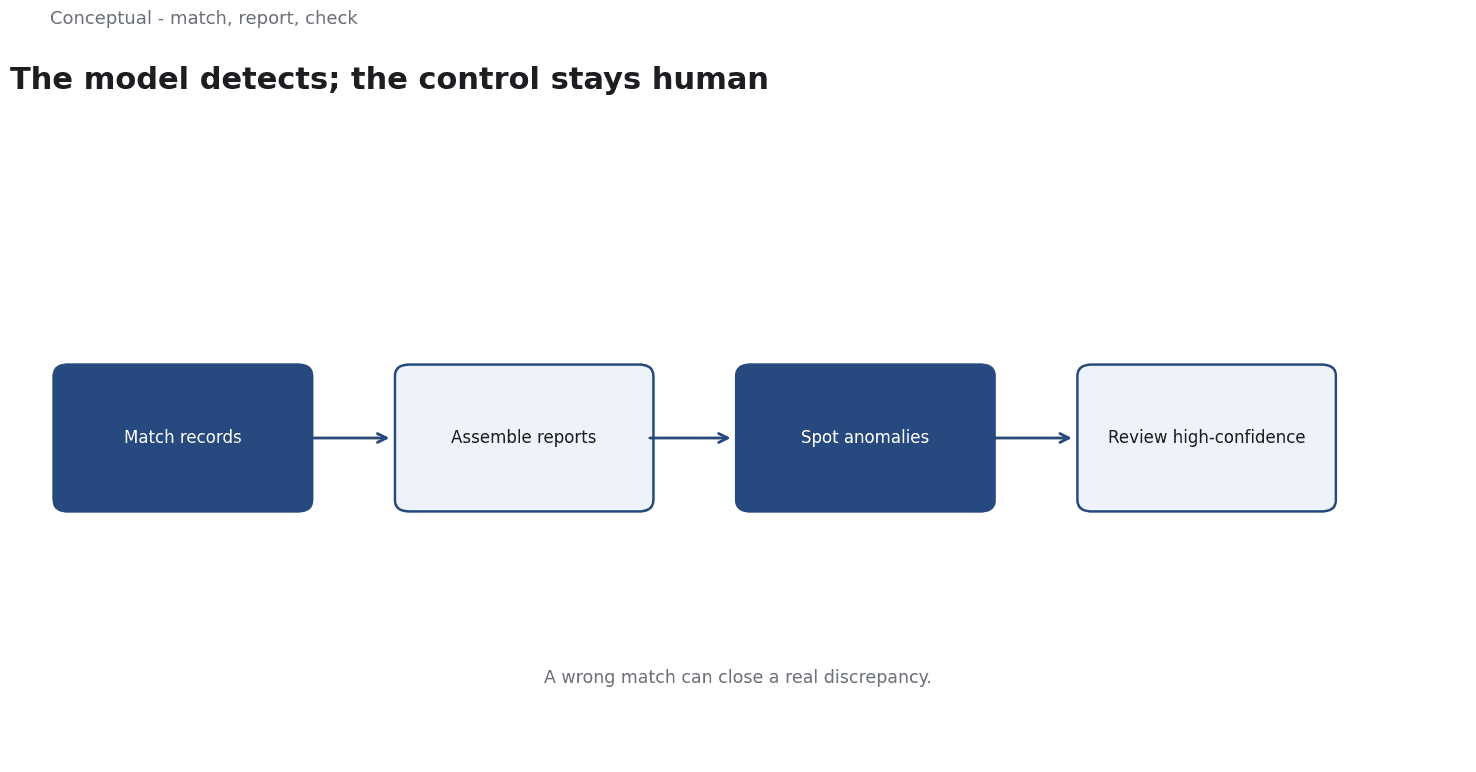
Three uses
Reconciliation. Match transactions between systems and flag unmatched items. The matching can be fuzzy, but the rule for what counts as a match should be explicit and testable, as the reporting-automation article explains for validation.
Reporting. Draft the narrative around numbers that have already been validated, using the figures verbatim and avoiding causal claims that the data does not support, as the reporting-automation article recommends.
Controls. Flag anomalies — an unusual amount, a duplicate payment, an out-of-period entry — for a person to review.
The model is a detector, not the control, which the anomaly-detection article explains.
A worked reconciliation
The following is hypothetical and illustrative.
A team reconciles 50,000 transactions a month between a billing system and a ledger. The AI workflow proposes matches on amount, date, and counterparty, and flags the rest.
Outcomes on a sample month:
- 46,000 matched automatically with high confidence.
- 3,000 matched with lower confidence and were reviewed by a person.
- 1,000 flagged as unmatched and investigated.
Three checks decide whether it is safe:
- False-match audit. Have a person review a sample of the 46,000 automatic matches. A wrong match that closes a real discrepancy is the dangerous error, which the evaluation-rubric article explains for false negatives.
- Rule transparency. Can the team see why a pair was matched? A black-box match cannot be defended to an auditor, which the data-governance article requires for documented decisions.
- Exception quality. Of the 1,000 flagged, how many were real issues? A high false-positive rate wastes investigation time, which the anomaly-detection article covers as alert fatigue.
Three conclusions follow:
- The automatic bucket needs auditing, not just the exceptions, as the risk-assessment article warns about unseen failures.
- Explanations are part of the control, which the model-explainability article covers in general terms.
- A person approves the final reconciliation, as the human-in-the-loop design requires.
Designing the human checkpoint
The value of a human checkpoint depends on where it sits. Four design choices matter:
Review the automatic bucket, not only the exceptions.
Give reviewers the evidence, not just the flag. A reviewer should see the two records being matched and the reason proposed, which the model-explainability article argues for in high-stakes decisions.
Make the exception queue actionable. Each flagged item should carry enough context for a person to decide quickly, which the anomaly-detection article covers as alert design.
Keep a decision record. Every approval, override, and adjustment needs an owner and a timestamp for the audit trail, as the data-governance article requires.
A checkpoint designed this way catches errors without becoming a rubber stamp, which the human-in-the-loop article explains as the central design challenge.
What finance AI cannot do
It cannot define the rule. What counts as a match or an acceptable variance is a policy decision, as the revenue-recognition article explains for accounting judgements.
It cannot replace the control environment. Segregation of duties, approvals, and audit trails remain, which the AI-governance article addresses for high-impact systems.
It cannot guarantee compliance. A model that flags anomalies does not ensure the underlying process is sound, which the risk-assessment article covers.
The counterargument — that finance is too regulated for AI — is fair for final decisions and wrong for the preparation work.
Automating matching and drafting while keeping approval human is a common pattern, as the reporting-automation article describes.
A decision test
- Automate matching and drafting, not final approval.
- State the match rule and keep it visible, as the validation article recommends.
- Audit the automatic bucket for false matches.
- Score exception quality to avoid alert fatigue.
- Keep an audit trail with an owner for every decision, as the data-governance article requires.
- Keep approval with a person, as the oversight article argues.
- Re-evaluate after a model or rule change, as the monitoring article recommends.
For the mechanics, see How to Automate Reporting with AI; for the control frame, see AI Governance Checklist for Small Teams.
References & Further Reading
- Anthropic, 2026. Guides to common use cases - Claude Platform Docs — Production use-case guides for ticket routing, customer support agents, content moderation, legal summarization and commerce agents.
- IFRS Foundation, 2026. IFRS - IFRS 15 Revenue from Contracts with Customers — The primary accounting standard for revenue from contracts with customers and its five-step model.