AI in Legal Research: Retrieval, Summarization, Citation Checks
Legal AI must show its sources. Read the three tasks, a worked research workflow, and why a fluent summary is not authority.
Legal research has three properties that make AI both useful and dangerous: the sources are authoritative and citable, the language is precise, and a wrong answer can affect a real decision. A tool that helps find and summarise law is valuable; a tool that invents a citation is a liability. The discipline is to keep the source visible at every step.
Direct answer:
Use AI to retrieve relevant authorities, summarise what they say, and check that every citation points to a real source supporting the claim.
Anthropic's legal summarisation guide is the primary use-case reference, and the retrieval article covers the search mechanism. The boundary: a model can locate and condense authority, but it cannot replace legal judgement about how a source applies to a specific matter, which the contract-review article explains for adjacent work.
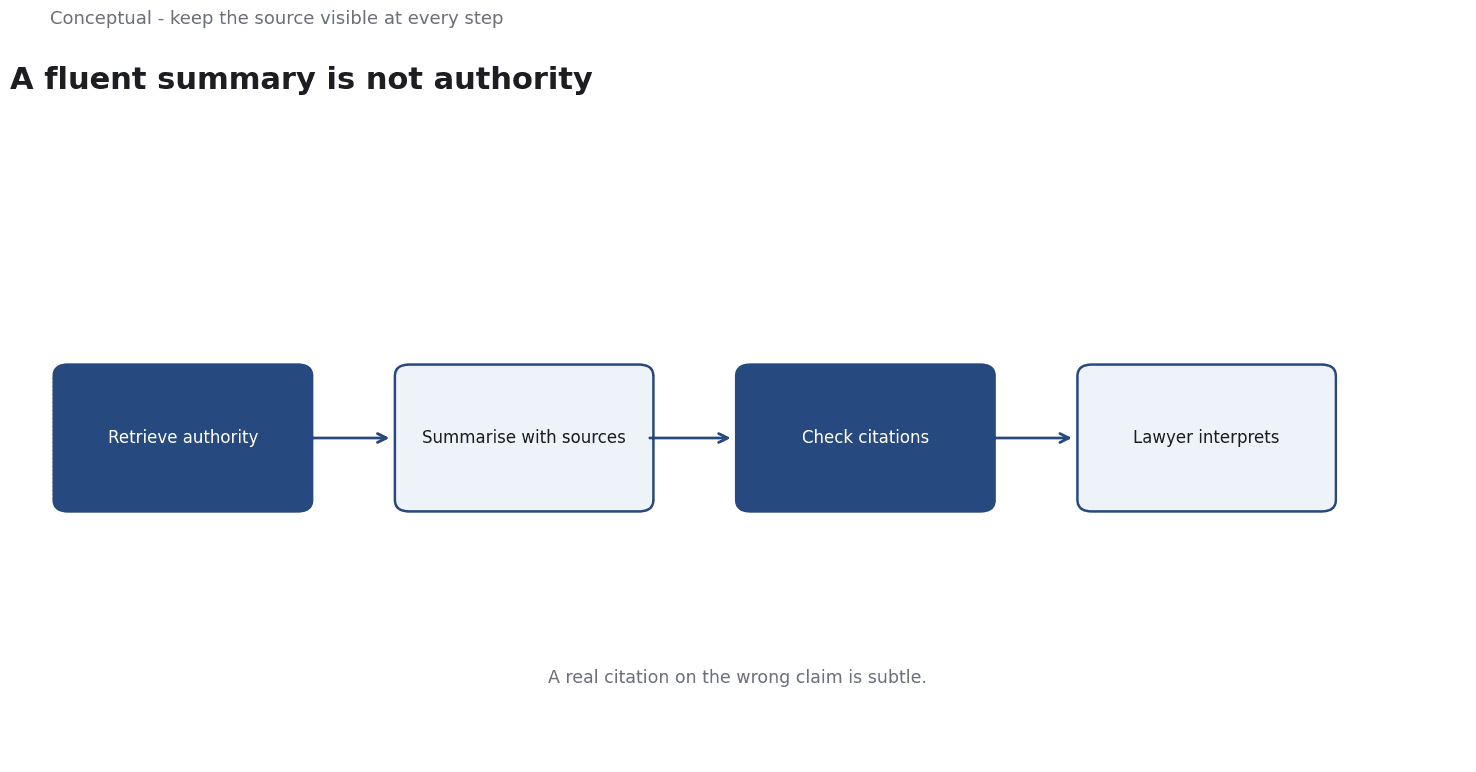
Three tasks
Retrieval. Find statutes, regulations, and case law relevant to a question. This is a search problem, as the retrieval article explains, and the measure is recall — did the search find the controlling authority?
Summarisation. Condense a long judgment or statute into the points that matter for the question. The reduce-hallucinations article covers grounding: every claim should trace to the text.
Citation checking. Verify that every cited source exists and supports the claim attached to it. This is the hardest and most important task, because a plausible but nonexistent citation is a specific failure mode of language models, as the detection article discusses for generated text generally.
A worked research workflow
The following is hypothetical and illustrative.
A lawyer asks a research assistant: "What does the governing statute say about notice periods for this contract type?"
The workflow:
- The system retrieves three candidate sources from a licensed database.
- It summarises the relevant sections, quoting the operative language.
- It produces an answer with a citation to section and paragraph for each claim.
Three checks decide whether the result is safe:
- Citation existence. Does the cited section exist? A check against the source database catches invented references, which the reduce-hallucinations article treats as a core verification.
- Citation support. Does the cited passage actually say what the summary claims? A real citation attached to a wrong claim is a subtler failure, which the evaluation-rubric article explains for groundedness scoring.
- Completeness. Was the controlling authority retrieved at all? A clean summary of the wrong source is worse than no answer, which the reranking article covers for retrieval quality.
Three conclusions follow:
- The lawyer verifies every citation, as the human-in-the-loop design requires.
- The system's value is in finding and condensing, not in deciding how the law applies, which the governance article addresses for high-stakes domains.
- Provenance is the product — a summary without traceable sources is not useful legal work, as the data-governance article argues.
Building a citation-checking habit
A citation check is only useful if it is routine and specific. Three practices make it reliable:
Check in two directions. Verify both that a cited source exists and that it supports the exact claim, as the reduce-hallucinations article distinguishes grounding from mere reference.
Keep the source text adjacent. A summary whose cited passage sits next to it is faster to check than one that requires opening a database. The context-engineering article explains why placing material near the decision improves use.
Record what was checked. A note of which citations were verified and when gives the reviewer a trail and makes a later challenge answerable, which the data-governance article requires for relied-upon records.
These habits are slow relative to generating a summary, which is precisely why they must be designed into the workflow rather than left to the reviewer's discretion at the end of a busy day.
What legal AI cannot do
It cannot give legal advice. A summary is a research aid, not an opinion, which the EU AI Act and governance discussions treat as a high-stakes distinction.
It cannot guarantee the law is current. A retrieved statute may have been amended, which the monitoring article frames as a change trigger.
It cannot replace judgement. Applying authority to a client's facts is the lawyer's work, as the contract-review article explains for the adjacent task of clause evaluation.
The counterargument — that a competent lawyer will catch errors — is true and does not remove the need for tool design that makes errors visible, which the security checklist argues for boundaries that do not depend on vigilance alone.
A decision test
- Retrieve from authoritative, licensed sources with a defined scope.
- Ground every summary claim in the retrieved text.
- Check that citations exist against the source database.
- Check that citations support the specific claim, not just the topic.
- Measure recall of controlling authority on a labelled set, as the embedding-selection article recommends.
- Keep legal judgement with a person, as the oversight article explains.
- Verify currency of sources with a dated check.
For the extraction mechanics, see AI for Document Processing; for the grounding method, see How to Reduce Hallucinations.
References & Further Reading
- Anthropic, 2026. Guides to common use cases - Claude Platform Docs — Production use-case guides for ticket routing, customer support agents, content moderation, legal summarization and commerce agents.
- Nils Reimers and Iryna Gurevych, 2019. Sentence-BERT: Sentence Embeddings using Siamese BERT-Networks — The bi-encoder recipe behind modern semantic search and RAG retrieval.