AI Literacy Checklist
AI literacy is knowing what a system can do, where it fails, and when to stop. Read the checklist, a worked review, and why tool training is not literacy.
AI training often teaches which buttons to press, which is useful and incomplete. Literacy means understanding what a system is doing, what it cannot know, and what to do when it is wrong, which the AI-literacy entry describes as knowledge and skills, as the NIST AI RMF frames trustworthiness across design, development, use, and evaluation, as the responsible-AI article treats fairness as a design property.
Direct answer: Build AI literacy around capability, limits, verification, and accountability — not tool features — with role-specific checks and a record. The AI-literacy entry provides the definition, and the NIST AI RMF provides the governance frame. The boundary: this is educational orientation, not a guarantee — systems and rules change, as the governance checklist requires an accountable owner, as the publication standard forbids guaranteed outcomes.
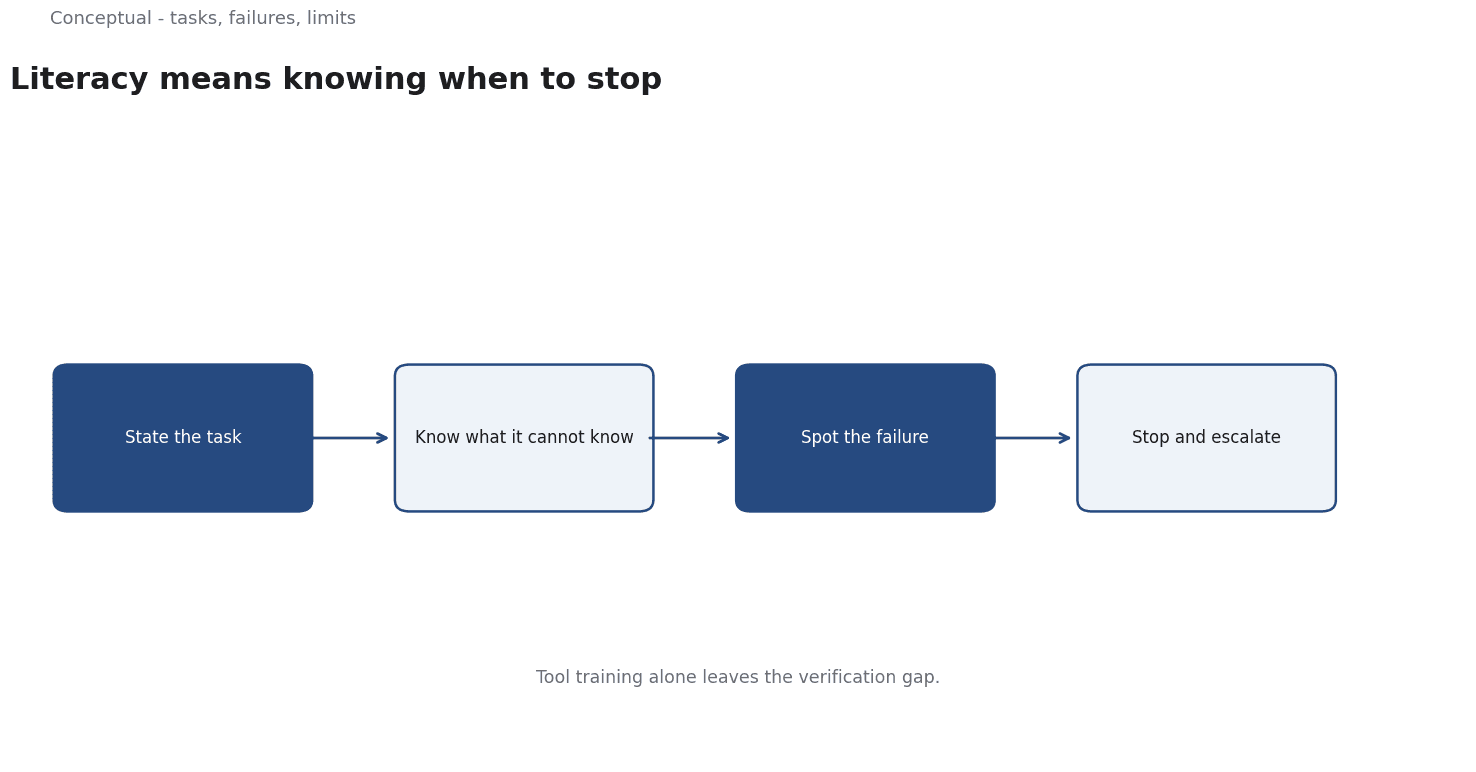
The checklist
What can it do? Name the task the system actually performs, which the use-case guides describe, as the evaluation-rubric article requires for concrete criteria, as the benchmarks article warns about broad claims.
A user who cannot state the task cannot judge the output.
What can it not know? Data recency, scope, and missing context, which the data-governance article requires you to source and date, as the long-context article warns about information position, as the hallucination article warns about confident wrong detail.
How do I verify? A check against a source or a held-out case, which the legal-research article treats as citation support, as the reduce-hallucinations article advises, as the evaluation-rubric article requires for evidence.
When do I escalate? A rule for high-impact or uncertain cases, which the approval-gates article treats as a boundary, as Human in the Loop by Design: Overrides, Escalation, and Failure States argues for meaningful review, as the risk-assessment article requires residual risk.
Who is accountable? A named owner for the decision, which the governance checklist requires, as the decision-memo article requires for a recorded judgement, as the AI-governance article argues for clear responsibility.
Three consequences follow. Training should be role-specific, as the AI-literacy entry advises, as the O*NET-style task descriptions help ground it, as the HR-screening article treats role duties. The checks should be written, as the rubric article requires, as the documentation article advises. And the checklist should be reviewed after a tool change, as the monitoring article treats as a trigger.
A worked review
The following is hypothetical and illustrative. A team gives staff access to an assistant that drafts client emails.
Three checks decide the literacy requirement. First, can staff state what the system does and does not know, as the use-case guides and data-governance article advise, with a dated source, as the hallucination article warns? Second, do they verify claims before sending, as the legal-research and reduce-hallucinations articles advise, with a rule for escalation, as the approval-gates article requires? Third, is there a named owner for the decision, as the governance checklist requires, with a record, as the decision-memo article requires?
Three conclusions follow.
Escalation rules matter at the point of use, as the approval-gates article advises. And the review should be recorded, as the decision-memo article requires, as the monitoring article advises for change.
What AI literacy cannot do
It cannot make a system accurate, which the publication standard forbids claiming, as the hallucination article warns about confident wrong detail. It does not remove governance duties, which the governance checklist requires, as the AI-governance article argues for responsibility. And it cannot guarantee safe use, which the risk-assessment article requires residual risk, as the red-teaming article treats testing as partial.
The counterargument that hands-on tool time is enough is fair for operation and incomplete for judgement, which the worked review shows, as the approval-gates and hallucination articles advise.
A decision test
- State the system's task in concrete terms, as the rubric article requires.
- Name what it cannot know, as the data-governance article advises.
- Define a verification step, as the legal-research article advises.
- Set an escalation rule, as the approval-gates article requires.
- Assign an accountable owner, as the governance checklist requires.
- Record the checklist, as the decision-memo article requires.
- Review after a tool change, as the monitoring article advises.
For the governance, see AI Governance Checklist; for the boundary, see Human-in-the-Loop by Design.
References & Further Reading
- Wikipedia contributors, 2026. AI literacy - Wikipedia — The knowledge and skills needed to understand and use AI.
- NIST, 2023. AI Risk Management Framework | NIST — The governance framework referenced in AI risk and compliance work.