AI Legal Research: a Decision Framework
Legal AI can find and summarise authority, not decide what it means. Read a framework for use, a worked check, and where the human must stay.
Legal research has two tasks that are often conflated: finding the relevant authority and deciding what it means for a client. AI is good at the first when the sources are bounded and citable, and unreliable at the second because interpretation depends on facts, jurisdiction, and judgement, as AI in Legal Research: Retrieval, Summarization, Citation Checks explains for citation checks, as AI for Contract Review: What to Automate and What to Escalate treats material clauses as a human decision. A framework should keep the two separate.
Direct answer:
Use AI for retrieval, summarisation, and citation checking under a defined scope, with a lawyer responsible for interpretation and a record of the sources used.
Anthropic's use-case guides cover summarisation patterns, and AAPOR's standards apply to any survey used in the research. The boundary: this is educational orientation, not legal advice — the law and the rules of professional conduct are jurisdiction-specific and change, as the copyright and AI Act articles treat current law as requiring a dated check.
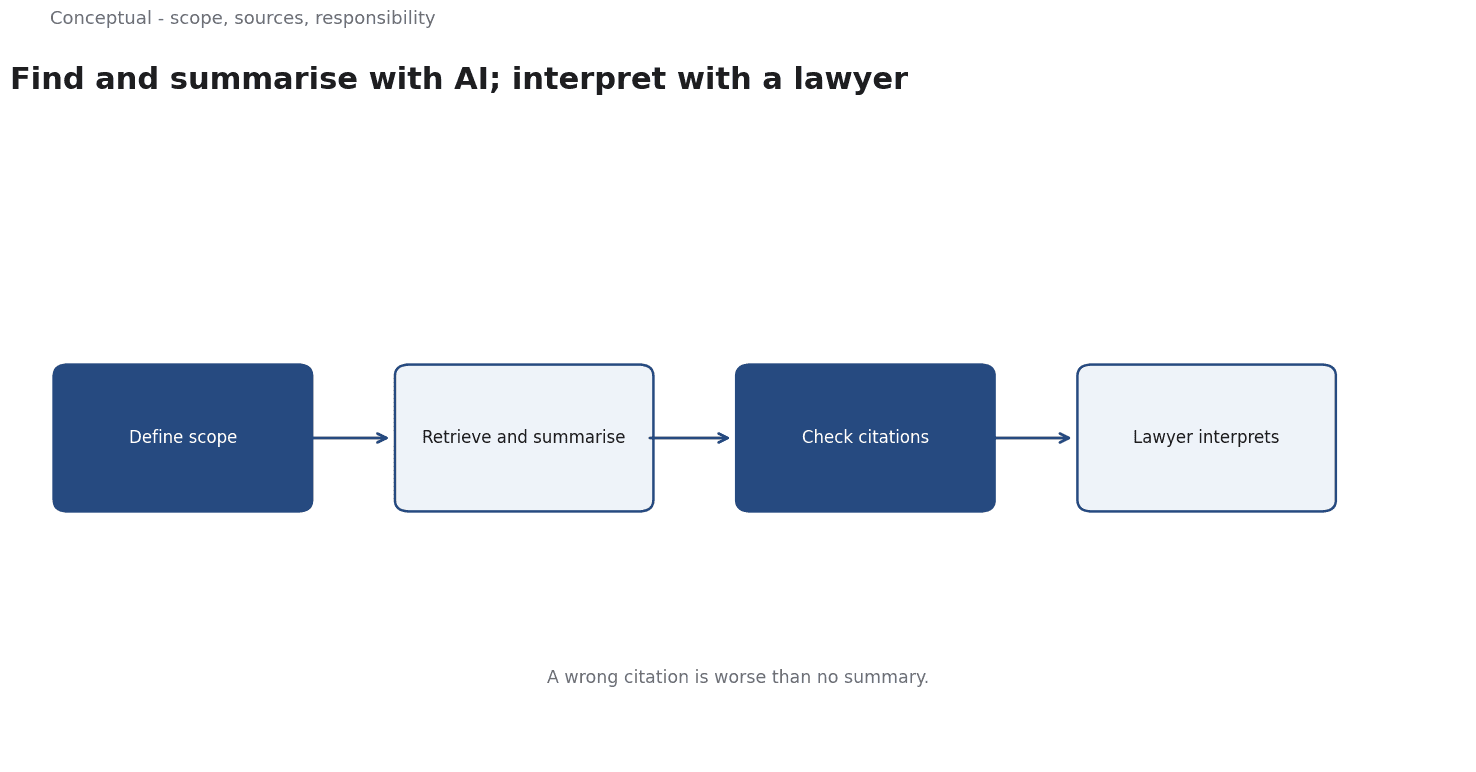
The framework
Scope the sources. Define the jurisdiction, the date range, and the types of authority the system may use, which the market-definition article analogises to defining the relevant set, as the data-governance article requires provenance for relied-upon records.
Ground every claim. Each summary point should cite a passage that supports it, which the legal-research article treats as the core control, as the hallucination article warns about invented citations, as the reduce-hallucinations article treats citation checks as a discipline.
Separate finding from interpreting. A tool can locate a statute and summarise it; a person decides how it applies, which the contract-review article treats as the boundary, as the human-in-the-loop article argues for a meaningful review.
Record the work. Keep the queries, the sources retrieved, and the review, which the decision-memo article requires for a recorded judgement, as the data-governance article requires for provenance.
Three consequences follow. The system's value is time saved on search, not authority, as AI in Legal Research: Retrieval, Summarization, Citation Checks explains.
And the scope should be reviewed when the matter changes, as the monitoring article treats as a trigger.
A worked check
The following is hypothetical and illustrative. A lawyer asks a tool to find authority on notice periods for a contract type in a jurisdiction.
Three checks decide whether the output is usable. First, citation existence: does the cited section exist, which the legal-research article requires? Second, support: does the passage actually say what the summary claims, as the reduce-hallucinations article treats as a separate check from existence? Third, completeness: was the controlling authority retrieved at all, which the reranking article treats as a recall problem, as AI in Legal Research: Retrieval, Summarization, Citation Checks warns that a clean summary of the wrong source is worse than none?
Three conclusions follow. The lawyer verifies every citation, as the oversight article requires for a meaningful review. The tool's output is a draft, not an opinion, as AI for Contract Review: What to Automate and What to Escalate argues for human judgement on material clauses. And the queries and sources should be recorded, as the decision-memo article requires.
What the framework cannot do
It cannot give legal advice, which the legal context requires a qualified person, as the AI Act article treats role-specific obligations, as the governance checklist requires an accountable owner. It cannot guarantee completeness, which the reranking article treats as a recall limit, as AI in Legal Research: Retrieval, Summarization, Citation Checks warns about missing authority. And it does not remove professional duties, which the current rules define, as AI in Legal Research: Retrieval, Summarization, Citation Checks requires a dated check.
The counterargument that the tool is faster than manual research is fair and incomplete, which the worked check shows: speed is useful only when the citations hold, as the evaluation-rubric article argues for outcome measures.
A decision test
- Define jurisdiction, dates, and source types, as the scope rule advises.
- Require a citation for every claim, as AI in Legal Research: Retrieval, Summarization, Citation Checks requires.
- Check existence and support separately, as the hallucination article advises.
- Keep interpretation with a qualified person, as AI for Contract Review: What to Automate and What to Escalate argues.
- Record queries, sources, and review, as the decision-memo article requires.
- Check current professional rules with a dated source, as AI in Legal Research: Retrieval, Summarization, Citation Checks advises.
- Review the scope when the matter changes, as the monitoring article recommends.
For the task pattern, see AI in Legal Research; for the clause boundary, see AI for Contract Review.
References & Further Reading
- Anthropic, 2026. Guides to common use cases - Claude Platform Docs — Production use-case guides for ticket routing, customer support agents, content moderation, legal summarization and commerce agents.
- American Association for Public Opinion Research, 2026. AAPOR — The professional association for public opinion and survey research; its standards and resources underpin the survey-design discussion.