AI Product Management: From Use Case to Roadmap
An AI roadmap starts with a decision, not a model. Read the selection criteria, a worked prioritisation, and what changes at each stage.
Many AI roadmaps are lists of capabilities the team wants to try — a chatbot, an agent, a summariser. That is a technology backlog, not a product roadmap. A useful roadmap starts with a decision that is currently slow or poor and asks whether AI changes it measurably.
Direct answer: Select AI use cases by decision value, data readiness, error cost, and reversibility, then move each through stages — problem, prototype, pilot, production — with a defined metric at each. Anthropic's use-case guides provide concrete patterns, and O*NET's task descriptions help identify the work a feature changes. The boundary: a capability that does not change a decision is a demo, and a use case with high error cost and poor data is a blocked project, not a priority.
Selection criteria
Decision value. What decision becomes better, faster, or cheaper? If nobody can name one, the use case is speculative.
Data readiness. Does the system have the information it needs, with known quality and access rights? The data-governance article covers the prerequisites.
Error cost. What happens when the AI is wrong? A recoverable suggestion is a better first project than an irreversible action, as the human-in-the-loop article explains.
Reversibility. Can the feature be rolled back? A reversible pilot teaches more than a large launch, which the deployment article describes.
A worked prioritisation
The following is hypothetical and illustrative.
A product team has four candidate use cases. Each is scored on value, data readiness, error cost (lower is better), and reversibility:
| Use case | Value | Data | Error cost | Reversible |
|---|---|---|---|---|
| Support reply drafts | High | Good | Low | Yes |
| Automated refunds | High | Good | High | No |
| Meeting summaries | Medium | Good | Low | Yes |
| Churn prediction | High | Poor | Medium | Yes |
Three decisions follow:
- Start with support drafts. High value, good data, low error cost, reversible — the clearest first candidate, as the customer-support use-case article describes.
- Do not start with automated refunds. The error cost is high and the action is irreversible. It belongs after a review stage has been measured, which the tool-calling article explains.
- Fix data before churn prediction. High value is irrelevant if the data is poor, as the data-quality article argues. This is a blocked project, not a late one.
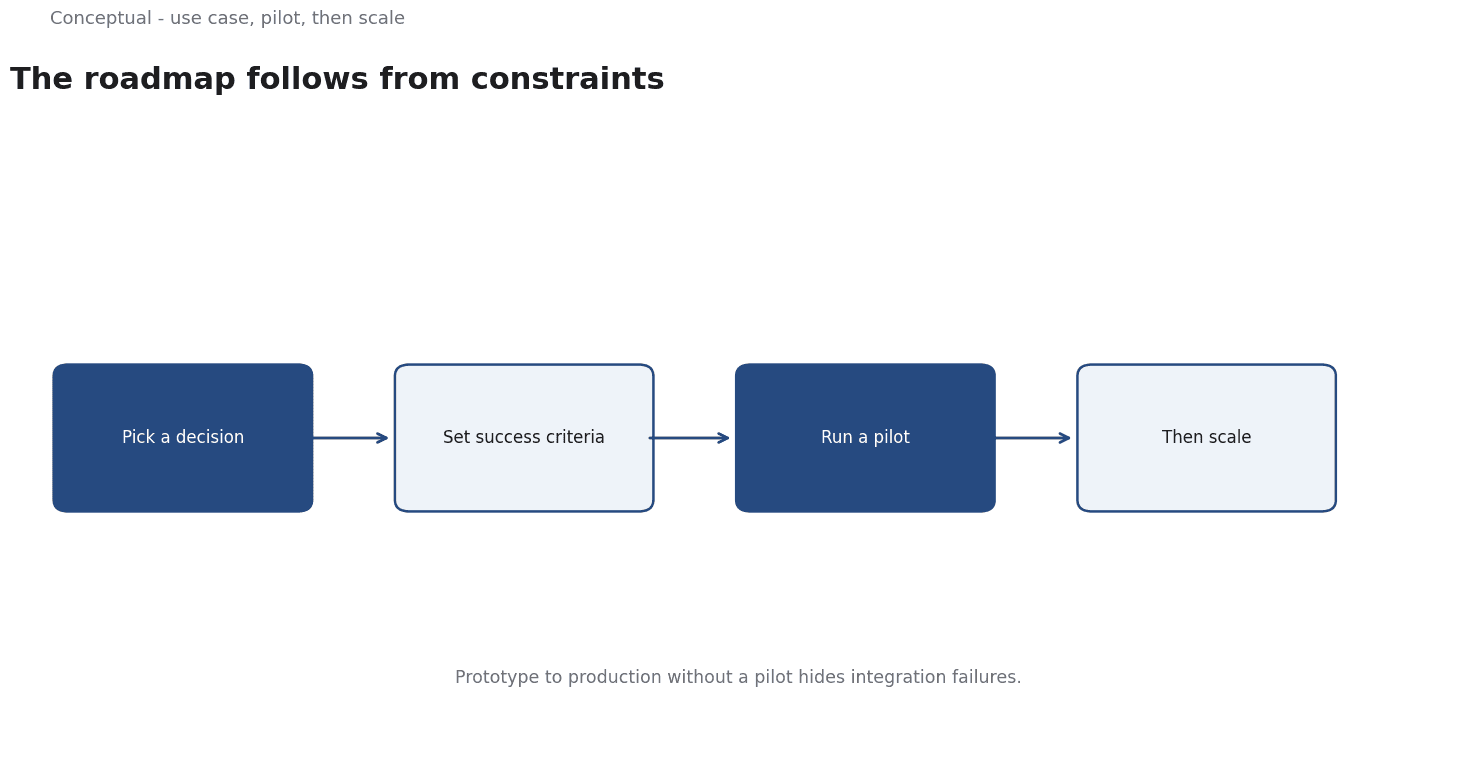
The point is that the roadmap follows from constraints, not from the excitement of the ideas.
Stages and what changes
Problem. Define the decision, the baseline, and the metric. No model work yet, as the AI-integration blueprint explains.
Prototype. Test whether a capability can do the task on a small labelled set. The question is feasibility, not scale, which the evaluation article covers.
Pilot. Put it in front of real users with a bounded scope and a review step. Measure the combined system, as the workflow-automation article describes.
Production. Add monitoring, ownership, a stop condition, and a review trigger. The governance checklist covers the requirements.
Each stage should be able to fail cheaply.
The metric at each stage
A roadmap without metrics is a sequence of activities. Four metrics keep it honest:
Feasibility rate at the prototype stage — how often a capability can do the task on a labelled set, which the evaluation article covers.
Adoption and usefulness at the pilot stage — whether users actually use the feature and whether it changes their decision, as the AI-adoption article distinguishes from mere access.
Combined-system accuracy at production — the error rate of the whole workflow, not the model alone, which the workflow-automation article explains.
Business outcome — the decision metric the use case was chosen for in the first place, such as time per task or cost per case, which the cost-estimator article quantifies.
A use case should be able to fail at any of these stages.
Killing a weak pilot is a success if it prevents an expensive production build.
What a roadmap cannot do
It cannot predict model capability changes. A model update can make a previously hard task easy or break a working one. The monitoring article explains why re-evaluation is tied to change.
It cannot remove governance. Each feature still needs an owner, a stop condition, and documentation, as the governance checklist requires.
It cannot substitute for measurement. A roadmap item is a hypothesis; the metric is the evidence, which the evaluation-rubric article explains.
The counterargument — that a fixed roadmap is unrealistic in a fast-moving field — is fair. The response is to keep the stages but allow the order to change when evidence changes, which the decision-memo article recommends for reversible decisions.
A decision test
- Name the decision each use case improves.
- Score value, data, error cost and reversibility.
- Start with low-error, reversible, data-ready cases.
- Move each through problem, prototype, pilot, production with a metric per stage.
- Block cases with poor data until the data is fixed.
- Keep a review step before irreversible actions.
- Re-prioritise on evidence, not on announcements.
For the selection frame, see What LLMs Actually Solve; for the implementation sequence, see AI Integration Into an Existing Business.
References & Further Reading
- Anthropic, 2026. Guides to common use cases - Claude Platform Docs — Production use-case guides for ticket routing, customer support agents, content moderation, legal summarization and commerce agents.
- U.S. Department of Labor, 2026. O*NET OnLine — The standard occupational taxonomy used to compare roles across industries.