AI Readiness Assessment: Questions to Ask Before Adopting
Readiness is not a score you buy. Read the four areas to assess, a worked test, and why the weakest answer decides the plan.
Organisations often treat AI readiness as a training exercise: teach everyone the basics, then start a project. That addresses one variable and ignores the others. A company can have skilled people and still lack the data, the decision rights, or the measurement needed to deploy anything responsibly.
Direct answer: Readiness is the weakest of four areas — data, skills, governance, and measurement — not their average. NIST's AI Risk Management Framework is "intended for voluntary use and to improve the ability to incorporate trustworthiness considerations into the design, development, use, and evaluation of AI products, services, and systems"; OECD.AI's work emphasises that AI carries risks for which "all actors must be accountable". The boundary: a readiness assessment is a set of questions that produce evidence, not a maturity score that predicts success.
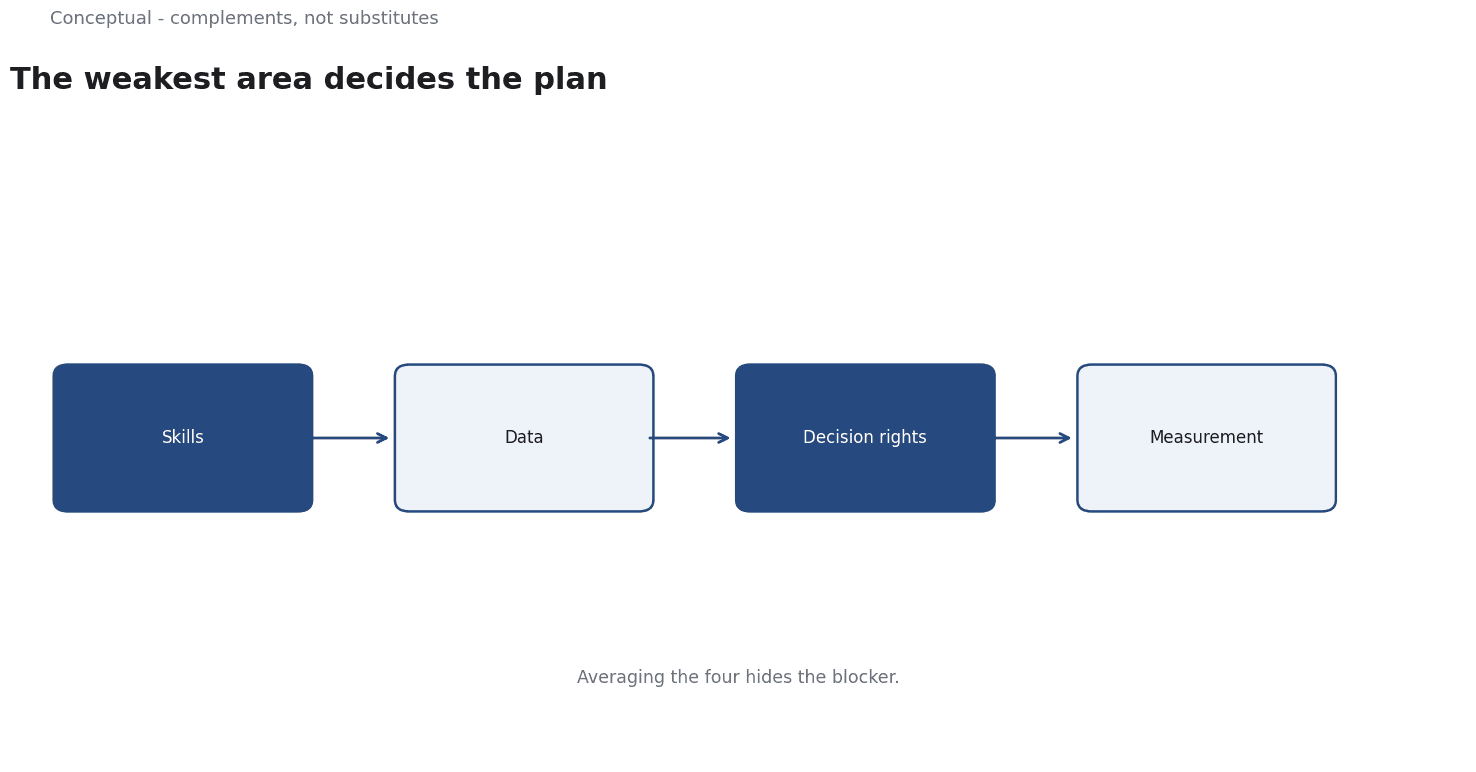
The four areas
Data. Can you locate the information a use case needs, and is it recorded consistently? An assessment that finds data split across systems or missing entirely has found the constraint before spending on models. Ask: where is it, who owns it, what is its quality, and may it be used for this purpose?
Skills. Does the team have the capability to operate what it adopts? O*NET's occupation descriptions — tasks, skills and requirements across "900+ occupations" — are a useful way to describe the work rather than naming a job title. Ask which tasks the system will change and who currently performs them.
Governance. Who is accountable when the system is wrong, and who can stop it? NIST's framework organises the work into governance, mapping, measurement and management. OECD.AI's framing adds that accountability is shared across actors — vendors, deployers and affected people — so a contract is not the end of the question.
Measurement. Can you tell whether the system improved anything? This requires a baseline before deployment. A team that cannot describe today's cost, error rate, or cycle time cannot demonstrate tomorrow's improvement.
Why the weakest area decides
These areas are complements, not substitutes.
Strong skills do not compensate for data that cannot be used. Excellent data does not help if nobody can stop a failing system. A clear governance policy is hollow without measurement to trigger it.
This is the opposite of a checklist where you tally points. A readiness profile with three strong areas and one absent one has a single project constraint, and the plan should be built around that constraint.
A worked example of a readiness test
The following is hypothetical and illustrative.
A mid-sized insurer considers an AI assistant to summarise claims documents. The assessment scores each area on three concrete questions:
| Area | Question 1 | Question 2 | Question 3 | Verdict |
|---|---|---|---|---|
| Data | Documents are digitised (yes) | Consistent format (no) | Usage rights clear (unclear) | Blocker |
| Skills | Staff use similar tools (yes) | Review skills present (yes) | Vendor management (no) | Partial |
| Governance | Owner named (yes) | Stop condition defined (no) | Escalation path (no) | Weak |
| Measurement | Cycle time recorded (yes) | Error baseline (yes) | Held-out set (no) | Partial |
Three conclusions follow:
- Data is the binding constraint. If documents are inconsistent in format and usage rights are unclear, a pilot that assumes clean inputs will measure the wrong thing. The first work item is standardisation and a legal check, not a model choice.
- Governance gaps are cheap to close. Naming a stop condition and an escalation path takes a workshop. These should be fixed in parallel, because they will be needed as soon as the data issue is resolved.
- The measurement foundation exists. Cycle time and error rate are already recorded; adding a held-out set is a manageable next step. This area is an asset, not a blocker.
A score that averaged these areas would call the company "mostly ready" and start a pilot that stalls. The profile says something more useful: fix data, close governance cheaply, and leverage the existing measurement discipline.
How to run the assessment
A practical process has four steps:
Choose one use case. Readiness is meaningless in the abstract; a company can be ready for document summarisation and unready for autonomous action.
List the evidence, not the opinions. For each area, ask for the artefact: a data inventory, a named owner, a recorded baseline, a documented stop condition. If no artefact exists, the answer is "not ready" regardless of confidence.
Score each area separately and identify the weakest. Do not combine them into one number.
Write the next action for the weakest area with an owner and a date. The assessment is useful only if it changes the plan.
The artefact test in practice
The difference between an opinion and evidence is concrete in each area:
- Data: an inventory with column definitions, an owner, and a documented usage right — not "we have a data lake".
- Skills: a task list mapped to current staff, with named people who have performed those tasks — not "the team is technical".
- Governance: a document naming the accountable owner, the stop condition, and the escalation path — not "we have an AI policy".
- Measurement: a recorded baseline with a denominator and a time window, and a held-out set the team has actually scored — not "we will measure it later".
Running this test usually changes the assessment. Areas that felt strong become partial when an artefact is requested; areas that felt weak sometimes turn out to be nearly complete because the artefact already exists in another team.
That is the point: the assessment should reveal what the organisation actually has, not what it believes about itself.
What assessments cannot do
They do not predict success. A strong profile removes known blockers; it does not guarantee that a use case creates value. The pilot still has to measure that.
They go stale. Data, staff, and rules change. Tie a review to material changes — a new system of record, a vendor change, a new regulation — not to an annual ritual.
NIST's framework is voluntary. It structures evidence; it is not a certification. Calling a system "AI RMF aligned" because a workshop was held would be exactly the kind of claim the framework's measurement emphasis is meant to prevent.
The counterargument — that a heavy assessment slows adoption — is fair. The response is scope: assess one use case, ask for artefacts that may already exist, and close the single binding constraint rather than trying to raise every area at once.
A decision test
- Name one use case before assessing anything.
- Ask for artefacts — inventory, owner, baseline, stop condition — not confidence ratings.
- Score data, skills, governance and measurement separately.
- Treat the weakest area as the project constraint.
- Assign an owner and date to the next action for that area.
- Use NIST and OECD material as structure, not as a badge.
- Re-assess on change, not on a fixed calendar.
For the sequence that follows a ready assessment, see AI Integration Into an Existing Business; for the governance frame, see AI Governance.
References & Further Reading
- NIST, 2023. AI Risk Management Framework | NIST — The governance framework referenced in AI risk and compliance work.
- OECD.AI, 2026. The AI Wonk - OECD.AI — OECD policy and measurement work on AI accountability and trustworthy adoption.
- U.S. Department of Labor, 2026. O*NET OnLine — The standard occupational taxonomy used to compare roles across industries.