AI Sales Research Mistakes to Avoid
AI can summarise accounts, not decide what a buyer needs. Read the mistakes, a worked example, and why fluent notes can hide weak evidence.
AI sales research is often measured by how much it shortens preparation, which ignores whether the preparation improved. Anthropic's use-case guides describe summarisation patterns, and the CRM entry covers the records such work depends on. The mistakes concern evidence and judgement.
Direct answer:
Use AI to gather and summarise account information from defined sources, with a person deciding what matters and a check on the claims.
The sources describe the capability and the system; the checks are a synthesis.
Delta: This article adds a claim-status table and a worked review, separating documented capability from the local judgement about relevance and accuracy.
The mechanism
Three points matter:
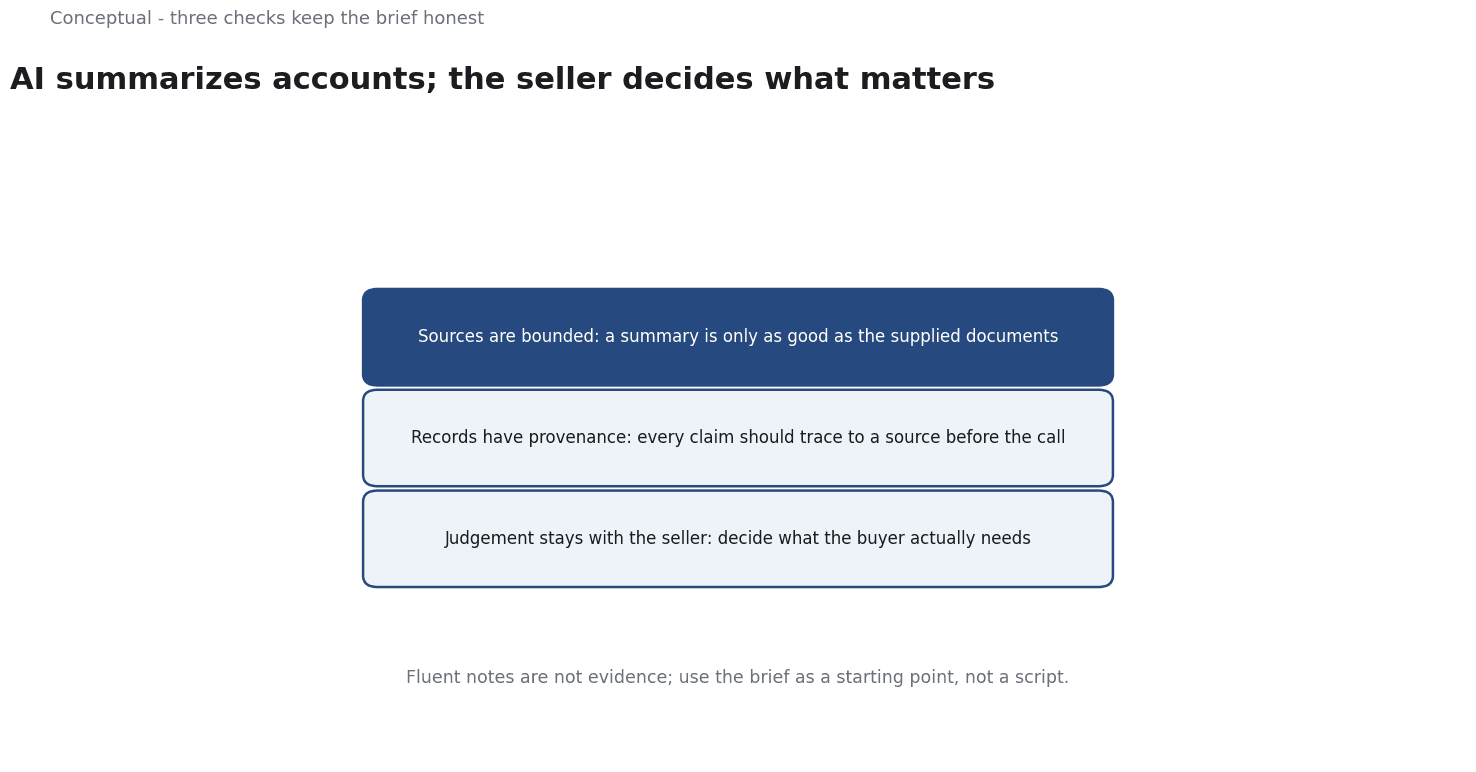
- Sources are bounded. The use-case guides describe working with supplied material. A summary is only as good as the documents it was given.
- Records have provenance. The CRM entry describes customer records. A claim without a traceable source cannot be checked before a call.
- Judgement stays with the seller. Deciding what a buyer cares about is the work, not producing a longer brief.
The sequence is: define the sources, check the summary against them, then decide what to use. Checking the summary is local work, so it is inferred; the capability is source-reported.
A worked example
Illustrative. A tool produces a two-page brief on a prospective client before a call.
Three checks decide. First, are the claims in the brief traceable to the sources provided? Second, does the brief distinguish what the company publicly says from what the tool inferred? Third, what would the seller do differently because of it?
The outcome is a use decision with a recorded limit. The scenario is hypothetical; the check sequence is the contribution.
Why the source set decides the usefulness
A brief built from a company's public filings and website will reflect what that company chooses to publish. A brief that also includes the conversations the seller has already had will reflect the relationship. Mixing the two without labelling them produces a document that sounds authoritative but cannot be checked.
The most useful briefs are short and specific. They name what is known, what is uncertain, and what the seller should ask. A longer document that repeats general industry context consumes preparation time without changing the call, which is the opposite of the tool's purpose.
Why privacy belongs in the checklist
Research that combines public and private information crosses a boundary that depends on jurisdiction and consent. Checking that boundary before the tool is used is cheaper than discovering it after the output has been circulated. It also sets a precedent for how the team handles similar tools.
Evidence status
| Claim | Status | Source | Verified | Recheck when |
|---|---|---|---|---|
| Models can summarise supplied material | source-reported | Anthropic use-case guides | 2026-11-18 | Capabilities change |
| CRM systems hold customer records | source-reported | Wikipedia, CRM | 2026-11-18 | System changes |
| Verify claims before using them | inferred | Derived from reconciliation practice | 2026-11-18 | Source set changes |
Why fluency is not evidence
A summary that reads well can combine a fact from a source with an inference that sounds equally certain. The distinction matters before a sales call, because a confident wrong claim damages credibility. Asking which sentence came from which document is a simple way to separate them.
A final issue is over-reliance.
Treating the brief as a starting point rather than a script preserves the part of sales work that requires attention.
The tool also has a maintenance cost. Sources change, links expire, and a brief generated from stale material is worse than no brief because it carries false confidence. Reviewing the source set on a schedule is part of using the tool responsibly.
A clear rule for what the brief may contain makes the boundary easier to hold. Stating that every claim must name its source turns a vague standard into something a reviewer can check, which is the difference between a policy and a practice.
The value of the tool is highest when the brief helps the seller ask a better question, not when it replaces the conversation.
A seller who can trace every claim in the brief to a source is in a much stronger position than one who only knows that the document reads well.
What it cannot do
It cannot know what a buyer values without evidence. It does not replace listening. And it cannot guarantee that a summary is accurate.
The counterargument that a brief is better than nothing is fair for orientation and incomplete for claims that will be repeated to a customer.
A decision test
- Define the sources.
- Check claims against them.
- Separate facts from inferences.
- Decide what to use.
- Check privacy obligations.
- Record the decision and recheck trigger.
For the system context, see CRM Marketing Trade-offs.
References & Further Reading
- Anthropic, 2026. Guides to common use cases - Claude Platform Docs — Production use-case guides for ticket routing, customer support agents, content moderation, legal summarization and commerce agents.
- Wikipedia contributors, 2026. Customer relationship management - Wikipedia — Systems for managing customer relationships.