CRM Marketing Trade-Offs
A CRM system holds records, not relationships. Read the trade-offs, a worked example, and why more data does not mean better messages.
A CRM is often bought as a way to improve customer relationships, which skips the question of what the organisation will do differently with the records. The CRM entry describes systems for managing relationships, as the demand-generation entry covers the stages a customer moves through, as the data-governance article requires provenance, as the email-marketing article treats measurement, as the value-proposition article argues for a specific promise, as the publication standard forbids guaranteed outcomes.
Direct answer: Choose CRM marketing practices by the decision they support, the data they need, and the privacy duties they create — not by the number of fields stored. Wikipedia's CRM entry provides the context, and demand generation covers the customer stages. The boundary: a record is not a relationship, which the voice-of-customer article treats as feedback, as the privacy article makes obligations jurisdiction-specific, as the risk article requires residual risk.
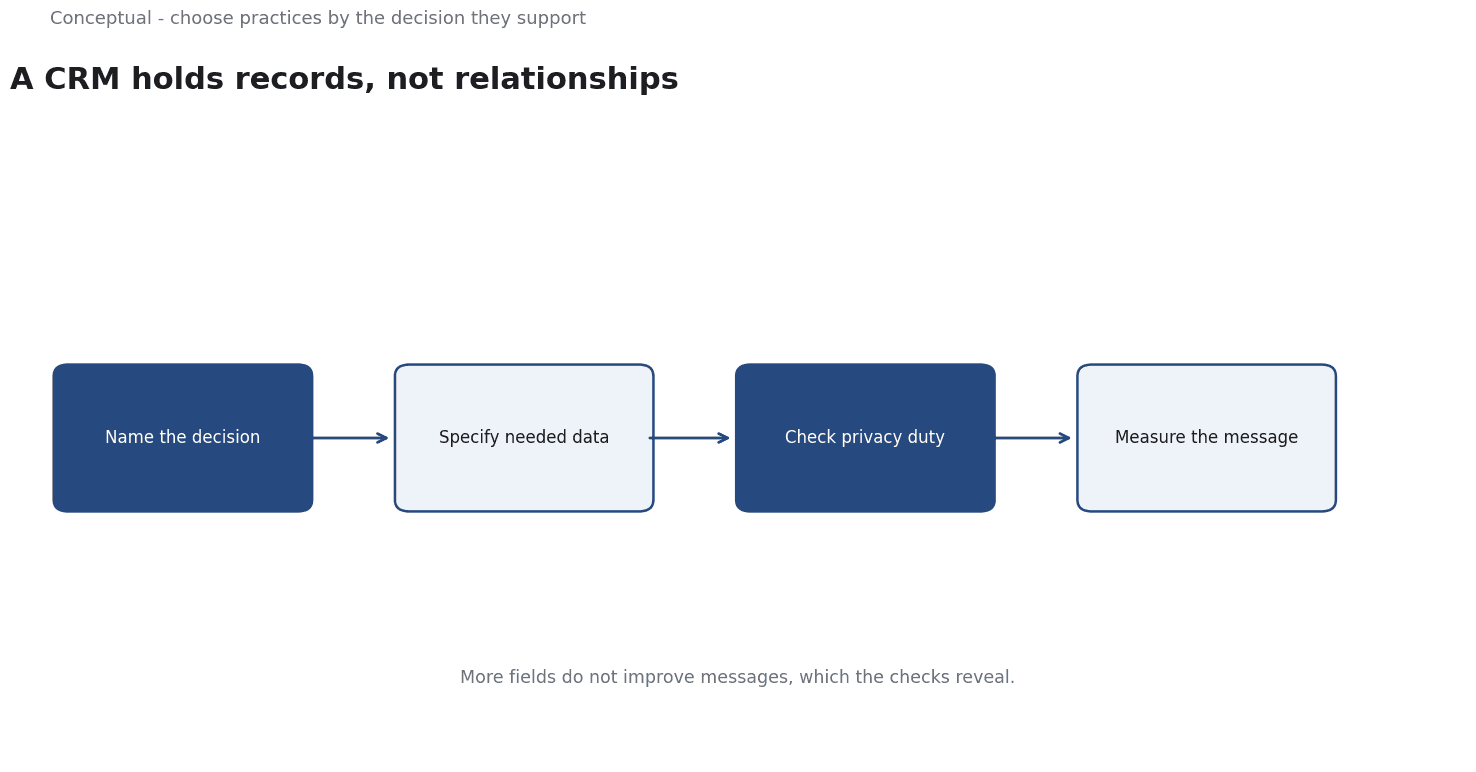
The trade-offs
Records versus relationships. A system can store every interaction, which the CRM entry describes, as the data-governance article requires provenance, as the voice-of-customer article treats feedback as a signal, as Lifecycle Email: Triggered Messages Across the Customer Journey advises for evidence, as the dashboard article argues for metrics tied to decisions, as the rubric article requires criteria, as the risk article requires residual risk.
Automation versus relevance. Triggered messages scale, which the marketing-automation entry describes, as the lifecycle-messaging article advises on stage fit, as the value-proposition article argues for a specific promise, as the email-metrics article treats intermediate signals, as the attribution article warns about credit rules, as the monitoring article advises for review.
Personalisation versus privacy. More data can tailor a message, which the CRM entry treats, as the privacy article makes obligations jurisdiction-specific, as the consent article advises, as the data-governance article requires provenance, as the first-party-data article treats purpose, as the governance checklist requires an owner, as the risk article requires residual risk, as the decision-memo article requires for a record.
Centralisation versus ownership. A shared system helps consistency, which the CRM entry describes, as the content-operations article treats process, as the martech article warns about tools without a use, as the governance checklist requires an owner, as the data-governance article requires dated definitions, as the monitoring article advises for review, as the risk article requires residual risk.
Three consequences follow. The decision comes before the fields, as the dashboard and rubric articles advise, as the value-proposition article argues, as the decision-memo article requires a question, as the data-governance article requires dated definitions, as the demand-generation entry describes stages, as the lifecycle-messaging article advises, as the email-metrics article treats signals, as the attribution article warns, as the privacy and consent articles require, as the first-party-data article treats purpose, as the governance checklist requires an owner, as the content-operations and martech articles advise, as the monitoring article advises for review, as the risk article requires residual risk, as the decision-memo article requires for a record.
A worked example
The following is hypothetical and illustrative. A team buys a CRM to improve retention and imports every past interaction.
Three checks decide. First, what decision should the records change, as the dashboard and decision-memo articles require, with a criterion, as the rubric article requires? Second, are the messages relevant to the customer's stage, as the lifecycle-messaging and value-proposition articles advise, with evidence, as the voice-of-customer article treats? Third, are privacy obligations met, as the privacy and consent articles require, with provenance, as data governance requires, as the governance checklist requires an owner, as the risk article requires residual risk?
Three conclusions follow.
More fields do not improve messages, which the checks reveal.
Relevance depends on the stage, as the lifecycle-messaging article advises. And the decision should be recorded, as the decision-memo article requires.
What CRM marketing cannot do
It does not remove privacy duties, which the privacy and consent articles require, as the first-party-data article treats purpose, as the data-governance article requires provenance, as the governance checklist requires an owner. And it cannot guarantee retention, which the retention article treats as an economic question, as the dashboard article argues, as the rubric article requires criteria, as the monitoring article advises for review.
The counterargument that a single system fixes coordination is fair for visibility and incomplete without a decision, which the worked example shows, as the dashboard and decision-memo articles advise, as the martech article warns about tools without a use, as the risk article requires residual risk.
A decision test
- Name the decision the CRM should support, as the decision-memo article requires.
- Define the needed data, as data governance requires.
- Match messages to stages, as the lifecycle-messaging article advises.
- Check privacy obligations, as the privacy article requires.
- Measure behaviour, as the analytics article advises.
- Treat credit rules as claims, as the attribution article warns.
- Record the decision and residual risk, as the decision-memo and risk articles require.
For the stages, see Demand Generation; for the messages, see Lifecycle Email.
References & Further Reading
- Wikipedia contributors, 2026. Customer relationship management - Wikipedia — Systems for managing customer relationships.
- Wikipedia contributors, 2026. Demand generation - Wikipedia — An overview of demand generation as a marketing discipline distinct from lead generation; secondary reference used with the lead-generation entry.