AI Search Costs Explained
AI search shifts where the cost of discovery lands. See what Google's AI features require, where assisted content spends effort, and a claim-status decision test.
Search engines now generate answers with AI features, and teams wonder what that costs them. Google's guidance describes how sites appear in those features, while Anthropic's use-case guides describe where AI assists content and analysis work. The real problem is that the cost of visibility moved from a technical checklist to ongoing content quality and review, which is harder to budget.
Direct answer:
AI search features produce answers that may satisfy a query without a click, so the return on creating content is harder to attribute than in classic results.
Google states that sites do not need special markup to appear in AI features; standard search best practices still apply. The cost therefore sits in producing and maintaining content worth citing and in reviewing AI-assisted output, not in a new tag to deploy.
Delta: This article adds a decision framing beyond the sources: it maps AI features and assisted-work use cases to a content-cost decision, with claim status explicit.
The mechanism
Google's documentation on AI features explains that these experiences generate answers and can link to sites, and that site owners do not need a special designation or markup to be included; the ordinary practices that make content discoverable - crawlable pages, clear structure, useful information - remain the basis. That continuity is important for cost planning. There is no new integration to buy and no proprietary tag to maintain, which means the marginal cost of appearing is not a setup fee but the ongoing quality of the content and the site that hosts it.
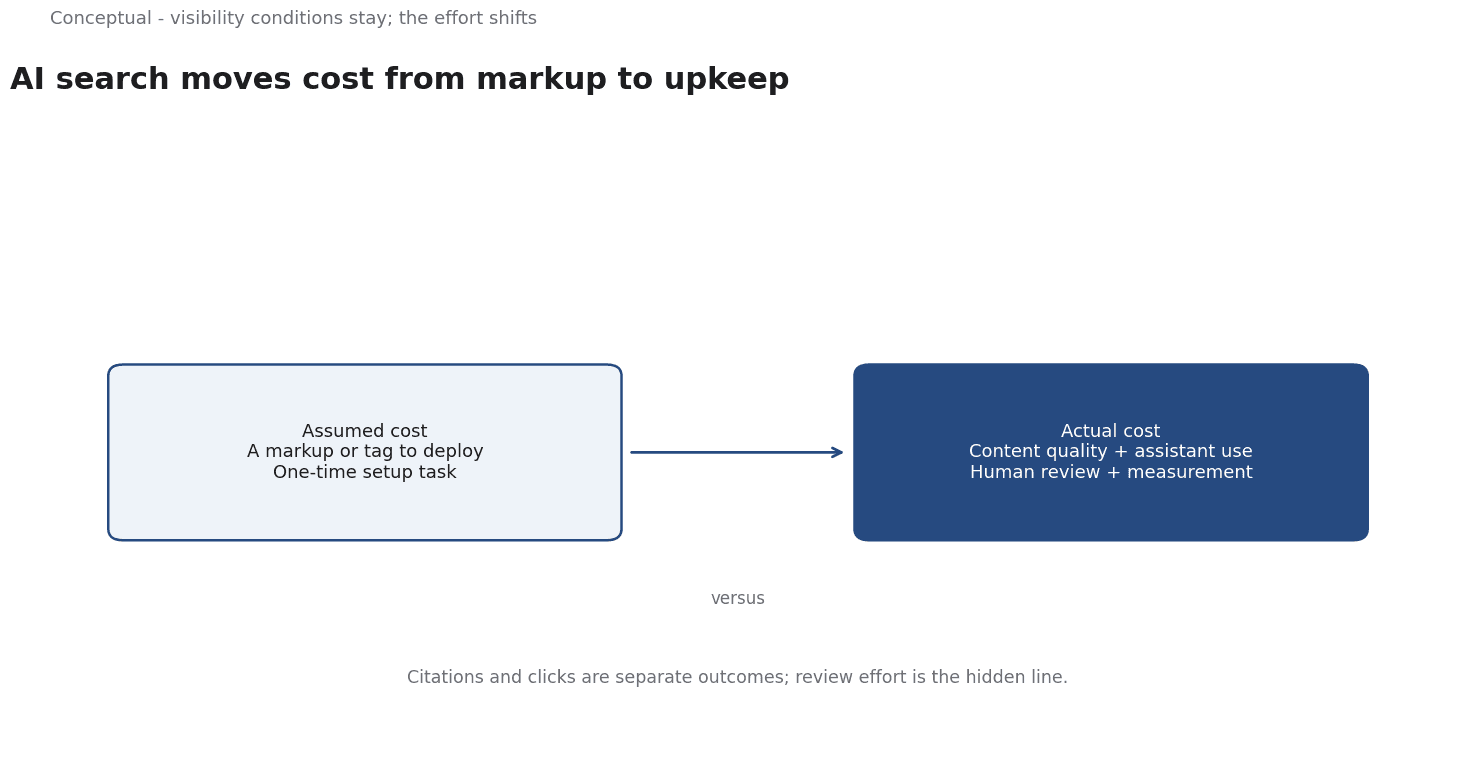
The consequence is a shift in where effort is spent. When an answer can be assembled from multiple sources, a page may be used as a cited input without receiving a visit, so traffic no longer tracks the value the content provides. Teams that budget for content by counting expected clicks will undercount that value, while teams that count impressions as conversions will overcount it. The defensible approach is to treat citation and visibility as separate outcomes from clicks and to measure them with different signals, accepting that neither is a complete measure of return.
Anthropic's use-case guides describe common ways an assistant is put to work, including generating and editing text, summarising material, and analysing information. These are the tasks a content team would use to keep material current at scale. The cost on this side is twofold: the usage required to run the assistant, and the human review needed before output is published. Because a guide lists a use case, it does not follow that the output is fit to publish unchecked; the review step is where accuracy and brand risk are contained, and it is the part most easily underestimated in a budget.
Together the sources point to a cost structure rather than a price. The Google material defines the conditions for visibility, and the Anthropic material describes the assisted work that can sustain it. Deciding how much to spend on content, on review, and on measurement is a local choice about a site's goals and risk tolerance, which is why the claim status is explicit below.
A worked example
The following is hypothetical and illustrative. A publisher sees that its explainer pages are cited in AI answers but clicks are flat, and it wants to decide whether to keep funding them. Three checks decide. First, a visibility check: the team confirms the pages are crawlable, well structured, and current, matching Google's stated conditions rather than adding speculative markup. Second, a cost check: it totals the assistant usage used to refresh the pages and the hours spent reviewing output before publication. Third, an outcome check: it records citations and assisted conversions separately from raw clicks. The outcome is a decision to keep the pages but cap review time on low-traffic topics. The scenario is hypothetical; the mapping from cost to decision is the contribution.
Evidence status
| Claim | Status | Source | Verified | Recheck when |
|---|---|---|---|---|
| AI features can surface site content without a special markup requirement | source-reported | Google AI features | 2026-11-18 | Google guidance changes |
| Claude use-case guides cover tasks such as content generation and analysis | source-reported | Anthropic use-case guides | 2026-11-18 | Guides or product scope change |
| The main cost shifts from markup to content quality and output review | inferred | Derived from the sources | 2026-11-18 | Attribution or assistant pricing changes |
The source-reported rows describe what the two documents actually say: one about appearing in AI features, the other about common assisted-work tasks. The inferred row is the article's synthesis of those statements into a cost structure, not a published conclusion. Recheck it if Google changes the conditions for visibility or if assistant usage costs move enough to change the review budget.
What it cannot do
This framing has a clear limit. The sources describe how AI features include sites and where an assistant can help with work; they do not provide a cost figure, a traffic forecast, or a guarantee that content will be cited. Any number attached to the return on AI search is a local estimate, not a fact the documents supply. The framework is useful for deciding what to measure and where effort goes, but it cannot tell you whether a particular page is worth funding or how a change in an answer engine will affect your traffic next quarter.
A hidden cost is attribution. When an answer is assembled from several sources, the link between a page and the eventual visit - if a visit happens at all - is weak, and standard analytics may show nothing for content that was used. Teams then either cut valuable content because the dashboard looks empty or keep funding it on faith. Neither is satisfying. Recording citations, assisted conversions, and direct visits as separate signals is more honest than forcing them into one return number, but it requires measurement work and a tolerance for ambiguity that a single metric would hide.
Publishing more pages because AI features exist can dilute quality and raise review costs without improving visibility, since the conditions Google describes reward useful content rather than volume. A related failure is treating AI-assisted output as finished; a guide lists a use case, not an accuracy guarantee, and published errors damage the credibility that makes a site worth citing in the first place. A third is copying the markup practices of an older search era onto a system that does not need them, spending budget on a technical task while the real cost - keeping content accurate and current - goes unmanaged.
The boundary is when this cost framing applies at all. Sites whose value comes from transactions, products, or services may care less about being cited in an answer than about the searches that lead to a purchase, and the cost of AI search then sits in a different part of the funnel. Conversely, a site that relies on informational traffic for its model has a direct exposure to answers that satisfy queries without clicks. The same sources support both situations; deciding which one governs a business is a strategy question that the documents do not answer.
Conditions also need review. Google's guidance on AI features can change as the products evolve, and the assistants described in the use-case guides gain new capabilities and pricing. A cost model built on today's conditions can quietly expire. Keep a record of the guidance version and the assistant usage assumptions behind each budget, and set a trigger to revisit them when the documentation changes or when citation and click patterns diverge. Without that, the team defends a cost structure that no longer matches the system it was built for.
The counterargument that AI search visibility is just classic search with a new label is fair for the technical conditions of being found, and incomplete for a model where answers can replace the click that used to pay for the content.
A decision test
- Confirm the basics. Ensure pages are crawlable, structured, and current before adding anything new.
- Avoid speculative markup. Do not fund a technical task the guidance does not require.
- Total the content cost. Count assistant usage and the human review hours behind each page.
- Separate the outcomes. Track citations, assisted conversions, and clicks as distinct signals.
- Set a review ceiling. Cap review effort on topics that do not justify it.
- Record the assumptions. Save the guidance version and usage costs with the budget.
- Set a review trigger. Revisit when Google's guidance or assistant costs change.
AI search costs are better understood as a relocation of effort than as a new line item. The sources say what visibility requires and where assistance can help; the budget is a local decision about content quality, review, and measurement. Make those choices explicit, and the spend becomes something you can defend when the answer engines change.
For further reading, see What AI Search Actually Measures.
References & Further Reading
- Google, 2026. AI Features and Your Website — What Google documents about AI Overviews and AI Mode in search.
- Anthropic, 2026. Guides to common use cases - Claude Platform Docs — Production use-case guides for ticket routing, customer support agents, content moderation, legal summarization and commerce agents.