What AI Search Actually Measures
A citation count or visibility score is not attention or preference. Read what each AI-search metric really records and what it leaves out.
AI-search dashboards report numbers with confident names — visibility score, citation share, answer presence. The question most readers do not ask is what those numbers actually record. A metric can be computed correctly and still describe something quite different from what its label suggests, which is a general problem in measurement, as the AAPOR standards and the evaluation-rubric article both argue.
Direct answer:
Most AI-search metrics record the output of a system under a specific test — whether a domain appeared in a sampled answer — not audience attention, preference, or revenue.
The measuring-GEO material is the reference for what can and cannot be counted, and geo-experiment guidance covers comparison designs. The boundary: no metric guarantees an outcome, which the publication standard states for SEO and GEO claims, and a credit rule is not a causal measurement, as the attribution article explains.
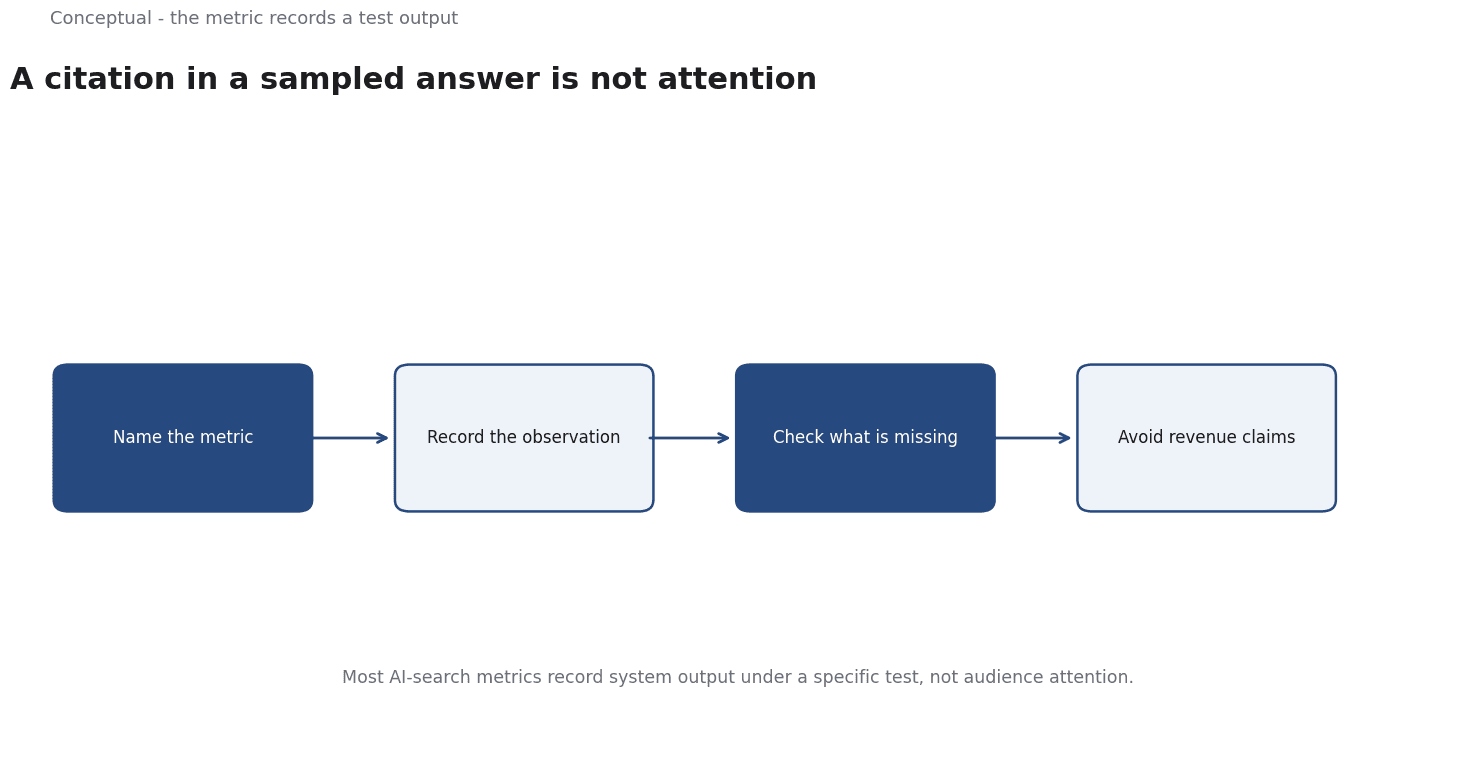
What the numbers record
Citation presence. Whether your domain appeared in a sampled answer at a point in time. It records the system's output for that question and run, which the measuring-GEO article treats as an observable signal, not a measure of how many people saw or trusted it.
Visibility score. Usually a composite of citation frequency across a question set, which is a property of the test set and the engines sampled, as the keyword-research article warns about treating a set as the market. Change the questions and the score changes, which means it measures the test as much as the brand.
Share of voice. A relative count of citations among competitors in the sample, which the brand-awareness article treats as a directional signal, not a measure of preference, as the brand-lift article distinguishes recognition from favourability.
Referral traffic. Actual visits from an answer engine, which is observed behaviour and the most defensible of the group, as the measuring-GEO article says, though it undercounts answers that produce a brand search instead of a click, as the zero-click article explains.
Three consequences follow. Metrics should be read with the question set, engines, and dates attached, which the data-governance article requires for relied-upon figures.
And they should be paired with a behavioural comparison, as the geo-experiment guidance recommends.
A worked interpretation
The following is hypothetical and illustrative. A tool reports a brand's visibility score rose from 20 to 35 over a quarter, and a dashboard shows referral traffic up 10%.
Three checks decide what can be said. First, was the question set fixed, as AAPOR's standards require for comparable wording? If questions were added that favour the brand, the rise is a change in the test. Second, do referrals and branded search move in the same direction, which the brand-lift article treats as corroboration? Third, is there a comparison against background trends, as the geo-experiment guidance recommends? A category-wide change in answer behaviour could explain both.
Three conclusions follow. The score is evidence about the sampled questions, not the market, as the keyword-research article advises. The interpretation should be labelled directional, which the measuring-GEO article requires. And any investment decision should be recorded with those limits, as the decision-memo article requires.
What the metrics cannot do
They cannot measure trust or preference, which the brand-awareness article distinguishes from recognition. They cannot guarantee a future citation, which the publication standard forbids claiming. And they do not establish causation from a score change, as the causal-inference article warns about treating association as effect.
The counterargument that directional metrics are useless is wrong.
They are useful when labelled, which the measuring-GEO article argues for honest practice, and harmful when presented as precise outcomes, which the publication standard prohibits.
A decision test
- State the question set, engines, and dates behind every metric.
- Read citation metrics as outputs of a test, as the measuring-GEO article advises.
- Pair with behavioural signals, as the brand-lift article recommends.
- Use a comparison for any effect claim, as the geo-experiment guidance requires.
- Do not present a score as revenue, as the attribution article warns.
- Label interpretation as directional, as the measuring-GEO article requires.
- Record the decision with its limits, as the decision-memo article advises.
For the method, see How to Evaluate AI Search; for the measurement limits, see Measuring GEO.
References & Further Reading
- American Association for Public Opinion Research, 2026. AAPOR — The professional association for public opinion and survey research; its standards and resources underpin the survey-design discussion.
- Brian Vaver and Koehler, 2011. Measuring Ad Effectiveness Using Geo Experiments — Geo experiments for incrementality, the cleanest way to attribute marketing spend.