AI Tools for Product Managers: A Practical Shortlist
Most AI tool lists are catalogues. Read a task-based shortlist for product work, with the checks that decide whether each tool is useful.
An AI tool list that names products ages quickly and answers the wrong question. The useful question is which part of product work has a shape that AI can help with — synthesis, drafting, analysis, or exploration — and what evidence would show that the tool improved it.
Direct answer: Product work breaks into tasks that AI assists differently: synthesising feedback, drafting specifications, exploring alternatives, analysing product data, and preparing communications. Anthropic's use-case guides cover concrete patterns, and O*NET's occupation descriptions help define what the role actually does. The boundary: a tool is a capability, not a workflow — value comes from embedding it in a decision process with a baseline and a review step.
Five task areas
Feedback synthesis. Grouping customer feedback by theme, extracting verbatim quotes, and counting mentions. The extraction-and-judgement pattern keeps the evidence separate from the interpretation.
Specification drafting. Producing a first version of a requirements document or user story from notes. A person still decides what the product should do.
Alternative exploration. Generating options for a design decision with their trade-offs. The value is breadth, not a recommendation — the PM owns the choice.
Product data analysis. Natural-language questions over a defined dataset, such as activation by cohort. The analysis must be grounded in the actual numbers, as the reporting-automation article explains.
Communication. Drafting updates, release notes, and stakeholder summaries. Tone and accuracy both need review.
A worked example of tool evaluation
The following is hypothetical and illustrative.
A PM wants to use an AI tool for feedback synthesis. The team currently spends six hours a month reading support tickets and writing a themes summary.
Step 1 — Baseline. Record the current time, the number of themes identified, and a sample of summaries for comparison.
Step 2 — Trial. Run one month of tickets through the tool with a fixed prompt: extract distinct complaints verbatim, group by underlying cause, count each group, and cite example tickets.
Step 3 — Check. Have a human review 50 tickets and compare their themes with the tool's. If the tool misses a theme that appears in more than 5% of tickets, the prompt or the input coverage needs work.
Step 4 — Decide. If the tool reduces time to two hours a month and the theme agreement is above the team's threshold, adopt it. Otherwise, keep the manual process or change the approach.
Three lessons follow:
- The tool is judged on a task metric, not on how impressive its demo looked.
- Theme agreement is measurable, which makes the decision defensible.
- Six hours saved is the entire benefit unless the synthesis changes a decision — which is a separate question the trial should also ask.
Building the habit
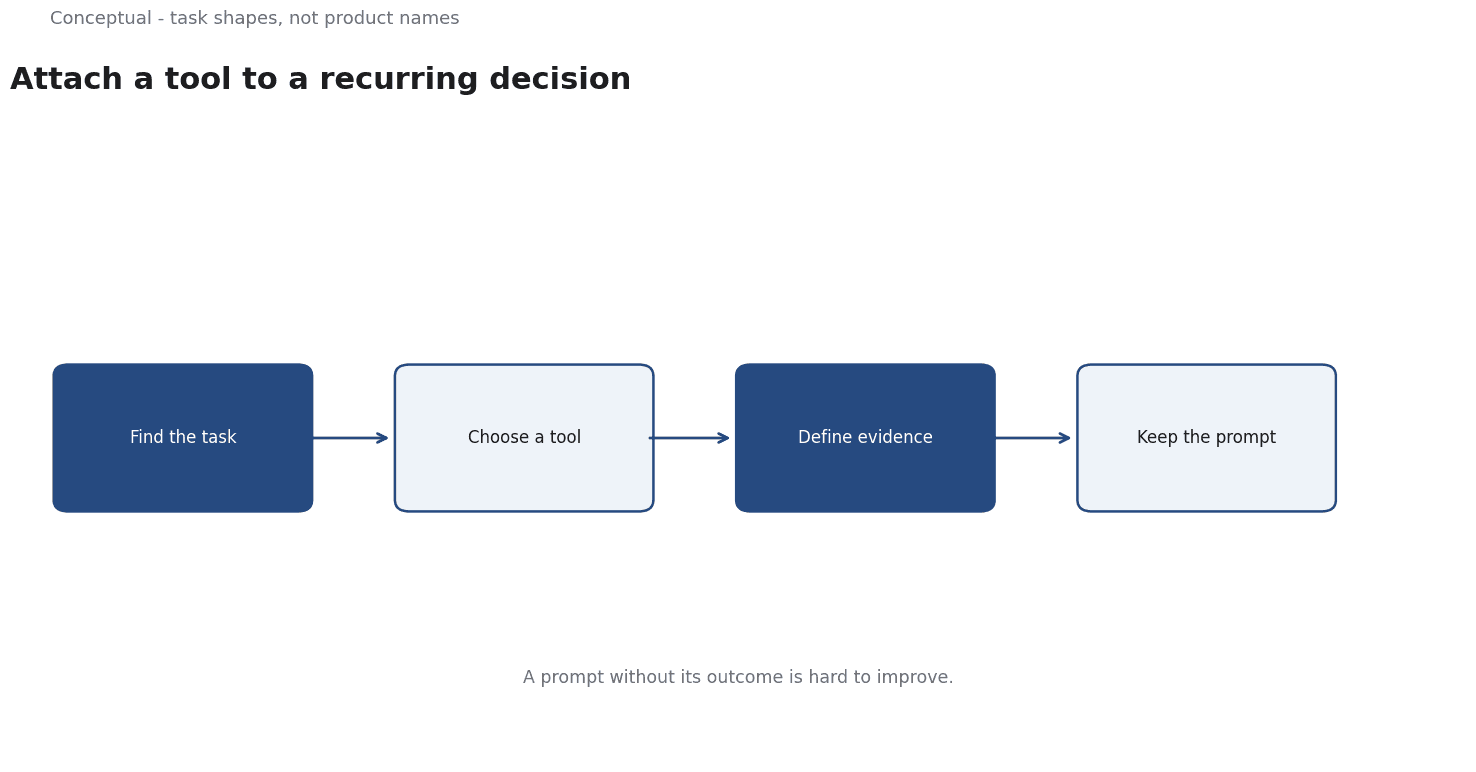
A tool becomes useful when it is attached to a recurring decision rather than tried once.
Three habits support that:
Keep a prompt library with outcomes. Save the prompts that worked, along with the task and the measured result.
Review failures, not just successes. When a generated summary misstates the data, record why. The failure category — wrong source, ambiguous instruction, unsupported cause — tells you whether to change the prompt, the data, or the review step.
Share the standard, not the tool. A team benefits more from an agreed threshold for accepting AI-assisted work than from everyone using the same product. The threshold is a decision about quality, which is the PM's responsibility.
These habits turn a shortlist into a practice.
Without them, tool adoption is a series of demos that never quite become part of how the product is built.
What the shortlist should not contain
A ranking of vendors by popularity. Popularity reflects marketing and distribution, not fit for your task.
Claims about productivity gains without a method. A vendor's case study describes their customers' conditions. Treat it as a claim, not evidence.
Tools that require a data foundation you do not have. An analytics assistant cannot answer questions about data that is not recorded consistently. The data-strategy article covers the prerequisite.
The counterargument — that PMs should experiment freely with tools — is reasonable. The response is to make the experiment cheap: one task, one month, one baseline, as in the worked example.
A decision test
- Name the task before looking at tools.
- Record a baseline — time, quality, and current output.
- Run a bounded trial on one month of real work.
- Check the output against human judgement on a sample.
- Decide on a task metric, not a demo.
- Verify the data foundation the tool depends on.
- Review the decision after a model update, since tool behaviour changes.
For the role context, see AI Product Management; for the evaluation method, see Evaluating LLM Applications.
References & Further Reading
- Anthropic, 2026. Guides to common use cases - Claude Platform Docs — Production use-case guides for ticket routing, customer support agents, content moderation, legal summarization and commerce agents.
- U.S. Department of Labor, 2026. O*NET OnLine — The standard occupational taxonomy used to compare roles across industries.