AI Vendor Selection Explained
A vendor is a dependency, not just a supplier. Read the selection frame, a worked example, and why a demo is not an evaluation.
AI vendor selection is often driven by a demo, which tests the presentation rather than the fit. Anthropic's use-case guides describe what models can do in production, and re:Work treats capability as a management concern. The decision should start from the work the tool must do.
Direct answer: Select by defining the task, testing on your own cases, checking operational requirements, and recording what would make you switch. The sources describe capability; the selection rule is a synthesis.
Delta: This article adds a claim-status table and a worked evaluation, separating documented capabilities from local judgements about fit and dependency.
The mechanism
Three points matter:
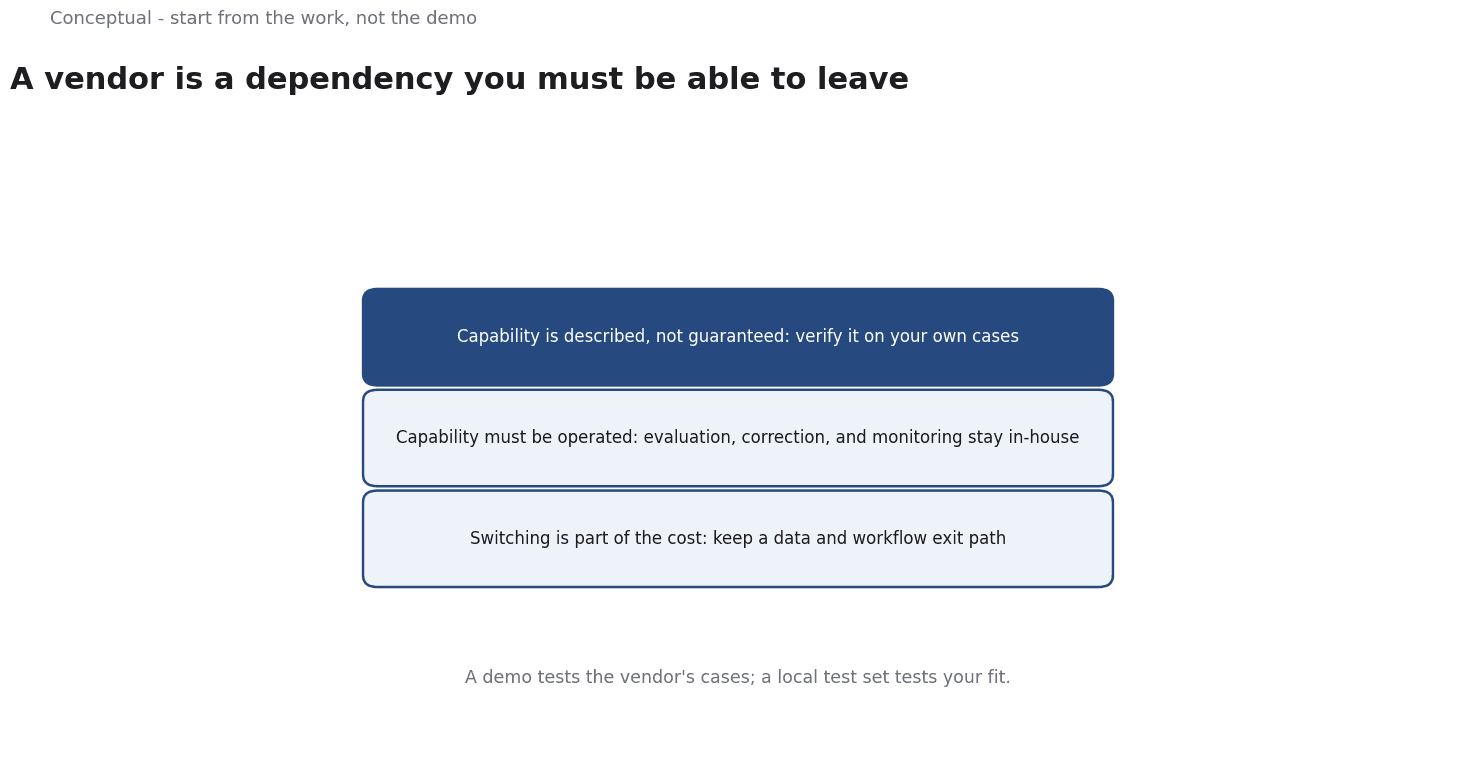
- Capability is described, not guaranteed. The use-case guides describe production patterns. A vendor's claim still needs local verification.
- Capability must be operated. The management material treats skill as something a team develops. A vendor that requires knowledge you do not have is a dependency, not a solution.
- Switching is part of the cost. A tool that holds data or workflows hostage is more expensive than its price suggests.
The sequence is: define the task, test on local cases, check operational fit, then record the exit path. The local work is inferred; the capability descriptions are source-reported.
A worked example
Illustrative. A team compares two vendors for document extraction.
Three checks decide. First, do both handle the team's actual documents, including the messy ones? Second, can the team evaluate failures and correct them without the vendor's help? Third, what happens to the data and the workflows if the vendor changes price or closes?
The outcome is a decision with an exit path. The scenarios are hypothetical; the evaluation method is the contribution.
Why operational fit decides
A tool can be impressive and still impossible to operate with the team's skills. Evaluation, correction, and monitoring all require people who understand what the tool does. A vendor that does not support those activities leaves the team dependent on support tickets for every problem, which is a cost that appears only after selection.
The second operational question is data. A tool that needs data the organisation does not have, or cannot lawfully use, is not a candidate regardless of its capabilities. Checking data availability early avoids spending time on a demonstration that cannot become a deployment.
Why the exit path belongs in the decision
Every vendor relationship ends eventually, through price, acquisition, or failure. A selection that records how data and workflows would be extracted makes that ending manageable. It also changes the initial design, because a system built with portability in mind is easier to leave.
Evidence status
| Claim | Status | Source | Verified | Recheck when |
|---|---|---|---|---|
| Models support defined production use cases | source-reported | Anthropic use-case guides | 2026-11-18 | Capabilities change |
| Capability is a management concern | source-reported | Google re:Work | 2026-11-18 | Practice changes |
| Test locally and record an exit path | inferred | Derived from capability practice | 2026-11-18 | Vendor terms change |
Why a demo is not an evaluation
A demo is built from cases the vendor chose. It answers the question of whether the tool can work in ideal conditions, which is rarely the decision that matters.
A local test set, including difficult cases, answers whether it will work for you.
The selection process itself has a cost. A long evaluation with many vendors can consume more time than the tool saves in its first year, particularly for a small team. Bounding the evaluation to a defined number of candidates and a fixed test set keeps the process proportionate.
Another limit is that a vendor's capabilities change. A tool that was unsuitable last year may now be a good fit, and one that was excellent may have changed its pricing or focus. This is why the decision needs a recheck condition rather than an expiry date that nobody watches. A short note stating what would make the team revisit the choice is more useful than a detailed report that will never be read again.
Finally, a vendor cannot fix a process that has no owner. Someone must be responsible for the tool's configuration, its evaluation, and its failures.
The exit path should be tested in principle before it is needed in practice, by confirming that data can be exported in a usable format.
What it cannot do
It cannot guarantee that a vendor will remain suitable. It does not remove the need for evaluation after selection. And it cannot create internal capability that the team does not have.
The counterargument that a known vendor is safer is fair for support and incomplete for fit.
A decision test
- Define the task.
- Build a local test set.
- Check evaluation and correction ability.
- Check data and exit terms.
- Compare lifetime cost.
- Record the decision and the switch condition.
For the broader choice, see AI Build Versus Buy.
References & Further Reading
- Anthropic, 2026. Guides to common use cases - Claude Platform Docs — Production use-case guides for ticket routing, customer support agents, content moderation, legal summarization and commerce agents.
- Google, 2026. Google re:Work — A large company's published people practices, including hiring and growth frameworks.