Anchor Text Explained
Anchor text is the visible words in a link. Learn what the sources define, a worked linking example, and why link wording alone cannot create relevance.
Anchor text is the visible, clickable words inside a hyperlink. Teams often treat those words as a minor copy detail, yet the same phrase is read by people and parsed by search systems at the same time. The practical problem is deciding what the words should say when readability and search relevance pull in different directions.
Direct answer: Use anchor text that describes the destination page in plain language, and avoid repeating the identical phrase for every link to the same URL. The Wikipedia entry defines what anchor text is and how it is used, while Google's starter guide advises descriptive links. The rule about matching wording to destination is a synthesis.
Delta: This article adds a claim-status table and a link-inventory decision test beyond the sources: it maps the wording of a single link to a site-wide linking decision, with claim status explicit.
The mechanism
Anchor text is the visible text portion of a hyperlink. The Wikipedia entry describes it as the words a reader sees and clicks, text that historically helped search systems understand what the linked page was about because it acted as a descriptor supplied by the linking page. Google's SEO Starter Guide recommends descriptive anchor text that gives both readers and crawlers context about the destination. In both sources the concept is the same: the words stand in for a short description of the target.
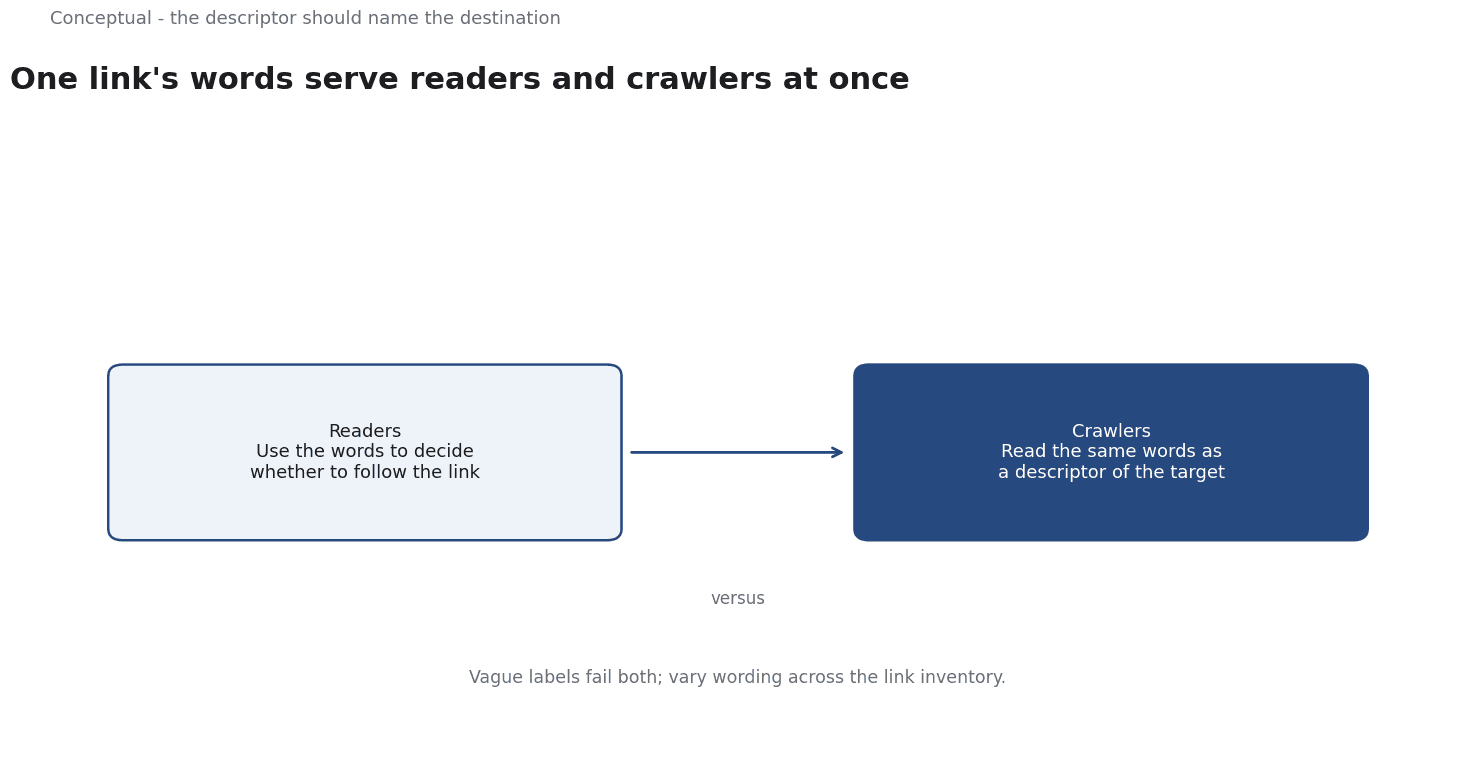
The practical consequence is that anchor text serves two audiences at once. A reader scanning a page uses those few words to decide whether the link is worth following. Vague labels such as "click here" or "learn more" strip both audiences of information, because neither a person nor a crawler can tell what lies on the other side.
Descriptive text is a usability improvement first and a search improvement second.
The two goals usually align: words that tell a person what they will get also tell a crawler what the destination covers.
Distribution across a site is the second concern. When many links to the same page use the same exact phrase, the pattern can look manufactured rather than editorial. Variety that stays relevant to the destination is the safer approach. The sources define anchor text and recommend descriptive wording, but they do not specify ratios or thresholds. Any number about how much repetition is safe is therefore a local choice derived from the sources, not a fact stated in them, and it should be recorded as inference rather than presented as documented guidance.
For a team, the consequence is procedural. Anchor text should be generated from the destination's own heading or topic, kept short, and checked across navigation, sidebars, and templates where the same phrase can repeat automatically. The unit of work is not one link but the whole set of links pointing to a page.
A worked example
The following is hypothetical and illustrative. A documentation site links to a single pricing page from three places: a sidebar, a tutorial paragraph, and a footer. Three checks decide the review. First, does each link's text describe the pricing page rather than the page it sits on? Second, do the three links use the identical phrase, or varied but relevant ones? Third, read on its own, would a visitor know where each link goes? The review finds two "click here" labels and one repeated exact phrase in all three templates. The analyst rewrites the labels to name the destination, keeps one descriptive exact phrase, and varies the other two. The outcome is a rewrite decision recorded with a date, not a new tool. The numbers are hypothetical; the verification method is the contribution.
Evidence status
| Claim | Status | Source | Verified | Recheck when |
|---|---|---|---|---|
| Anchor text is the visible text of a hyperlink | source-reported | Wikipedia, Anchor text | 2026-11-18 | Definition revised |
| Descriptive anchor text is recommended for search | source-reported | Google, SEO Starter Guide | 2026-11-18 | Guide updated |
| Match link wording to destination across a link inventory | inferred | Derived from the sources | 2026-11-18 | Link templates change |
Two factual claims come directly from the sources: the definition of anchor text and the recommendation for descriptive wording. The third row is a synthesis, because neither source prescribes an inventory process. Recheck the first two rows when the definition or the guide changes, and the third when the site's link templates change.
What it cannot do
Anchor text is one signal among many, and it cannot rescue a page that has thin content or a confused structure. It describes a destination; it does not create authority or relevance that the page itself lacks. The sources define what anchor text is and recommend descriptive wording, but they do not claim that link wording alone changes how a page is evaluated. Treating a phrase as a substitute for substance overstates what is documented. A team that rewrites every link and expects a ranking change will likely be disappointed, because the wording communicates information rather than manufacturing it.
The hidden cost sits in templates. A single "learn more" label placed in a navigation component becomes hundreds of identical links once that component repeats across a site. Fixing the problem is not a single edit but a change to shared templates and content fields, and the effort grows with site size. Editors who can change one page often cannot change the component that generated the phrase. This is why link-wording problems persist long after they are noticed: the visible text is easy to see and the mechanism that produced it is hard to reach.
The common failure mode is over-optimization.
The sources give no safe ratio, so a team without a local threshold can swing between stuffing phrases and writing text so vague that it helps no one. The failure is also quiet. Rankings move for many reasons, so a change in anchor text cannot be isolated as the cause of a later gain or loss. Without a recorded decision, there is no way to learn from the change.
There is a clear boundary around what this guidance covers. Anchor text does not replace internal link structure, crawl paths, or content quality, and it says nothing about links coming from other sites. External anchor text is written by people a team cannot edit, so the discipline described here applies only to links under local control. A review that assumes full control over all inbound wording will misjudge what it can change.
Because templates and navigation evolve, anchor text needs periodic review rather than a one-time cleanup. A quarterly inventory of repeated phrases catches drift before it spreads. Each decision should be recorded with a date and a recheck condition, and any threshold should be marked as a local choice rather than a source-derived fact.
The counterargument that exact-match anchor text is fair for clarity is incomplete when the same phrase is repeated across many templates.
A decision test
- List every place that links to the destination page.
- Read each anchor text without its surrounding context.
- Check that the words describe the destination, not the linking page.
- Note phrases repeated identically across templates.
- Vary the wording while keeping it relevant to the target.
- Rewrite vague labels such as "click here" or "learn more".
- Record the decision with a date and a recheck condition.
Anchor text is cheap to write and expensive to fix at scale. The test keeps the wording tied to the destination and makes the local choices visible, so a reviewer can see why a phrase was chosen and when it should be revisited. For further reading, see Technical Writing: Documentation, API Docs, and Developer Experience.
References & Further Reading
- Wikipedia contributors, 2026. Anchor text - Wikipedia — The visible text of a hyperlink.
- Google, 2026. SEO Starter Guide: The Basics — The search engine's own description of what it needs from a site.