Brand Voice Guidelines That People Actually Use
A voice guide should help someone write today, not sit on a shelf. Read what makes it usable, a worked example, and how to keep it alive.
Most brand voice guidelines are a list of adjectives — bold, friendly, authoritative — that no writer can apply to a sentence. A usable guide translates those adjectives into decisions a writer makes at the keyboard: which words, how long, what to avoid, and what a good example looks like in the writer's own context.
Direct answer: A voice guide should contain a few principles with concrete examples and anti-examples, tailored to the contexts where the brand actually writes. Brand-management principles treat voice as part of a maintained identity, and the brand-guidelines article argues for rules with reasons. The boundary: a guide cannot create a good product or a clear promise, which the value-proposition article argues, and it goes stale if nobody owns it, as the monitoring article warns for any maintained standard.
Why adjectives fail writers
A writer facing a blank document needs a decision, not a mood. The word "confident" can produce anything from a crisp assertion to an arrogant claim, and a writer who guesses will produce something different from the person who wrote the guideline. The technical-writing article makes the same point about consistent terms: a shared vocabulary reduces the number of choices a reader has to make. A voice guide does the same for the writer, converting an abstract quality into a small set of observable choices.
This is why the most useful guides are built from pairs. A sentence that works and one that does not, drawn from real material the organisation published, teach more than a paragraph of explanation. The naming article recommends the same approach for verbal identity, and the evaluation-rubric article argues for anchor descriptions that make scoring possible. With anchors, a reviewer can say which principle a draft misses instead of saying that it does not sound right, which is a discussion that goes nowhere.
A guide also needs to state where voice changes. A support reply and a launch announcement express the same brand differently because the reader is at a different decision stage, as the brand-consistency article explains for what must travel intact and what should adapt. A guide that demands identical tone everywhere produces copy that fits no context. The best ones name the contexts, give an example for each, and leave room for judgment, which the design-brief article treats as the point of a good specification.
What makes it usable
Principles with examples. For each principle, show a sentence that works and one that does not, which the naming article recommends for verbal identity.
Context-specific. A support reply and a launch post need different expressions of the same voice, as the brand-consistency article distinguishes what must travel intact from what should adapt.
Short enough to consult. A one-page guide used daily beats a fifty-page document nobody opens, which the technical-writing article argues for documentation that fits the work.
Owned and updated. Someone must be able to change a rule and communicate it, which the governance checklist requires for any maintained standard.
A worked example
The following is hypothetical and illustrative.
A company describes its voice as "clear and respectful". A usable guide turns that into:
- Use plain words. "We'll check your order" rather than "We shall initiate a review of your order status," as Technical Writing: Documentation, API Docs, and Developer Experience recommends for direct language.
- State the constraint. In a support reply, say what happens next and when, rather than apologising at length, which the customer-support article treats as useful action.
- Avoid invented urgency. No "act now" unless there is a real date, as the subject-line article warns about training readers to ignore urgency.
Three checks decide whether the guide works:
- Application. Can a new writer produce an on-voice support reply without asking, which the design-brief article treats as the purpose of a clear specification?
- Consistency. Do samples from different channels feel like the same source, as the brand-consistency article measures recognition?
- Use. Is the guide actually opened, which the documentation article treats as the test of a living document?
Three conclusions follow:
- Examples do the teaching, not adjectives, as Brand Guidelines Template: What to Include recommends.
- The guide fits the writing, which the voice article argues for concrete anti-patterns.
- It is maintained, which the monitoring article requires for any standard tied to a changing product.
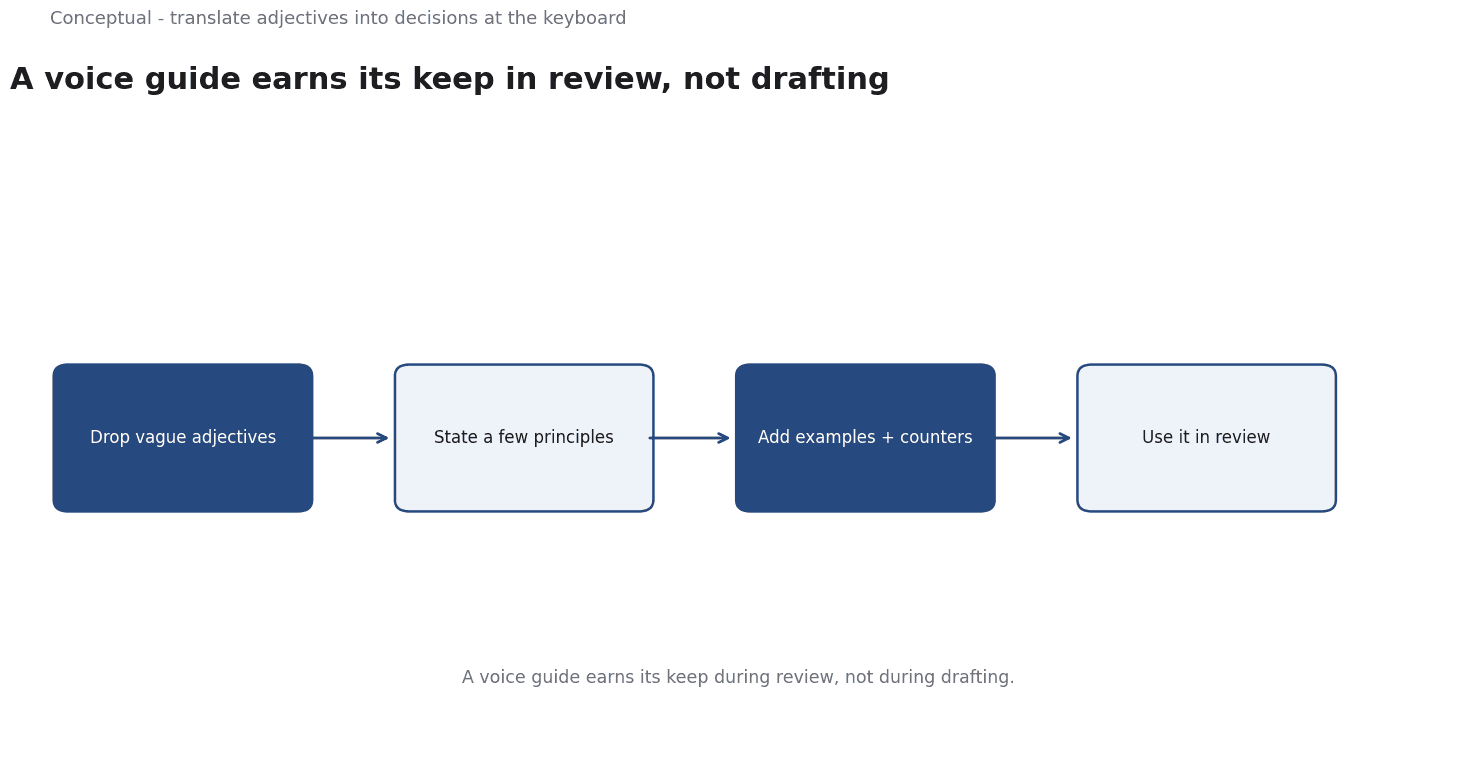
A voice guide earns its keep during review, not during drafting.
When a reviewer disagrees with a piece of copy, the guide gives both people a shared standard to point at instead of a matter of taste. That turns review into a discussion about whether the text meets a stated principle, which the evaluation-rubric article argues for in any scored judgement. A guide that is never referenced in review is a document nobody needed.
What a voice guide cannot do
It cannot fix a weak promise. Clear writing about an unclear value still leaves the buyer unsure, as the value-proposition article argues.
It cannot make a bad experience sound good. Polished support language around a broken process is discovered, as the reputation article warns about claims experience contradicts.
It is not a style police.
The counterargument — that good writers do not need a guide — misses the point.
The guide makes consistency possible across many writers and channels, which the marketing-communications article treats as coordination.
A decision test
- Translate adjectives into choices — words, length, structure, as the naming article recommends.
- Add examples and anti-examples for each principle, which the guidelines article requires.
- Tailor to contexts the team actually writes in, as the brand-consistency article advises.
- Keep it short. A one-page guide people open, which the documentation article recommends.
- Assign an owner to update it, as the governance checklist requires.
- Test with a new writer for application, as the design-brief article suggests.
- Review on product or audience change, as the monitoring article advises.
For the document, see Brand Guidelines Template; for the craft, see Technical Writing.
References & Further Reading
- Wikipedia contributors, 2026. Brand management - Wikipedia — The discipline of maintaining a brand across touchpoints; secondary reference used for channel consistency.
- Wikipedia contributors, 2026. Marketing communications - Wikipedia — The coordination of messages across channels and the distinction between consistent and identical communication.