Canonicalization Metrics that Matter
Canonical tags are hints, not directives. Read how to measure whether Google consolidated your duplicate URLs, a worked check, and what the signals cannot prove.
Teams often treat a canonical tag as a switch that decides which URL search engines index. The canonical link element and Google's documentation describe it as a hint that consolidates signals across duplicate pages, not a command. The real problem is knowing whether the hint worked and what to measure when it did not.
Direct answer: A canonical tag tells search engines which URL you prefer as the representative of a duplicate set, and Google may still choose a different one. That gap, not the tag's presence, is the signal that matters.
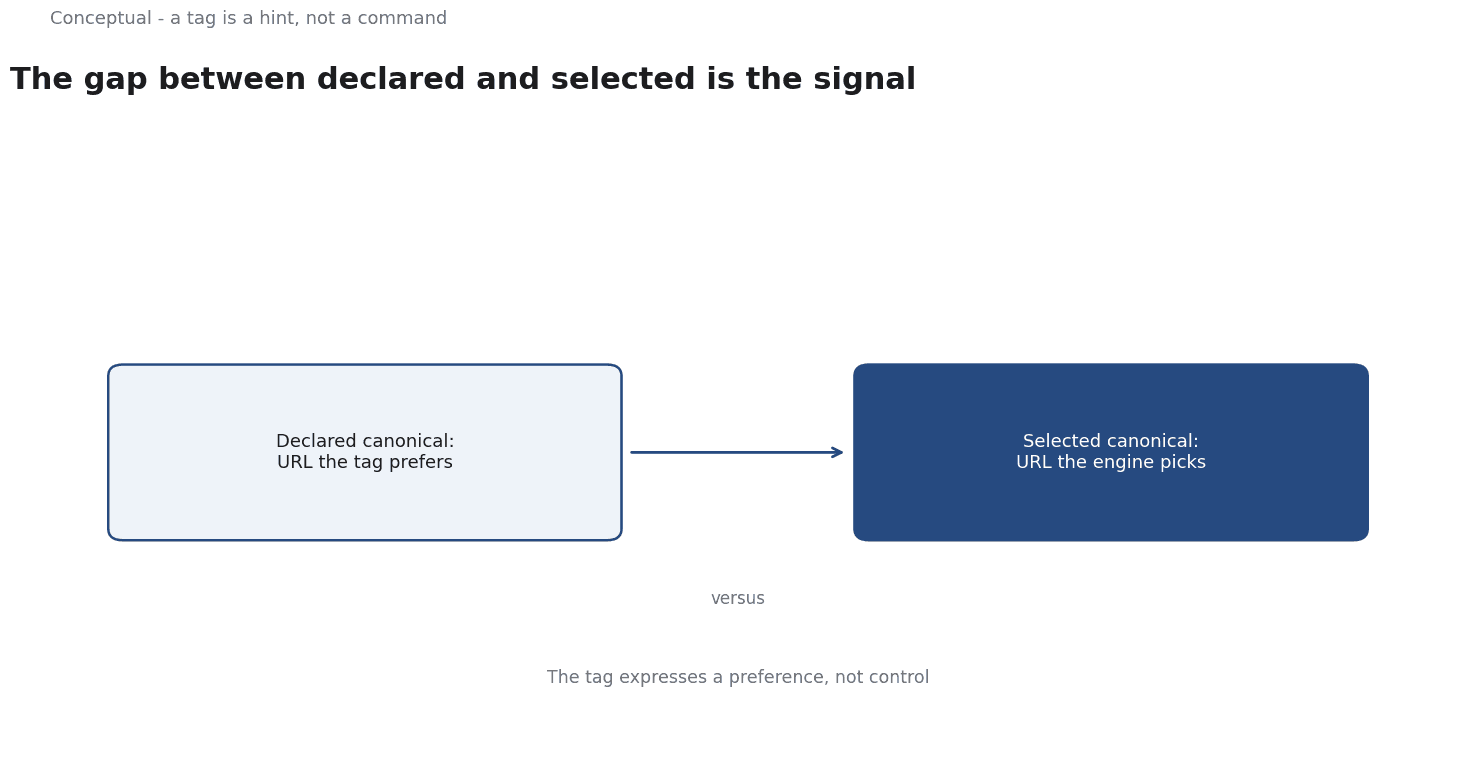
Measure the gap between the canonical you declare and the canonical the engine selects.
Delta: This article adds a measurement test beyond the sources: it maps canonical signals to a consolidation decision, with claim status explicit.
The mechanism
The canonical link element is an HTML link tag in the head of a page that points to a preferred URL. Its purpose is to consolidate ranking signals that would otherwise be split across near-duplicate pages, such as product pages reachable through several parameter combinations or the same article served at multiple paths. Wikipedia's entry traces the convention to the major search engines, which introduced it to give site owners a way to label the preferred copy. The practical consequence is that canonicalization is a signal-management tool: the point is to concentrate signals, not to hide pages.
Google's documentation lists several ways to express a canonical: the link element in the page head, an HTTP Link header, a sitemap, and redirects. The link element is the most common. A self-referencing canonical points a page at itself and is useful for establishing a single preferred version even when no duplicate exists. A cross-domain canonical points to a different host. Each method has a different scope, so choosing one is a decision about where the signal lives, not merely a formatting choice.
The crucial qualification in both sources is that a canonical is a hint, not a directive. Google states that it may consider other signals and select a different canonical. This is where measurement enters. Because the tag does not guarantee the outcome, verifying consolidation requires observing which URL the engine actually treats as canonical. Treating the presence of a tag as proof of consolidation skips the only step that confirms the result.
The synthesis is to read canonicalization as a measurement problem. A declared canonical and a selected canonical are two different things, and the distance between them is the useful metric. Mapping that gap to a decision - fix the tag, fix a conflicting signal, or accept the engine's choice - is a judgement about how to use the documentation, not a statement the sources make. Keeping that mark visible prevents a reading method from being reported as a finding.
A worked example
The following is hypothetical and illustrative. A team ships a product catalog where each item is reachable at three URL variants, and adds a canonical tag to each variant pointing at the clean URL. The first check is consistency: do all variants declare the same clean URL, and is the tag present in the rendered head rather than only in source a crawler might not see? The second check is selection: does the reporting show the clean URL as the chosen canonical, or a parameter variant? The third check is competing signals: do internal links, redirects, and noindex directives agree with the declared canonical? The outcome is that two variants report the clean URL as selected while one still resolves to a parameter URL, which points the team to a conflicting internal link. The scenario is invented; the signals come from the sources.
Evidence status
| Claim | Status | Source | Verified | Recheck when |
|---|---|---|---|---|
| The canonical link element is a hint that consolidates signals for duplicate URLs | source-reported | Canonical link element (Wikipedia) | 2026-11-18 | Search engine guidance changes |
| Google lists the link element, HTTP header, sitemap, and redirects as canonical methods | source-reported | How to Specify a Canonical (Google) | 2026-11-18 | Documentation is updated |
| The declared-versus-selected canonical gap is a usable consolidation metric | inferred | Derived from the sources | 2026-11-18 | Site architecture changes |
The first two rows are claims the sources make. The third is a measurement method, not a finding of either source, so it is marked inferred. Its usefulness depends on site structure, and it should be rechecked when URLs, templates, or engine behaviour change. The table keeps that dependence visible between audits.
What it cannot do
A canonical tag cannot force a search engine to index a preferred URL. Both sources describe it as a hint, and Google explicitly reserves the right to choose a different canonical based on other signals. A perfectly formed tag can therefore be ignored, and a measurement that assumes compliance will misread the result.
This is the central limit: the tag expresses a preference, and preference is not control.
Teams that treat canonicalization as a directive will keep asking why the wrong URL ranks instead of examining the signals the engine weighed.
The hidden cost is that a wrong canonical can consolidate signals onto the wrong page. If a template emits a canonical pointing at a category page instead of the item page, the engine may concentrate ranking signals where the team did not intend. Because consolidation is the mechanism, an error in the target is amplified rather than ignored. A misdirected canonical is more damaging than no canonical, since it actively steers signals away from the pages the team wanted to rank, and the resulting loss is hard to attribute without the measurement described above.
A canonical tag that says one thing while a redirect, a noindex directive, or internal linking says another creates ambiguity, and the engine resolves it on its own terms. Parameter-heavy URLs, paginated series, and pages rendered by JavaScript are frequent sources of such conflict, especially when the canonical appears only after client-side rendering. When signals disagree, the declared canonical is no longer a reliable input, and the measured gap widens for reasons that have nothing to do with the tag itself.
The boundary is between consolidation and removal. A canonical consolidates signals and keeps one URL representative; noindex removes a page from the index; a redirect moves users and crawlers to a new address. Confusing these tools produces the wrong outcome for the wrong problem. A page that should not be indexed is not fixed by a canonical, and a page that has permanently moved is not fixed by a hint. The documentation describes these as distinct mechanisms, and evaluation is where the distinction has to be applied rather than assumed.
Because sites change, canonicals drift. Templates are edited, migrations rename paths, and new URL parameters appear over time, so a canonical set that was correct at launch can decay without anyone editing it. That drift needs an owner and a review condition. The sources provide the mechanism but not a schedule, so setting one locally is what keeps canonicalization a maintained signal rather than a line of markup that was correct once and then forgotten.
Counterargument: "The counterargument that canonical tags are simple to add is fair for a small static site with one URL per page and incomplete where parameter variants, migrations, and conflicting signals decide which URL actually consolidates."
A decision test
- List the duplicate URL sets you want to consolidate.
- Confirm each URL declares a single, consistent canonical target.
- Check the canonical appears in the rendered head, not only in raw source.
- Compare the declared canonical with the one the engine reports as selected.
- Look for competing signals: redirects, noindex directives, and internal links.
- Assign an owner and a review date for the canonical set.
- Recheck after any migration, template change, or new URL parameter.
The test turns markup into a measurable decision. Each step checks whether a declared preference matches the observed outcome, and the final steps keep the set current. A passing set is not proof that every URL was indexed; it is evidence that the signals were checked and the gaps were made visible to whoever owns the decision.
For further reading, see What AI Search Actually Measures.
References & Further Reading
- Wikipedia contributors, 2026. Canonical link element - Wikipedia — HTML element indicating a preferred URL.
- Google, 2026. How to Specify a Canonical with rel="canonical" and Other Methods — What Google says about redirects, canonicals, and duplicate handling.