Climate Risk Pitfalls
Climate risk spans physical and transition channels. Read the scenario pitfalls, a worked check, and where scenario outputs stop being useful.
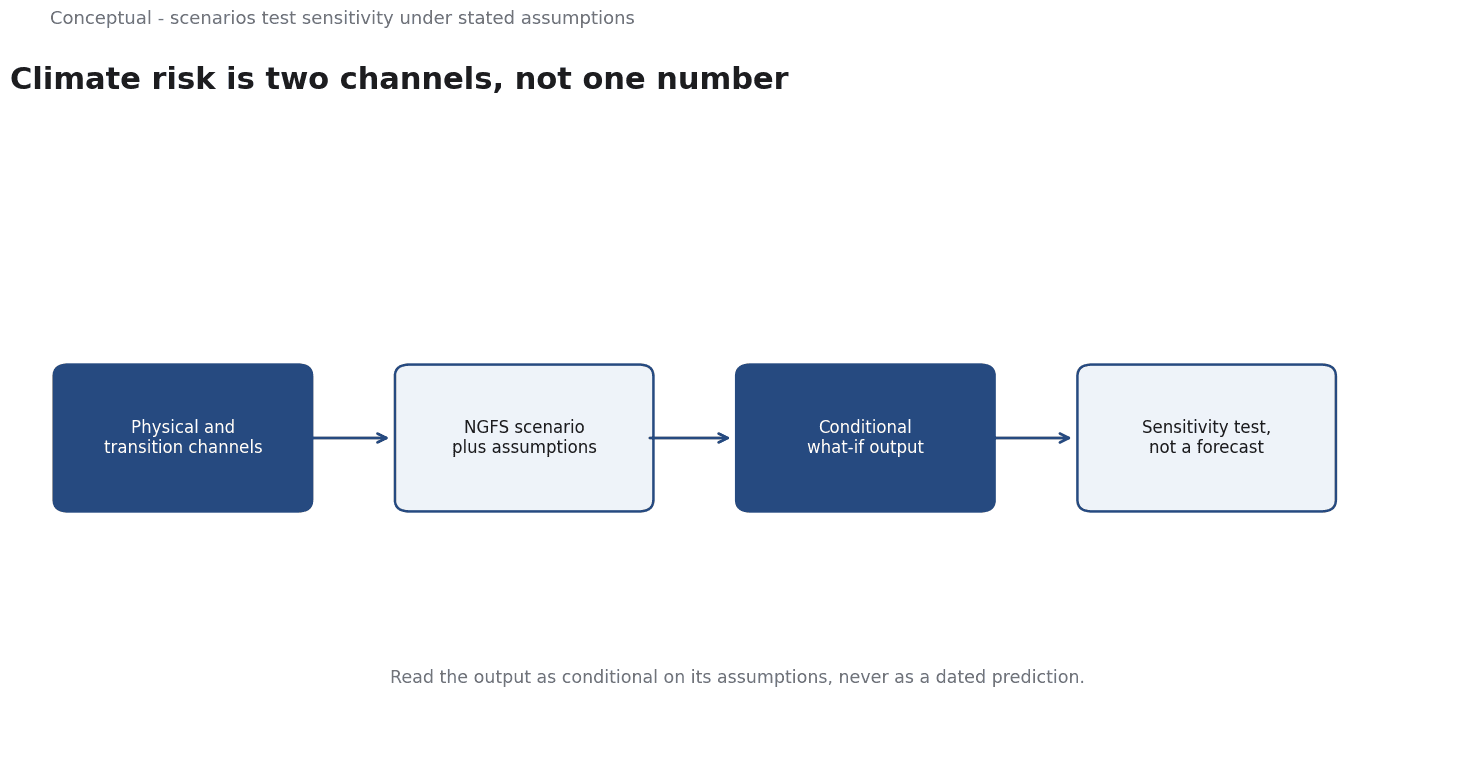
Climate risk is often discussed as if it were a single number, but the climate risk entry describes several distinct channels through which climate change can affect value, while the NGFS describes scenario work used by supervisors and central banks. The real problem is that a reader can take a scenario output and treat it as a forecast, when the two serve different purposes and rest on different assumptions.
Direct answer: Climate risk covers potential losses from physical changes and from the transition to a lower-carbon economy, while NGFS scenarios are tools for exploring plausible futures rather than predictions. The climate risk entry provides the channel definitions; NGFS provides the scenario framework. The boundary: this is educational orientation, not a forecast for any asset, because scenario outputs depend on stated assumptions.
Delta: This article adds a claim-status table beyond the sources: it maps scenario outputs to a planning decision, with claim status explicit.
The mechanism
The climate risk entry distinguishes physical risk, which arises from climate hazards such as flooding, heat, and storms, from transition risk, which arises from changes in policy, technology, and markets as the economy shifts toward lower-carbon activity. The practical consequence is that an institution exposed to one channel may not be exposed to the other in the same way, so a single aggregate score can hide the mix. Knowing which channel dominates is a prerequisite for choosing any response.
Transition risk includes policy and legal change, technology shifts, and market and reputational effects. The practical consequence is that an asset can lose value without suffering any physical damage, simply because a market reprices it under new expectations. Physical exposure data alone is therefore incomplete. A portfolio can look safe on hazard maps while carrying significant exposure to a transition that changes demand, input costs, or the cost of capital.
NGFS is a network of central banks and supervisors that develops climate scenarios and publishes guidance for the financial sector. A scenario describes a possible pathway for the climate and the economy under a defined set of assumptions. The practical consequence is that a scenario is a structured what-if used to test resilience, not a prediction carrying a probability. Two scenarios can produce very different results precisely because they encode different assumptions about policy and technology, and neither is asserting that its pathway will occur.
A coherent reading keeps the roles separate. The entry describes the risk channels; NGFS offers a way to explore how those channels might develop under different assumptions. Neither states what will happen to a particular portfolio or on what date.
The synthesis is that scenarios are best used to test direction and sensitivity, with assumption sets recorded alongside every output.
Treating an output as a conditional result rather than a forecast is an inference from combining the two sources, not a claim that either makes directly.
A worked example
The following is hypothetical and illustrative. A lender uses a climate scenario to test a portfolio of commercial properties and is tempted to quote the resulting loss figure as a forecast. Three checks decide how to read it. First, the analyst identifies the physical hazards relevant to each property location rather than applying one national hazard assumption to all of them. Second, the analyst runs two scenario pathways with different transition assumptions to see how the value of buildings with poor energy performance changes. Third, the analyst states the time horizon and the assumptions behind each run, so that the output is read as conditional on those choices. The outcome is a qualified finding: one property group is sensitive under a stringent transition pathway, but that is a scenario result, not a dated prediction. The figures are hypothetical; the sequence of checks is the contribution.
Evidence status
| Claim | Status | Source | Verified | Recheck when |
|---|---|---|---|---|
| Climate risk includes physical and transition channels | source-reported | Wikipedia, Climate risk | 2026-11-18 | The risk taxonomy changes |
| NGFS develops climate scenarios for financial supervisors | source-reported | NGFS, Network home | 2026-11-18 | Scenario sets or guidance are updated |
| Scenario outputs are conditional on assumptions, not forecasts | inferred | Derived from the sources | 2026-11-18 | A source states probabilities for outcomes |
The first row is documented in the climate risk entry; the second on the NGFS site. The third row is an inference from the idea of a scenario combined with a risk taxonomy that separates channels. Recheck it if either source begins attaching likelihoods to specific outcomes, since that would change how an output should be read.
What it cannot do
Climate risk categories cannot tell an institution the exposure of a specific asset. The channels are general, while actual exposure depends on location, sector, and the design of the asset. A property in one region and an identical property in another can face different hazards and different transition pressures. The practical limit is that a taxonomy organises thinking but does not produce a measurement on its own.
A hidden cost of scenario work is the upkeep it requires. Each run depends on assumptions about policy, technology, and hazard that age as conditions change, and maintaining a defensible set of scenarios takes expertise and data. The cost is easy to underestimate because the headline output looks tidy. The burden appears later, when an old scenario is quietly reused long after its assumptions have stopped reflecting the world it was built to describe.
Once a number is reported, readers tend to remember the value and forget the pathway that produced it. A related failure is selecting only the scenario that supports a preferred decision, which turns a resilience test into a confirmation exercise. Both failures share the same root: the conditional nature of the output is lost between the run and the decision.
The boundary of the source material is a general definition of climate risk and a description of a scenario-producing network. Neither source supplies probabilities, a valuation for a given portfolio, or guidance on a specific investment. Claims that a particular asset will lose a given amount by a given date therefore exceed what the sources support. Such claims require asset-level data and a model whose assumptions can be examined, not a general description of risk channels.
These points need review whenever scenarios, horizons, or hazard data are updated. A revised scenario set can change results without any change in the underlying portfolio, and a figure that was comparable last year may not be comparable now. Recording the scenario name, version, and assumption set beside each output is the only way to keep a series interpretable. Without that record, a trend line can reflect a methodology change rather than a change in risk.
The counterargument that scenarios are too assumption-dependent to guide decisions is fair for predicting exact losses and incomplete for testing direction and sensitivity, where comparing pathways is the point.
A decision test
- Identify which risk channels apply to the asset or portfolio under review.
- Match each channel to the data that can describe it at the relevant location or sector.
- Choose more than one scenario so that results are not tied to a single pathway.
- Record the scenario name, version, and assumptions beside each output.
- State the time horizon and read results as conditional on it.
- Look for assets sensitive across several pathways, not just one.
- Review the analysis whenever scenarios or hazard data are updated.
These steps turn a scenario output into a bounded planning input. They do not make the future knowable, but they prevent the most common error: quoting a conditional result as a dated forecast. The result is a decision tied to what the analysis can actually show. For further reading, see data governance: managing data as an asset.
References & Further Reading
- Wikipedia contributors, 2026. Climate risk - Wikipedia — Risks arising from climate change and transition.
- NGFS, 2026. Network for Greening the Financial System — The standard climate scenarios used for financial risk analysis.