Conflict Resolution Examples
Conflict is often about interests, not positions. Read worked examples, the method behind them, and why a quick compromise can fail.
A conflict that looks like a personality clash is often a disagreement about interests that nobody has stated. Two teams want the same engineer, and the argument is about priority; behind the positions are different obligations with different deadlines. The Program on Negotiation material treats interests as the thing to uncover, as the negotiation framework article applies to business and career decisions, as the team-culture article warns about norms nobody makes explicit.
Direct answer: Resolve conflict by separating positions from interests, defining the decision, and testing options against shared criteria rather than splitting a position. The Program on Negotiation at Harvard Law School is the primary source, and O*NET's task descriptions help ground role obligations. The boundary: these are examples, not a script — a conflict involving harassment, safety, or legal duty is not a negotiation, as the HR-screening and legal articles treat those as formal obligations, as the publication standard forbids guaranteed outcomes.
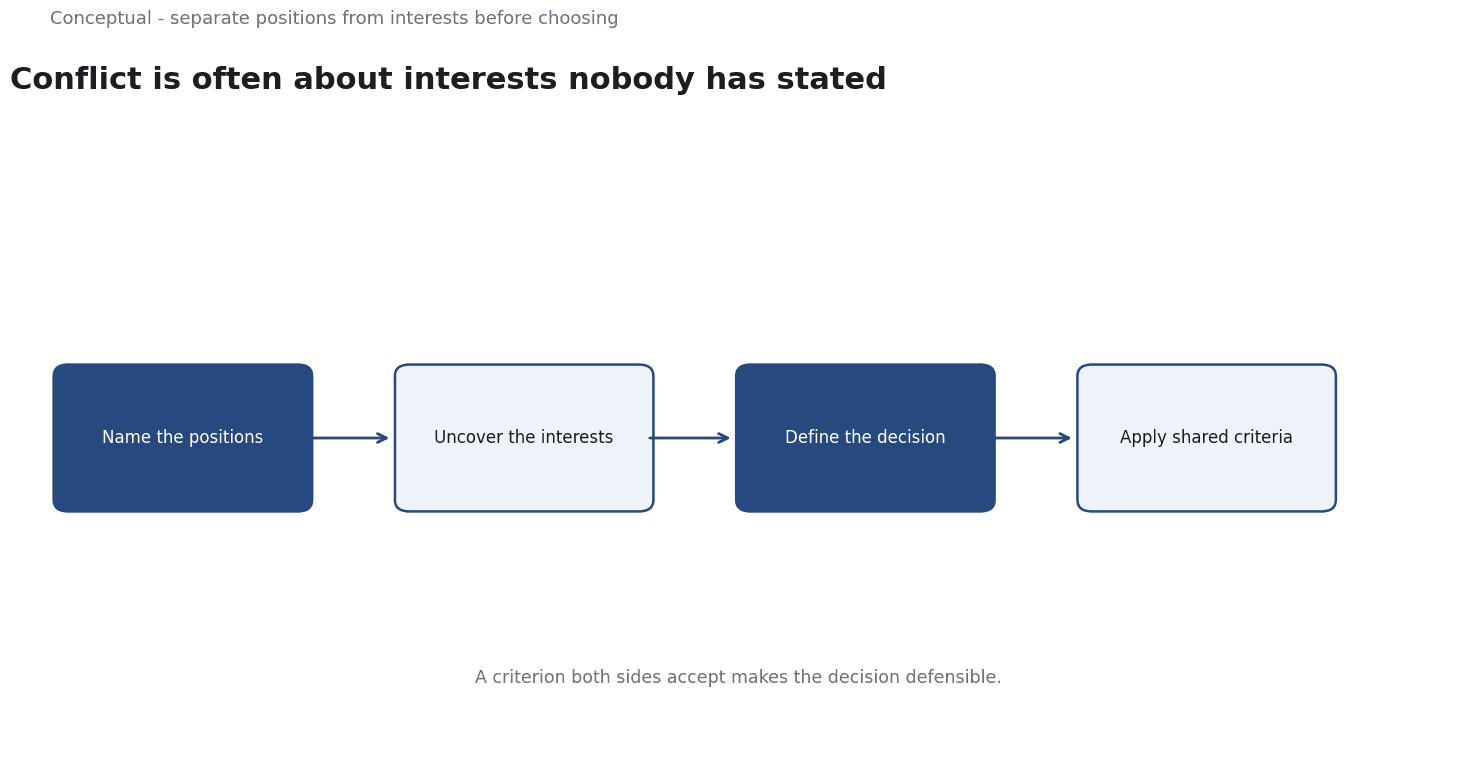
The method in the examples
Separate position from interest. "I need the engineer full-time" is a position; "my release depends on their work" is an interest, which the negotiation article treats as the distinction that opens options, as the decision-memo article requires a specific question.
Name the decision and the owner.
One person should be accountable, as the governance checklist requires.
Use a shared criterion. Options should be judged against a criterion both sides accept — customer impact, deadline, risk — as the evaluation-rubric article requires for concrete criteria, as the prioritisation article advises for ranking.
Record the outcome. The agreement and its reason should be written where the team can find it, which the documentation article advises, as the internal-communications article treats decisions others must act on, as the decision-memo article requires.
Three consequences follow. A compromise that splits a position can leave both interests unmet, which the examples below show, as Negotiation: a Decision Framework argues for generating options first. A fair process needs a real criterion, as the rubric article requires, as the fairness discussion in the responsible-AI article treats as a design property. And the outcome should be reviewed after a material change, as the monitoring article advises.
Worked examples
The following are hypothetical and illustrative.
Two teams, one engineer. Team A says the engineer must join its release; Team B says the same. A split would halve both efforts. Asking what each needs reveals that Team A needs a two-week review, while Team B needs a design decision, which the negotiation article treats as interests behind positions, as the O*NET-style task descriptions help ground the obligations. One option is to schedule the review and the design decision in the same fortnight, with a named owner for the conflict, as the small-team decision article advises.
A recurring meeting dispute. Two leaders keep reopening whether a meeting is needed. The unstated interest is different: one wants visibility, the other wants uninterrupted time, which the time-management article treats as a shared attention constraint, as Feedback Delivery Checklist advises on raising the issue directly. A shared criterion — does the meeting change a decision — resolves it, as the dashboard article argues for metrics tied to action, as the evaluation-rubric article requires for concrete criteria.
A performance disagreement. A manager wants a teammate removed from a project; the teammate wants to stay. The interests are delivery risk and career development, which the engineering-management article treats as a real trade-off, as Negotiation: a Decision Framework advises on interests, as the legal and HR articles treat any formal process as a separate path. The resolution should be recorded with the criterion, as the decision-memo article requires.
Three conclusions follow from these examples. Positions are the starting point, not the problem definition, as Negotiation: a Decision Framework explains.
A criterion both sides accept makes the decision defensible, as the rubric article requires.
And a record prevents the conflict from being relitigated, as the documentation article advises.
What conflict examples cannot do
They cannot resolve a conflict with a power imbalance or a legal duty, which the HR and legal articles treat as formal obligations, as the governance checklist requires an accountable owner. They do not remove the need for a decision, which the small-team decision article treats as the substance, as the decision-memo article requires. And they cannot guarantee agreement, which the publication standard forbids claiming, as the risk-assessment article requires residual uncertainty.
The counterargument that a fast compromise is better than a long process is fair when the stakes are low and reversible, which the negotiation article treats as a fit question, as the decision-memo article argues for proportionality, as the worked examples show for higher-stakes cases.
A decision test
- State each side's position and the interest behind it, as Negotiation: a Decision Framework advises.
- Name the decision and one accountable owner, as the decision-memo article requires.
- Choose a criterion both sides accept, as the rubric article requires.
- Generate options before judging them, as Negotiation: a Decision Framework recommends.
- Check whether the conflict is actually a formal HR or legal matter, as those articles require.
- Record the outcome and its reason, as the documentation article advises.
- Review after a material change, as the monitoring article recommends.
For the method, see Negotiation: a Decision Framework; for the feedback, see Feedback Delivery Checklist.
References & Further Reading
- Harvard Law School, 2026. Program on Negotiation at Harvard Law School — A university consortium dedicated to developing the theory and practice of negotiation and dispute resolution.
- U.S. Department of Labor, 2026. O*NET OnLine — The standard occupational taxonomy used to compare roles across industries.