Feedback Delivery Checklist
Feedback changes behaviour only when it is specific and usable. Read the checklist, a worked conversation, and why praise and criticism need the same care.
Feedback is often delivered as a verdict — "good job" or "needs improvement" — which gives the recipient nothing to act on. The useful form is an observation, an impact, and a question, grounded in a real task rather than a personality trait, which the O*NET task descriptions help define, as Performance Reviews: Common Questions treats feedback as part of a formal process, as the voice-of-customer article applies the same logic to customer input.
Direct answer: Deliver feedback about a specific behaviour, its observed impact, and a next step, with the recipient's view heard before the conclusion. O*NET provides task-level role definitions, and the marketing-communications entry covers how messages are encoded and received. The boundary: this is a practical checklist, not a substitute for a formal process involving HR or legal duties, which the HR-screening and legal articles treat as formal obligations, as the publication standard forbids guaranteed outcomes.
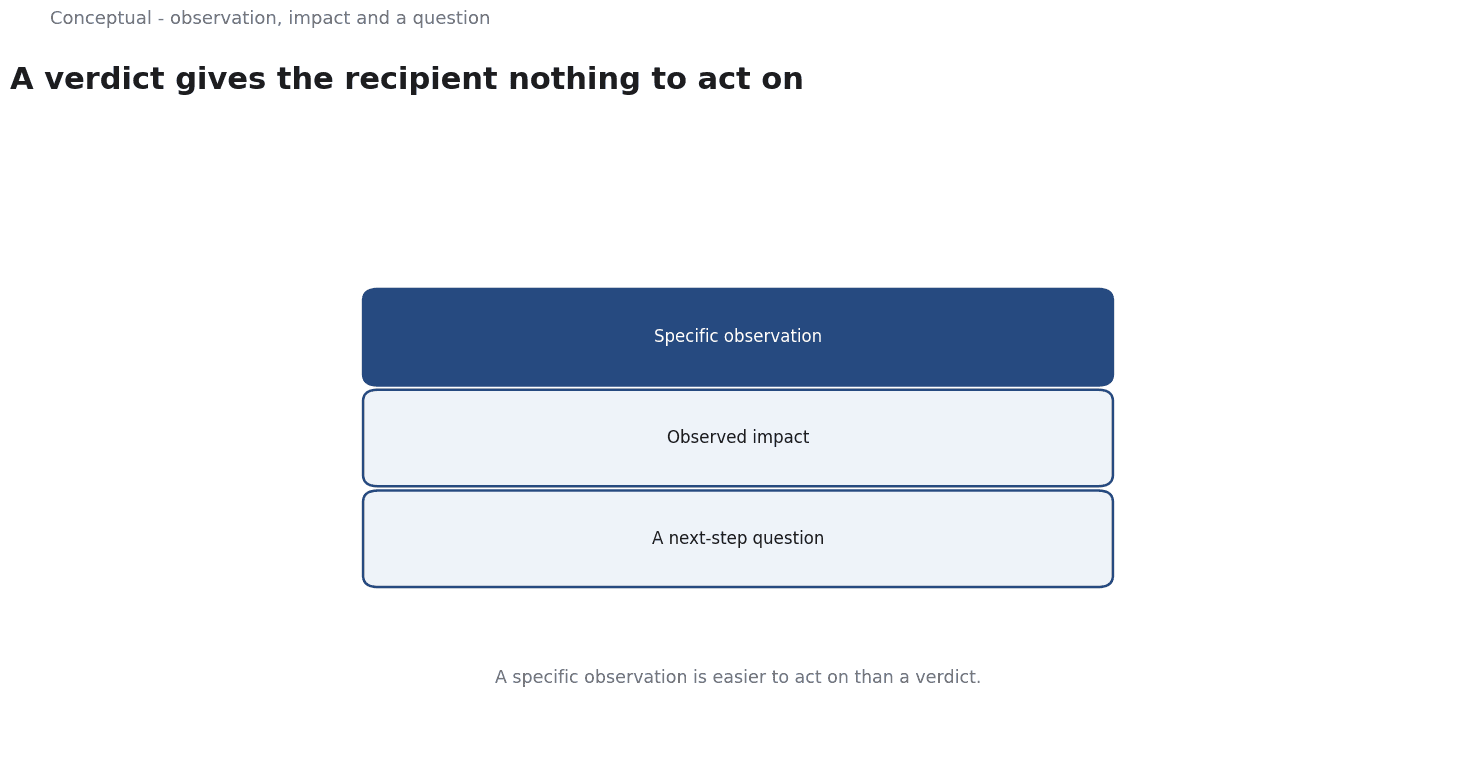
The checklist
Base it on an observation. What did the person actually do, which the O*NET-style task descriptions help ground, as the evaluation-rubric article requires for concrete criteria?
State the impact. What changed as a result, which the impact-measurement article treats as an outcome, as the dashboard article argues for metrics tied to decisions? An impact can be on a teammate, a deadline, or a customer, as Voice of Customer: Turning Feedback into Decisions treats behaviour as evidence.
Ask before concluding. What was the person's view of the situation, which the negotiation article treats as the interest behind a position, as the conflict article advises? This is not agreement; it is information, as the decision-memo article requires for evidence.
Agree on a next step. What should happen differently, with a criterion that both can recognise, as the rubric article requires, as the small-team decision article advises for a named owner?
Record the outcome. A note with the behaviour, the impact, and the next step, which the documentation article advises, as the decision-memo article requires for a recorded judgement, as the data-governance article requires for provenance where feedback informs a formal decision.
Three consequences follow. Praise should be as specific as criticism, which the performance-review article advises, as the marketing-communications entry treats a message as something received, not just sent. Feedback should be timely, which the performance-review article treats as part of the process, as the monitoring article advises for review after change. And a formal concern should follow the formal path, as the HR and legal articles require, as the governance checklist requires an accountable owner.
A worked conversation
The following is hypothetical and illustrative. A teammate submits a report late for the second week, and another person depends on it.
Three checks decide the conversation. First, is the observation specific, as the rubric article requires — the report arrived after the agreed time twice, rather than "you are unreliable," as the team-culture article advises on vague labels? Second, is the impact stated, as the dashboard article advises — the dependent analysis was delayed, as Voice of Customer: Turning Feedback into Decisions treats behaviour as evidence? Third, was the person's view heard, as the negotiation and conflict articles advise, before agreeing on a next step, as the decision-memo article requires for evidence?
Three conclusions follow.
A specific observation is easier to act on than a verdict, which the O*NET-style task grounding supports.
The next step should have a recognisable criterion, as the rubric article requires, as the small-team decision article advises. And the outcome should be recorded, as the documentation article advises, as the decision-memo article requires.
What a feedback checklist cannot do
It cannot replace a formal performance or conduct process, which the HR and legal articles require, as the governance checklist assigns an accountable owner. It does not guarantee the recipient changes, which the publication standard forbids claiming, as the risk-assessment article requires residual uncertainty. And it cannot fix a role that is badly defined, which the O*NET-style task descriptions help with, as the value-proposition article treats clarity as prior.
The counterargument that feedback should be informal and fast is fair for small, reversible issues and incomplete where a pattern or a formal duty is involved, which the performance-review article treats as a process, as the worked conversation shows.
A decision test
- Describe a specific behaviour, as the rubric article requires.
- State the observed impact, as the dashboard article advises.
- Ask for the person's view before concluding, as the negotiation article advises.
- Agree on a next step with a criterion, as the rubric article requires.
- Keep praise as specific as criticism, as Performance Reviews: Common Questions advises.
- Route formal concerns to the formal path, as the HR and legal articles require.
- Record the outcome, as the decision-memo article requires.
For the process, see Performance Reviews; for the source of feedback, see Voice of Customer.
References & Further Reading
- U.S. Department of Labor, 2026. O*NET OnLine — The standard occupational taxonomy used to compare roles across industries.
- Wikipedia contributors, 2026. Marketing communications - Wikipedia — The coordination of messages across channels and the distinction between consistent and identical communication.