Consent Mode without the Hype
Consent mode adapts measurement to a choice. Read what it does, a worked example, and why it is not a legal safe harbour.
Consent mode is often described as a way to keep measuring after a refusal, which hides what it actually does. GDPR Article 6 sets conditions for lawful processing, and the Privacy Sandbox entry describes browser mechanisms that limit tracking. The question is what a consent signal changes.
Direct answer: Use consent mode to make measurement respect a stated choice, with a lawful basis for what remains and a clear account of what is lost. The sources describe the law and the mechanisms; the rule is a synthesis.
Delta: This article adds a claim-status table and a worked example, separating documented obligations from local judgements about implementation.
The mechanism
The first point is the signal. A consent choice is information about what a person allowed, which a system must be able to receive and honour. A mechanism that records the choice but continues the same processing has not changed anything, whatever its name.
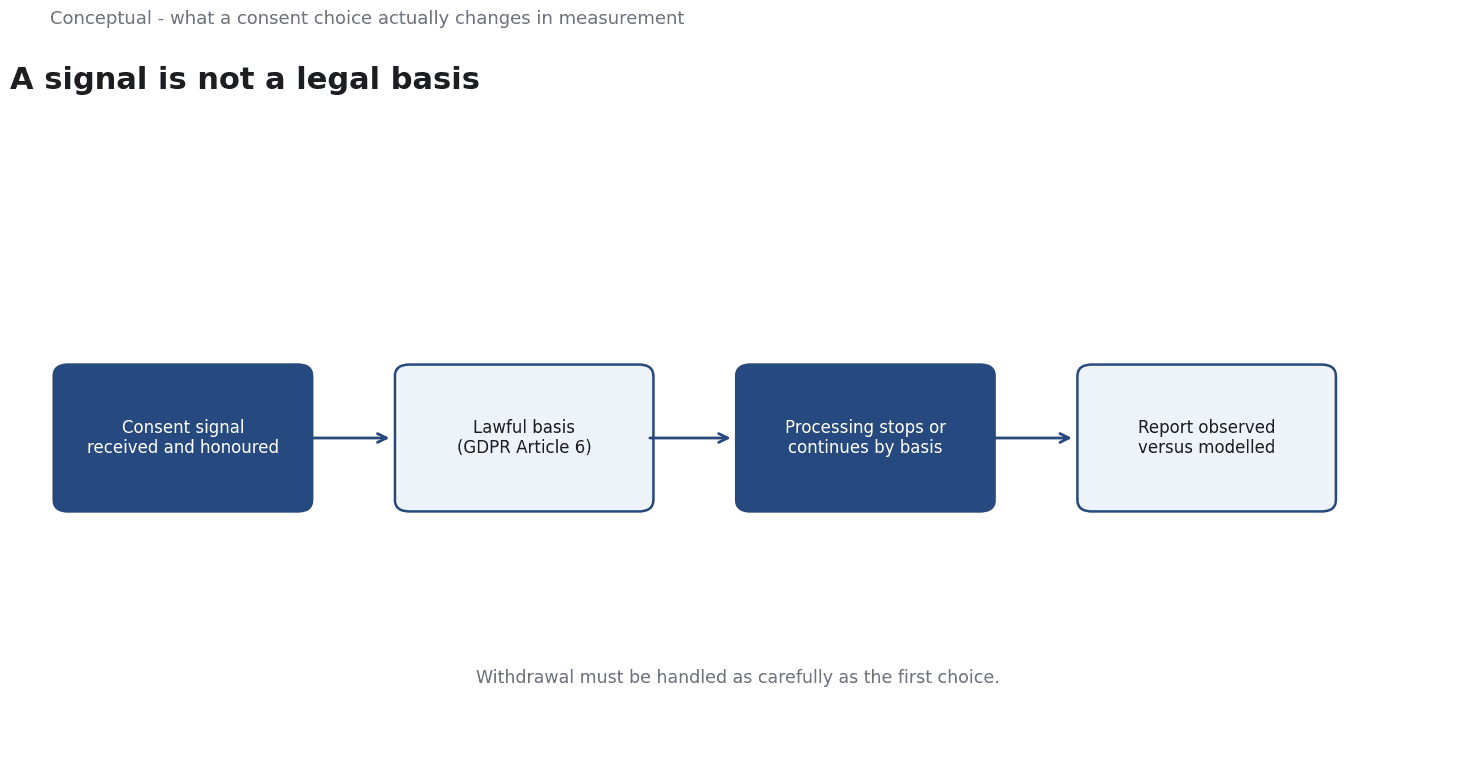
The second point is the lawful basis. GDPR Article 6 describes the conditions under which processing is permitted, which is independent of the consent mechanism. A tool can implement a signal correctly and still be used without an adequate basis, and the two questions should be kept separate.
The third point is data loss. When consent is withheld, some measurement becomes unavailable, and a system that fills the gap with modelling is producing estimates rather than observations. Naming which figures are modelled is the condition for honest reporting.
The sequence is: define the processing, map it to the choice, establish the basis, then report what is observed versus modelled. The choices are local, so the conclusions are inferred; the obligations are source-reported.
A worked example
Illustrative. A site adopts a consent signal and continues to report campaign conversions.
Three checks decide. First, which processing stops when consent is withheld, and which continues with a different basis? Second, is the lawful basis documented for each? Third, which reported figures are modelled, and are they labelled as such?
The outcome is an implementation with an honest data account. The scenario is hypothetical; the method is the contribution.
Evidence status
| Claim | Status | Source | Verified | Recheck when |
|---|---|---|---|---|
| Lawful bases are required for processing | source-reported | GDPR Article 6 | 2026-11-18 | Law changes |
| Browser mechanisms limit tracking | source-reported | Wikipedia, Privacy Sandbox | 2026-11-18 | Proposals change |
| Map choices to processing and label models | inferred | Derived from both | 2026-11-18 | Implementation changes |
Why it is not a safe harbour
A consent mechanism is an implementation detail, and a legal assessment depends on the processing it supports. Treating the presence of a signal as compliance skips the question that matters, which is what the organisation does with the data.
A further point is that consent can be withdrawn. A system that handles the first choice but cannot handle a later change will keep processing after permission ends, and the reversal path belongs in the design. Testing it is part of implementation.
The modelled data also needs a limit. An estimate that fills a reporting gap is useful for some decisions and weak for others, and a report that does not distinguish it from an observation will be trusted too much. Labelling the source of each figure is the practical control.
The third limitation is that a consent choice reduces data.
Accepting the gap is part of adopting the mechanism.
A consent choice can be withdrawn, and the reversal path belongs in the design.
A modelled figure should be labelled as an estimate, not reported as an observation.
A tool that implements the signal correctly can still lack a lawful basis, which is a separate question.
A mechanism is not a legal basis, and the two belong in separate reviews.
The data lost after a refusal should be accepted, not treated as a bug to fix.
A signal that is recorded but not honoured changes nothing about the processing.
Withdrawal should be tested as carefully as the first choice.
Measured data loss after a refusal is a design consequence, not a failure.
The processing that continues after a refusal should be documented, since a signal alone does not describe it.
A report that labels its modelled figures is more trustworthy than one that hides the gap.
A decision test
- Define the processing.
- Map each item to a consent choice.
- Document the lawful basis.
- Handle withdrawal.
- Label modelled figures.
- Record the design and recheck condition.
For the privacy frame, see Privacy.
A counterargument
A fair objection is that the article separates the mechanism from the lawful basis too cleanly. GDPR Article 6, its own source, lists consent as one of the lawful bases for processing, so the signal and the basis are not always independent: where an organisation relies on consent, the mechanism is partly the basis, not merely an implementation detail beside it. The observation-versus-model distinction is also untidy. The cited Privacy Sandbox proposals limit tracking at the browser level, so data remaining after a refusal may be partial or aggregated, and some "observed" figures are already shaped by privacy mechanisms. Finally, accepting the post-refusal drop as a design consequence assumes the whole drop reflects honoured choices; a misconfigured signal produces the same symptom, and calling that acceptance hides a defect.
References & Further Reading
- GDPR Info, 2016. Art. 6 GDPR – Lawfulness of processing - General Data Protection Regulation (GDPR) — The lawful bases for processing personal data under GDPR.
- Wikipedia contributors, 2026. Privacy Sandbox - Wikipedia — Browser proposals to limit tracking while supporting advertising.