Consulting Costs Explained
A consultant is paid for judgement and time, not for a guarantee. Read the cost structure, a worked engagement, and why a cheap day rate can be expensive.
Consulting is often priced as a day rate, which makes it look like a simple purchase of hours. The work is really buying judgement, access, and a deliverable, which the consultant entry describes for the role, as the management-consulting entry covers the engagement and its critics, as the unit-economics article requires for contribution, as the cash-flow article requires for the cash, as Decision Memos That Survive Review requires for a recorded judgement.
Direct answer: Evaluate consulting cost by the decision it changes and the deliverable it produces, not by the day rate. Wikipedia's consultant entry provides the role, and management consulting covers the engagement. The boundary: this is educational orientation, not a guarantee — outcomes depend on the problem and the client, as the management-consulting entry notes criticism, as the publication standard forbids guaranteed outcomes, as the risk-assessment article requires residual risk.
The cost structure
Fees and scope. The day rate or fixed fee is visible, which the consultant entry describes, as the term-sheet article treats formal terms as substantive, as the cost estimator requires for spend, as the cash-flow article requires for cash, as the unit-economics article requires for contribution.
Internal time. A consultant needs access to people and data, which the management-consulting entry treats as the engagement, as the small-team time article treats attention as a constraint, as the data-governance article requires provenance, as the dashboard article argues for metrics tied to decisions, as Decision Memos That Survive Review requires for a record.
Implementation gap. A recommendation that is not implemented has no value, which the management-consulting entry treats as a criticism, as the ops article treats execution as the mechanism, as the root-cause article treats symptom and cause, as the monitoring article advises for review, as the risk article requires residual risk.
Dependency risk.
Three consequences follow. The decision should be defined before the engagement, as Decision Memos That Survive Review requires, as the rubric article requires for concrete criteria, as the dashboard article argues, as the risk article requires residual risk. The internal time should be counted, as the time-management and cost-estimator articles advise, as the cash-flow article requires. And the result should be reviewed, as the monitoring article advises, as Decision Memos That Survive Review requires for a record.
A worked engagement
The following is hypothetical and illustrative. A team hires a consultant to diagnose a margin problem.
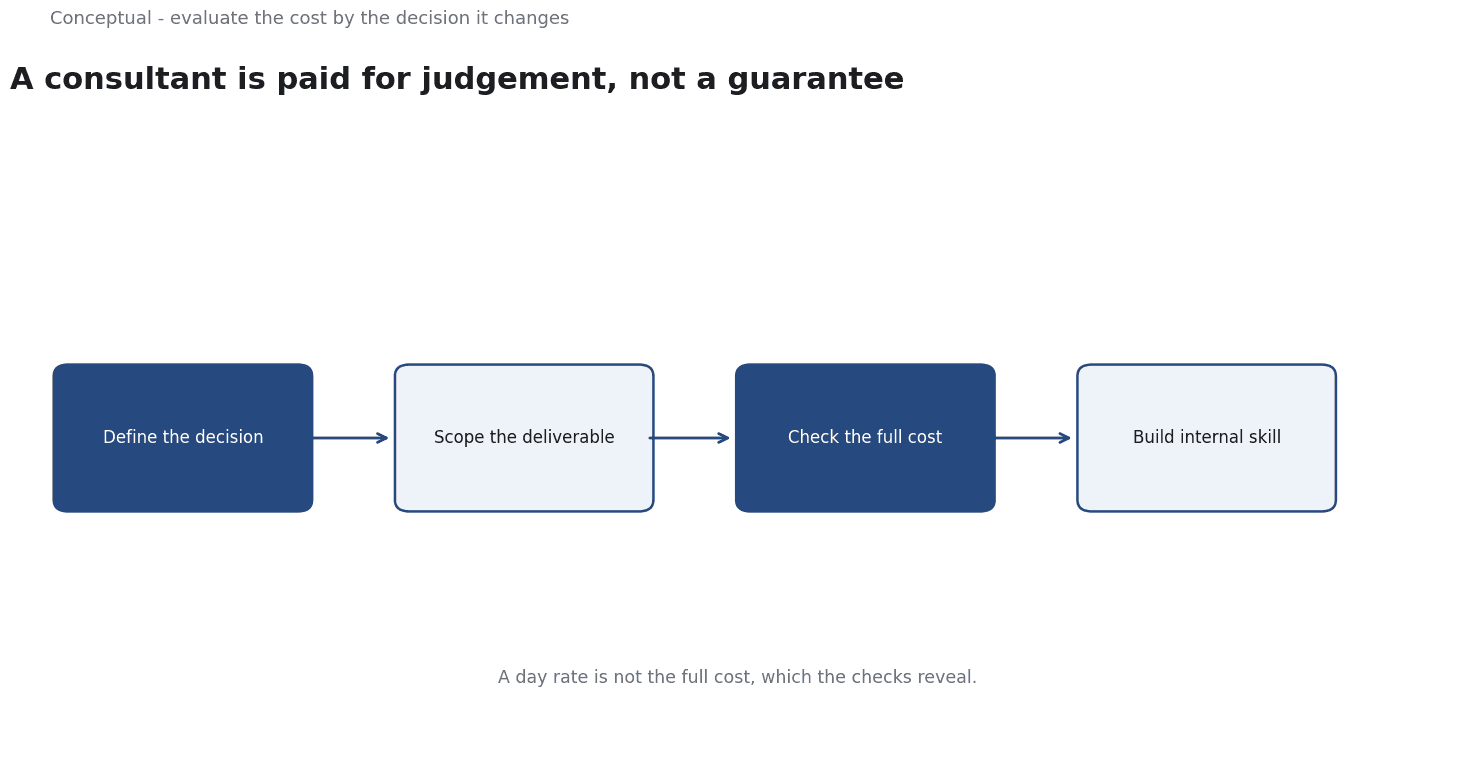
Three checks decide. First, what decision will the work change, as the decision-memo and rubric articles require, with a metric, as the dashboard article argues? Second, what internal time and data are needed, as the time-management and data-governance articles require, with a cost, as the cost estimator requires, as the cash-flow article requires for cash? Third, what happens after the recommendation, as the management-consulting entry and ops article advise, with capability retained, as the AI-literacy article advises, as the risk article requires residual risk, as Decision Memos That Survive Review requires for a record?
Three conclusions follow.
A day rate is not the full cost, which the checks reveal.
Internal access is a real expense, as the time-management and data-governance articles advise. And the result should be recorded, as Decision Memos That Survive Review requires, as the monitoring article advises for review.
What consulting cannot do
It cannot guarantee an outcome, which the publication standard forbids claiming, as the management-consulting entry treats criticism, as the risk article requires residual risk. It does not replace internal capability, which the AI-literacy article treats as the goal, as the governance checklist requires an owner, as Decision Memos That Survive Review requires. And it cannot remove the need to execute, which the ops article treats as the mechanism, as the root-cause article advises, as the monitoring article advises for review.
The counterargument that a cheap consultant is the best value is fair for a bounded question and incomplete when implementation and dependency are counted, which the worked engagement shows, as the management-consulting entry advises.
A decision test
- Define the decision the work should change, as Decision Memos That Survive Review requires.
- Count fees and internal time, as the cost estimator and time-management articles advise.
- Check the deliverable, as the consultant entry advises.
- Plan implementation, as the ops article advises.
- Retain capability, as the AI-literacy article advises.
- Use dated figures, as data governance requires.
- Record the decision and residual risk, as the decision-memo and risk articles require.
For the engagement, see Consulting Mistakes to Avoid; for the decision, see Decision Memos.
References & Further Reading
- Wikipedia contributors, 2026. Consultant - Wikipedia — The role and economics of professional advisory work.
- Wikipedia contributors, 2026. Management consulting - Wikipedia — The structure of consulting engagements and their critics.